


By Christian Mauerer, founder of One with Tea.
Tenryu tea is sencha grown in the mountains of Tenryu Ward, in the north of Hamamatsu City, Shizuoka Prefecture, on the slopes that fall away on both sides of the Tenryu River basin (Hamamatsu City). Hamamatsu's own agriculture department splits the city's tea in two, and Tenryu sits firmly on the mountain side of the line (Hamamatsu City).

From our tea room
Superior Sencha Green Tea - USDA Organic Japanese First Flush
First-flush loose leaf, USDA Organic, direct from Japanese family farms.
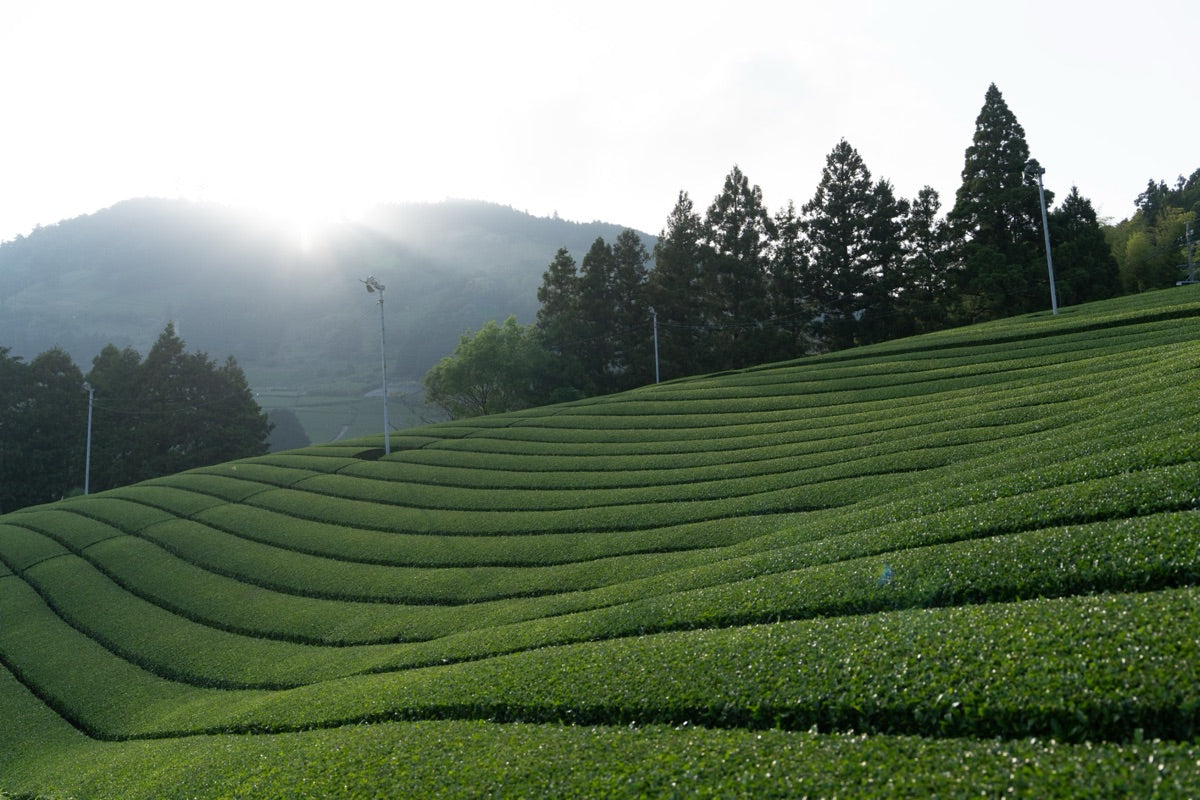
View Superior SenchaHere's the number that reframed the place for me. Tenryu Ward is about 61 percent of Hamamatsu City's total area, and about 91 percent of the ward is forest (Hamamatsu City, Tenryu Ward). This is not a tea region with some woodland around it. It's a forest with tea in the gaps, and that ratio explains almost everything about how the tea tastes and how little of it there is.
Before you read further: we don't sell Tenryu tea, and we don't buy from any farm named here. This is reporting, not a product listing. It's written for anyone deciding whether a bag labelled Tenryu is worth buying, and for buyers trying to understand where this region actually sits among Shizuoka's mountain teas.
Key Takeaways
- Tenryu tea comes from Tenryu Ward in northern Hamamatsu City, Shizuoka, on the mountain slopes flanking the Tenryu River, with satellite areas at Haruno-cho and the Tatsuyama plateau (Hamamatsu City; Sazen Tea).
- It's an asamushi, or light-steamed, tea by the city's own definition, because short sunshine hours and a wide day-to-night temperature swing give soft leaf, in deliberate contrast to the deep-steamed Hamamatsu-cha grown on the Mikatahara plateau in the same city (Hamamatsu City).
- The harvest is one of the latest in Japan, running roughly early to late May rather than the usual late April to early May, because the plantations sit in high mountain valleys with limited sunlight (JAL / Japan Travel; CHANOYU).
- Volume is tiny. The tea retailer CHANOYU puts the old Tenryu City area at about 180 tonnes of leaf a year, against roughly 25,000 tonnes for Shizuoka as a whole on 2020 data (CHANOYU).
- Hamamatsu City, which contains Tenryu, finishes second in Shizuoka's internal standings. At the 2020 national tea competition, Shizuoka's internal ranking for the ordinary sencha 4 kg division put Kawanehon-cho first on 595 points and Hamamatsu City second on 579, and Kawanehon-cho also took the national producing-region award for that division (Chunichi Shimbun). The entries are credited to Hamamatsu City, not to Tenryu specifically.

Where is Tenryu tea from, and why does tea grow there?
Tenryu Ward covers the northern end of Hamamatsu City, in western Shizuoka Prefecture. The city puts it at about 61 percent of the municipal area, about 91 percent of it forest (Hamamatsu City, Tenryu Ward). A tea retailer's guide gives the forest share as about 90 percent; I've used the city's figure throughout, since it's the ward's own administrator (CHANOYU).
The Tenryu River runs down the middle of the ward toward the Enshu coast, fed by tributaries the city names as the Ochise, the Misakubo, the Keta and the Adako (Hamamatsu City, Tenryu Ward). Those valleys are steep enough that the cedar and cypress on their flanks form Tenryu Birin, counted as one of Japan's three great forests, and the mountains above them feed four dams and get called the water jug of Enshu (Hamamatsu City, Tenryu Ward).
That's the terrain the tea has to fit into. Plantations here sit on the sides of steep forest valleys, which is exactly the constraint that shapes the leaf (JAL / Japan Travel). Altitude varies hard from plot to plot. One Japanese merchant describes the Tatsuyama area as a plateau at 600 metres above sea level inside Tenryu Ward, farmed without agricultural chemicals and fed with organic fertiliser (Sazen Tea). That's a merchant's description of its own supply, so read it as such, but the elevation is consistent with everything the city says about the ward.
The city credits the day-to-night temperature difference and the fog for the quality of the ward's tea, shiitake and yam alike (Hamamatsu City, Tenryu Ward). Shizuoka Prefecture puts it more directly: the gardens are drenched in the morning mist typical of mountain country, and the tea is shaped by the swing in altitude and temperature (Shizuoka Prefecture). If you've read our overview of the Shizuoka tea region, Tenryu is its far western mountain edge, the way Kawane is its central one.
Why does Tenryu steam its leaf so short?

Because the leaf is soft, and soft leaf can't take a long steam. Hamamatsu City draws the line itself: on the Mikatahara plateau, long sunshine hours and a mild climate grow thick leaf, so deep-steamed fukamushi dominates there. Up in the Tenryu district, sunshine hours are short and the temperature swing is wide, the leaf comes out soft, and the tea is mainly asamushi, lightly steamed (Hamamatsu City).
I find that split unusually honest for a municipal page. Same city, same agriculture department, two teas that contradict each other on purpose. CHANOYU describes Tenryu tea as fundamentally an asamushi tea, steamed briefly to keep the aroma, while the Hamamatsu-cha of the Mikatahara plateau is steamed roughly twice as long (CHANOYU).
The short steam is why the cup looks weaker than it is. CHANOYU describes a pale young-leaf green liquor that tastes considerably deeper than its colour suggests, with an astringency that stays in the mouth (CHANOYU). Hamamatsu City's own note is a refreshing, clear aroma with umami and astringency in fine balance, and umami that persists after you swallow, which the prefecture renders as a highly fragrant, elegant tea (Hamamatsu City; Shizuoka Prefecture).
Light steaming also leaves more of the work to the grower, because a short steam hides nothing. Prefecture and the Shizuoka cultural resource database both note the same habit here: many Tenryu producers insist on hand-picking (Shizuoka Prefecture; Arts Council Shizuoka). For what happens between the field and the finished leaf, our note on aracha covers the unrefined stage this tea passes through.
For where this sits on the map, see where Japan's tea is really grown.
| Tenryu-cha | Haruno-cha | Hamamatsu-cha | |
|---|---|---|---|
| Where | Mountain valleys of Tenryu Ward, both sides of the Tenryu River | Haruno-cho, inside Tenryu Ward, higher and more basin-like | The Mikatahara plateau and the lowland north of the city |
| Sunlight | Short hours, steep forest valleys | Short hours, deep fog, high altitude | Long hours, mild climate |
| Leaf | Soft | Soft | Thick |
| Steaming | Mainly asamushi, light-steamed | Mainly asamushi, though one regional guide gives asamushi through chumushi | Mainly fukamushi, deep-steamed |
| In the cup | Refreshing clear aroma, umami and astringency in balance, umami persists | Gentle fresh aroma, calm umami, moderate astringency | Deep flavour, high aroma |
When is Tenryu tea harvested, and what does picking late cost?

Tenryu picks late. Nationally, new tea is usually cut from late April into early May, but Tenryu's cool mountains push its first flush to roughly early through late May (CHANOYU). Hamamatsu City lists the main harvest for Tenryu-cha simply as May (Hamamatsu City). JAL's regional guide goes further and calls it one of the latest harvests in Japan, a direct consequence of limited sunlight in high mountain valleys (JAL / Japan Travel).
Picking late is not free, and this next part is my reading rather than anything a source states. A first flush that lands in the third week of May arrives after the lowland Shizuoka tea is already moving, and it arrives in small quantity. That looks to me like the trade the geography forces, and it's the part of Tenryu's story that marketing copy usually leaves out.
How much Tenryu tea is actually there?

Not much, and the honest answer requires hedging, because I could not find a government figure for it. The tea retailer CHANOYU says the old Tenryu City area is said to produce about 180 tonnes of leaf a year, and puts Shizuoka Prefecture as a whole at roughly 25,000 tonnes annually on 2020 data, first in Japan (CHANOYU). Taking those two numbers at face value, Tenryu is roughly 0.7 percent of its own prefecture's output. Treat both as a retailer's figures rather than official statistics. The same source puts the retail price commonly around 1,000 yen per 100 g (CHANOYU).
The raw cost is public, and we keep it current: the import data behind matcha pricing.
A word on which Tenryu we're counting, because three different footprints get used interchangeably and they are not the same area. Tenryu Ward is the current administrative unit (Hamamatsu City, Tenryu Ward). The old Tenryu City is the pre-merger municipality the 180 tonne figure is scoped to (CHANOYU). And "Tenryu, Mori and Haruno" is the wider tea-region grouping used in regional guides, which reaches beyond the ward (JAL / Japan Travel). Any single tonnage for "Tenryu tea" is only as good as which of those three it means.
How does Tenryu rank against Shizuoka's other tea regions?
There is a harder measure available, and it needs reading carefully. At the national tea competition judged in Kagoshima in 2020, across eight divisions and 987 entries from 16 prefectures, the national producing-region award for the ordinary sencha 4 kg division went outright to Kawanehon-cho, its fifteenth and its first in seven years (Chunichi Shimbun). Hamamatsu won nothing national. What it did do is place second inside Shizuoka's own standings for that division, 579 points against Kawanehon-cho's 595 (Chunichi Shimbun). In the same division, Tomohisa Shimizu of Hamamatsu City placed fifth among the prefecture's first-class entries, in a prefecture whose small sub-regions include Asahina (Chunichi Shimbun).
One caveat matters, and no source resolves it. Those points are credited to Hamamatsu City, and Hamamatsu City contains both the mountain gardens of Tenryu and the deep-steamed lowland tea of the Mikatahara plateau (Hamamatsu City). The newspaper does not say which part of the city the entries came from, so read 579 as the city's number, not as Tenryu's.
Sixteen points, and the gap is the city's rather than the region's. Still, it's the closest hard measure anyone publishes, and it fits everything else: Tenryu is not a secret and not the leader. It's a genuinely high-grade mountain area sitting just behind a bigger, better-known neighbour, inside a city better known for the tea grown on its flat land.
The cultivars Tenryu grows

Yabukita first, as almost everywhere in Japan. The cultivar was found by the Shizuoka tea farmer Hikosaburo Sugiyama, and Tenryu tea developed from it alongside the rest of Japanese sencha (CHANOYU). A Hamamatsu regional guide records it as designated a Shizuoka recommended cultivar in 1955, and now roughly 75 percent of Japan's cultivated tea bushes (Hamamatsu Enjoy Information Club). The merchant offering from the Tatsuyama plateau is Yabukita too (Sazen Tea).
The one worth ordering by name is Koushun, a cross of Kurasawa and Kanayamidori that CHANOYU describes as carrying a distinctly floral aroma, the sharp astringency of one parent married to the milky sweetness of the other (CHANOYU). In a region whose whole processing choice is built around protecting aroma, an aromatic cultivar is not a novelty. It's the logical end of the argument.
Tenryu also has a second flavour of its own inside the same ward, set out in the table above. Haruno tea, from Haruno-cho, is the softer, calmer counterpart to Tenryu's crispness, and the city notes that the area works together on organic cultivation (Hamamatsu City; CHANOYU).
And there's an open ambition. Hamamatsu City states plainly that the Tenryu district is aiming to develop as a new tencha producing area, tencha being the shaded leaf that gets ground into matcha (Hamamatsu City). A region built on unshaded, lightly steamed, aroma-forward sencha is deliberately learning to grow the opposite thing. That tells you something about how the volume problem feels from the inside.
Masataka Ota, Tenryu's best-known grower

If Tenryu has a public face, it's Masataka Ota (太田昌孝) of Kaneta Otaen, at 36-1 Nishifujihira, Tenryu Ward, Hamamatsu City (NIHONMONO; Shizuoka Prefecture). He was born in 1940, and was past eighty when NIHONMONO profiled him in 2021 (NIHONMONO). He farms in the mountains along the upper reaches of the Adako River, a Tenryu tributary that was selected as one of the 100 Best Waters of the Heisei Era (NIHONMONO).
One thing I want to be straight about: I could not find a published founding year for Kaneta Otaen, or a stated generation number for Ota himself. Profiles of him describe his method in detail and say nothing about his lineage. Rather than round that gap up into "fourth generation" the way these articles usually do, I'm leaving it as what it is, unknown to me.
What is documented is specific. His gardens are among the highest in the prefecture. He grows 13 to 14 cultivars, matched plot by plot, because on a slope the mountain side and the valley side behave differently. Soil preparation alone can run seven to eight years on his own fully matured compost. On the steepest plots he picks by hand or with small machines rather than large ones, the same constraint another Shizuoka mountain grower works under. And unlike most growers, who send leaf to market, he processes and sells his own, keeping the hi-ire, the final firing, deliberately light (NIHONMONO). In the cup, NIHONMONO's visit found the liquor golden rather than green (NIHONMONO).
On awards, I'll report exactly what the source reports. Ota's Tenryu tea was served to heads of state at the 2008 G8 Hokkaido Toyako Summit. He holds the Medal with Yellow Ribbon, an Emperor's Prize, and awards from the Ministry of Agriculture, Forestry and Fisheries (NIHONMONO). The source gives no years and no competition names for those last three, so I'm not attaching any. Only the 2008 summit carries a date I can verify.
The gardens he's renting back
The detail that stayed with me isn't an award. Ota is renting abandoned tea gardens upstream on the Adako, choosing cultivars suited to each particular plot, and bringing them back (NIHONMONO). Abandoned gardens are increasing in that valley. In a ward that is 91 percent forest, land stops being farmed and the forest simply takes it back (Hamamatsu City, Tenryu Ward). A man past eighty is leasing that ground back one plot at a time.
There's a small administrative fact that says the same thing more quietly. Shizuoka's cultural resource database lists two institutional anchors for Tenryu tea: the Enshu Chuo JA Tenryu Farming Centre at 199-1 Futamata, Futamata-cho, which houses the Tenryu Tea Promotion Association, and the Tenryu Tea Merchants' Association at 36-1 Nishifujihira (Arts Council Shizuoka). That second address is Kaneta Otaen's address, and the listed phone number for the merchants' association is Kaneta Otaen's phone number (Arts Council Shizuoka). The region's trade body answers at one farmhouse.
Two ways to take this further
Straight with you first: we don't sell Tenryu tea, and we don't buy from any farm named in this article. This is reporting, not a product listing.
If you're drinking at home. Our own shelf is organic Japanese tea from producers we work with directly, and you can see the range in our tea shop.
If you're buying for a business. Cafes, retailers and tea rooms can ask about pricing, samples and lead times through our wholesale page.
Frequently asked questions
What is Tenryu tea, and where does it come from?
Tenryu tea is sencha grown in the mountains of Tenryu Ward, in the north of Hamamatsu City, Shizuoka Prefecture, on the slopes flanking the Tenryu River basin (Hamamatsu City). Regional guides group it as part of the Tenryu, Mori and Haruno area, one of Shizuoka's eight tea regions, with plantations on the sides of steep forest valleys (JAL / Japan Travel).
Is Tenryu tea light-steamed or deep-steamed?
Light-steamed. Hamamatsu City states that Tenryu-cha and Haruno tea are mainly asamushi, because short sunshine hours and a wide temperature swing produce soft leaf, while the Hamamatsu-cha grown on the Mikatahara plateau in the same city is mainly deep-steamed fukamushi (Hamamatsu City). CHANOYU adds that the Mikatahara tea is steamed roughly twice as long (CHANOYU).
Why is Tenryu tea harvested so late?
Altitude and shade. The plantations sit in high mountain valleys with limited sunlight, which JAL's guide says makes the harvest one of the latest in Japan (JAL / Japan Travel). Where Japanese new tea is usually cut from late April into early May, Tenryu's first flush runs roughly early to late May (CHANOYU).
How much Tenryu tea is produced each year?
The tea retailer CHANOYU says the old Tenryu City area is said to produce about 180 tonnes of leaf a year, against roughly 25,000 tonnes for Shizuoka Prefecture as a whole on 2020 data (CHANOYU). That is a retailer's figure rather than an official statistic, and I found no government publication of a Tenryu-only tonnage.
Who is the best-known Tenryu tea producer?
Masataka Ota (太田昌孝) of Kaneta Otaen, at 36-1 Nishifujihira in Tenryu Ward, is the grower most often profiled (NIHONMONO). Born in 1940, he grows 13 to 14 cultivars matched plot by plot along the upper Adako River, processes and sells his own tea, and had his Tenryu tea served to heads of state at the 2008 G8 Hokkaido Toyako Summit. He also holds the Medal with Yellow Ribbon, an Emperor's Prize and Ministry of Agriculture, Forestry and Fisheries awards, for which the source gives no years or competition names (NIHONMONO).
What stays with me
A trade association that answers at one farmhouse. A man in his eighties leasing back ground the forest was in the middle of reclaiming, choosing a different cultivar for each plot because the mountain side of a slope is not the valley side. A whole city sixteen points behind the famous neighbour, on entries nobody troubled to tell us came from the mountains or the flat land. I keep turning over the tencha ambition, a region whose entire character is short steam and open sky teaching itself to grow shaded leaf. That's not a betrayal of the tradition. That's what it looks like when people intend to still be there.
Sources
- 浜松市で生産されるお茶 (Teas produced in Hamamatsu), Hamamatsu City official site, page updated 2026-01-05. The city's own split between Mikatahara-plateau Hamamatsu-cha (long sunshine, thick leaf, deep-steamed fukamushi) and mountain Tenryu-cha and Haruno tea (short sunshine, wide temperature swing, soft leaf, light-steamed asamushi); Tenryu-cha produced on the slopes either side of the Tenryu River basin; its tasting profile of clear aroma, balanced umami and astringency, and lingering umami; the May main harvest; Haruno tea's profile and the area's joint organic cultivation; and the statement that the Tenryu district is aiming to develop as a new tencha producing area. Retrieved 2026-09-29.
- 天竜区の紹介 (Introduction to Tenryu Ward), Hamamatsu City official site, updated 2023-12-04. Tenryu Ward as about 61 percent of the city's area and about 91 percent forest; the Ochise, Misakubo, Keta and Adako tributaries; Tenryu Birin as one of Japan's three great forests; the Sakuma, Misakubo, Akiha and Funagira dams and the "water jug of Enshu" description; and the attribution of good-quality tea, shiitake and yam to the day-night temperature difference and fog. Retrieved 2026-09-29.
- Tenryu Tea, Shizuoka Prefecture official food information centre. Gardens drenched in mountain morning mist; tea shaped by differences in altitude and temperature; the harmonious balance of flavour and bitterness and the fragrant, elegant character; that many producers are particular about hand-picking; the long history as a high-quality production area with the industry active since the Meiji period; and the Futamata-cho and Nishifujihira addresses. Retrieved 2026-09-29.
- 日本でも有数の名人が作る上品な「天竜茶」カネタ太田園 太田昌孝さん (Kaneta Otaen, Masataka Ota), NIHONMONO, published 2021-04-14. Ota's full name and the Nishifujihira address; his birth in 1940; the Adako's selection among the 100 Best Waters of the Heisei Era; gardens among the highest in the prefecture; 13 to 14 cultivars matched plot by plot; seven to eight years of soil building with his own compost; hand-picking and small machines on steep plots; processing and selling his own tea with a deliberately light hi-ire; the golden liquor; the 2008 G8 Hokkaido Toyako Summit service; the Medal with Yellow Ribbon, Emperor's Prize and Ministry of Agriculture, Forestry and Fisheries awards, given without years or competition names; and the renting and replanting of abandoned gardens upstream on the Adako. Retrieved 2026-09-29.
- 全国茶品評会 県内から普通煎茶四キロと深蒸し煎茶の部で大臣賞 (National tea competition results), Chunichi Shimbun, 2020-08-29. The producing-region award standings in the ordinary sencha 4 kg division, Kawanehon-cho first on 595 points and Hamamatsu City second on 579; Tomohisa Shimizu of Hamamatsu City in fifth among the prefecture's first-class entries; and the competition's scale that year of eight divisions and 987 entries from 16 prefectures judged over four days in Kagoshima City. Retrieved 2026-09-29.
- 天竜茶の特徴とは (What is Tenryu tea), CHANOYU, a Japanese tea retailer's content site. The forest share of about 90 percent (superseded here by the city's 91 percent); Tenryu tea drunk since the Meiji era; Yabukita found by the Shizuoka farmer Hikosaburo Sugiyama; Koushun as a Kurasawa and Kanayamidori cross with a floral aroma; Tenryu as fundamentally asamushi against Mikatahara's roughly twice-as-long steam; the pale young-leaf liquor that tastes deeper than it looks; the approximately 180 tonnes a year attributed to the old Tenryu City area and roughly 25,000 tonnes for Shizuoka on 2020 data; the roughly 1,000 yen per 100 g retail price; the early-to-late-May first flush against the national late-April to early-May norm; and Haruno tea as the softer counterpart. Figures here are a retailer's, not official statistics. Retrieved 2026-09-29.
- The Eight Tea Regions of Shizuoka, JAL / Japan Travel. Tenryu grouped as "Tenryu, Mori and Haruno" among Shizuoka's eight tea regions; plantations typically on the sides of steep forest valleys in high mountain valleys; limited sunlight making the harvest one of the latest in Japan; and the description of the tea as rich with complex yet gentle flavours. Retrieved 2026-09-29.
- 天竜茶 (Tenryu tea), Arts Council Shizuoka, Shizuoka Cultural Resource Database. The long history as a high-grade production area with the tea business flourishing since the Meiji era; that many producers insist on hand-picking; and the two institutional anchors, the Enshu Chuo JA Tenryu Farming Centre at 199-1 Futamata, Futamata-cho housing the Tenryu Tea Promotion Association, and the Tenryu Tea Merchants' Association at 36-1 Nishifujihira listed with Kaneta Otaen's address and phone number. Retrieved 2026-09-29.
- Tenryu Yamacha, Sazen Tea, a Japanese tea merchant. The Tatsuyama area described as a plateau 600 metres above sea level in Tenryu Ward, Hamamatsu City; the Yabukita cultivar; and cultivation without agricultural chemicals using organic fertilisers. A merchant's description of its own supply. Retrieved 2026-09-29.
- 浜松にもお茶どころがあるって知ってますか (Hamamatsu's tea regions), Hamamatsu Enjoy Information Club, updated 2026-04-23. The three-way comparison of Tenryu-cha, Haruno-cha and Inasa-cha by terrain, climate, steaming style and flavour; and Yabukita designated a Shizuoka recommended cultivar in 1955 and now roughly 75 percent of Japan's cultivated tea bushes. A regional tourism site. Retrieved 2026-09-29.
Share:
Kawane Tea: Shizuoka's Mountain Sencha Region
Honyama Tea: Shizuoka's Oldest Tea Valley, Named in 1917