

By Christian Mauerer, founder of One with Tea.
Honyama tea is the tea grown in the basin of the Abe River and its tributary the Warashina, both of which run down through Shizuoka City, Shizuoka Prefecture (Shizuoka Prefecture). That is the whole definition, and Shizuoka City's own tea office attaches the claim that makes the place matter: of all the tea districts in the prefecture, this one has the oldest history (Shizuoka City).
Go far enough up either river and the country turns severe. The area around Ikawa (井川) and Umegashima (梅ヶ島) is called Abe-oku (安倍奥), the deep Abe, and it sits with the Southern Alps at its back. Mean annual temperature there is just over 10 degrees C, and winters stay below freezing (Shizuoka City). Shizuoka Prefecture writes the brand name 静岡本山茶, Shizuoka Honyamacha.
Straight with you first. We don't sell Honyama tea, and we don't buy from any farm named in this article. This is reporting, not a product listing, written for someone holding a bag with Honyama on the label and trying to work out whether that word is doing any real work.
Key Takeaways
- Honyama tea comes from the Abe and Warashina river basins inside Shizuoka City, not from Shizuoka Prefecture generally, and the upper end of that country, around Ikawa and Umegashima, is called Abe-oku (Shizuoka Prefecture; Shizuoka City).
- It holds the oldest history of any tea district in Shizuoka, traced to seed that Shoichi Kokushi brought back from Song China and sowed at Ashikubo, in the middle reaches of the Abe (Shizuoka Prefecture; Shizuoka City).
- The official Japanese sources give no year for that planting. Prefecture and city both say only "about 800 years ago". English-language write-ups give 1241 and 1244, and disagree with each other (Shizuoka Prefecture; Japanese Tea Pedia; Rishi Tea).
- The name is only about a century old. The tea was called Abe-cha until the farmer Tsukiji Kotaro wrote "Honyama" on tea he had raised at Kiyosawa, in Taisho 6, which is 1917 (Shizuoka Tea Merchants Industrial Cooperative).
- Two official bodies describe the leaf differently. Shizuoka City says river fog gives softer leaf flesh than lowland tea; the Shizuoka Tea Merchants Industrial Cooperative says thinner. Both call the aroma fresh, and the trade body names it yama no kaori, the mountain aroma (Shizuoka City; Shizuoka Tea Merchants Industrial Cooperative).
- The competition record belongs to Shizuoka City, not to Honyama. At the 70th National Tea Competition in FY2016 the city took the producing-region award in the ordinary sencha 4 kg division for a third straight year, but the city holds the Shimizu districts as well as these valleys (Shizuoka City).
| Field | What the record says | Source |
|---|---|---|
| Japanese name | 静岡本山茶, Shizuoka Honyamacha | Shizuoka Prefecture |
| Earlier name | 安倍茶, Abe-cha | Shizuoka City |
| Region, as the prefecture and city define it | The basin of the Abe River and its tributary the Warashina | Shizuoka Prefecture; Shizuoka City |
| Region, as the trade body defines it | The upper reaches of the Abe and Warashina | Shizuoka Tea Merchants Industrial Cooperative |
| Municipality | Shizuoka City, Shizuoka Prefecture. Ashikubo and Koseto sit in Aoi Ward. No source I found puts the whole region in a single ward, and that last part is my finding, not theirs | Shizuoka Prefecture |
| Upper district | Abe-oku, 安倍奥, around Ikawa and Umegashima | Shizuoka City |
| Mean annual temperature in Abe-oku | Just over 10 degrees C, with winters holding below freezing | Shizuoka City |
| First planting | About 800 years ago at Ashikubo, by Shoichi Kokushi. No year appears in the official record | Shizuoka Prefecture; Shizuoka City |
| Name coined | Taisho 6, which is 1917, by Tsukiji Kotaro at Kiyosawa | Shizuoka Tea Merchants Industrial Cooperative |
| Supplied to the shogunate as goyocha | From Tenna 1, which is 1681 | Shizuoka Tea Merchants Industrial Cooperative |
| Signature aroma | Yama no kaori, 山の香り, the mountain aroma | Shizuoka Tea Merchants Industrial Cooperative |
| Harvest timing | Roughly a month later than other tea regions | Rishi Tea |
| Named cultivars grown here | Kogane Midori, 黄金みどり, and Koju, 香寿 | Oku-Warashina; Marutaka Noen; Shizuoka City |
| Aged product | Jukusei honyama-cha, matured until autumn in the storehouse at Ikawa Dainichi Pass, above 1,000 m | Shizuoka City |
| Planted area and annual tonnage | Not published in any prefectural, municipal or trade source I could find | Not published |
| Elevation of the gardens | Not published. The 1,000 m figure above is the storehouse, not the gardens | Not published |
The last two rows are the ones no competing article carries. They are absences, and an absence is worth stating rather than filling in.

Where exactly does Honyama tea grow?
In the Abe and Warashina valleys, inside Shizuoka City. Shizuoka Prefecture's own English page puts it plainly: Shizuoka Honyamacha is tea produced in the basin of the Abe River and its tributary, the Warashina River, which runs through Shizuoka City (Shizuoka Prefecture). Shizuoka City words it almost identically, adding that this is the district with the oldest history in the prefecture (Shizuoka City). It is one district inside a very large prefecture, which we map in our overview of the Shizuoka tea region.
We track the production side: where Japan's tea is really grown.
There is a quiet disagreement about how far down the rivers the name reaches, and it matters if you're buying. Prefecture and city both say the basin. The Shizuoka Tea Merchants Industrial Cooperative, the trade body, says the upper reaches of the Abe and Warashina (Shizuoka Tea Merchants Industrial Cooperative). A basin is a wider footprint than an upper reach, and nobody publishes a boundary line, so the region's own institutions are describing slightly different areas.
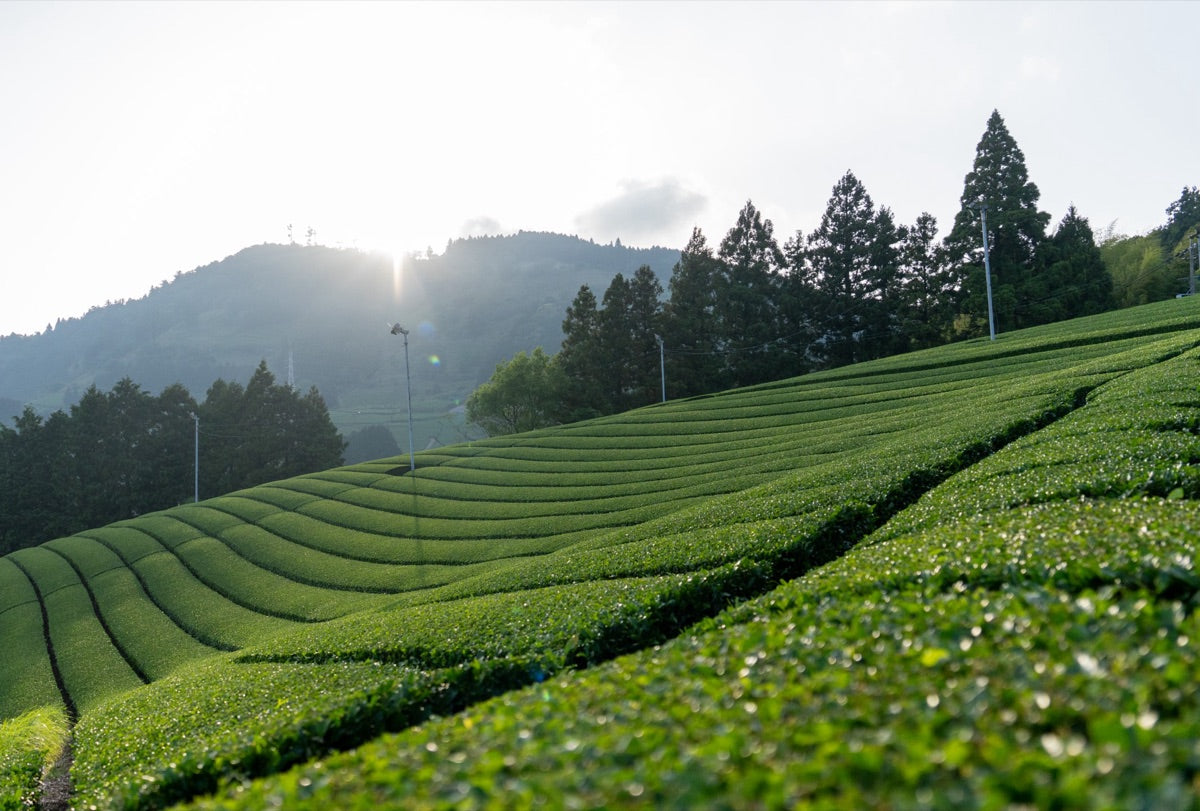
Upstream is where the climate does the work. Around Ikawa and Umegashima, the stretch known as Abe-oku, the Southern Alps stand behind the gardens, mean annual temperature is just over 10 degrees C, and winters hold below freezing (Shizuoka City). Downstream, the history sits in the middle reaches of the Abe, at Ashikubo (Shizuoka City).
Worth separating two things that share a city. Honyama is the Abe and Warashina side of the city. Shizuoka City also contains Shimizu Ward, whose tea districts include Nihondaira, Ihara, Ryogochi and Kojima, and whose history runs back to Suruga no Kiyomi in the Kamakura period (Shizuoka City). The farm we profiled in our Houkouen mountain tea report is in Ryogochi, so it is Shimizu, not Honyama, however mountainous it looks. Same city, same prefecture, different district and different tea.
One thing I could not find anywhere, and I looked: a published planted area or annual tonnage for Honyama. No hectares, no tonnes, in any prefectural, municipal or trade source I read. So this article gives none. Our reports on Kawane mountain sencha and the Tenryu tea region do carry numbers, and even those come with caveats.
Why is Honyama the oldest tea district in Shizuoka?
Because the seed landed here first. Shizuoka Prefecture tells it this way: Shoichi Kokushi (聖一国師), said to have founded Tofuku-ji in Kyoto, brought tea seed back from Song China and sowed it at Ashikubo (足久保) in Aoi Ward, Shizuoka City, near where he was born (Shizuoka Prefecture). Shizuoka City states the consequence without hedging: the history of Shizuoka tea began at Ashikubo, in the middle reaches of the Abe (Shizuoka City).
The detail that stopped me is the second half of it. Shoichi Kokushi was born at Tochizawa (栃沢), in the Okawa district, upstream on the Warashina (Shizuoka City). The same valley system produced the man and received the seed. That is rare, and in English-language tea writing it's almost never mentioned.
Now the part that usually gets smoothed over. Neither the prefecture nor the city gives a year. Both say "about 800 years ago" and leave it there (Shizuoka Prefecture; Shizuoka City). English sources are more confident and less consistent: one tea encyclopedia dates the planting to 1241, an American importer to 1244 (Japanese Tea Pedia; Rishi Tea).
Three years apart is not a big gap. The direction of travel is the point: the institutions closest to the ground decline to pick a year, and the English retellings supply one anyway. "About 800 years ago" is what the record supports.
The farmer who wrote the name Honyama in 1917
This is my favourite thing in the whole story, and it's nearly invisible in English. For most of its history the tea of these valleys wasn't called Honyama at all. It was Abe-cha (安倍茶), named for the river. The name we use now was coined by a single tea farmer who wanted the tea of Abe-oku told apart from everything else on the market (Shizuoka City).
His name was Tsukiji Kotaro (築地光太郎). He was born at the end of the Edo period in Kiyosawa village, in the upper Warashina, which is Aimata in Kiyosawa, Shizuoka City today. He studied tea-making seriously enough to present tea to the Meiji Emperor, which lifted the standing of Abe tea generally. Then, in Taisho 6, he wrote the name "Honyama" on tea he had raised himself at Kiyosawa (Shizuoka Tea Merchants Industrial Cooperative).
Taisho 6 is 1917. Hold that next to the eight hundred years, because the gap is the interesting bit. The growing is ancient. The brand is about a century old, and it has an author.
We keep the full record: our sourced chronology of tea, 486 dated entries.
The character he chose is doing deliberate work. 本 carries the sense of 本物, the real thing, and 本場, the true home ground (Shizuoka City). 山 is mountain. A retailer's glossary renders the whole name as the mountain tea of the true home ground (CHANOYU). A claim of authenticity, made by a producer, about his own district, in a competitive market. Brand strategy, 1917.
What does the river fog actually do to the leaf?

Everyone agrees on the mechanism and then splits on the result. The gardens sit on mountain slopes along the rivers and spend much of their lives inside river fog (Shizuoka City; Shizuoka Tea Merchants Industrial Cooperative). What the fog does to the leaf depends on which official body you ask.
Shizuoka City says tea grown on fog-wrapped mountain slopes has softer leaf flesh than lowland tea, with a vivid green, and that the finished leaf runs out straight and fine (Shizuoka City). The Shizuoka Tea Merchants Industrial Cooperative says the leaf flesh is thinner than lowland tea, also with a vivid green (Shizuoka Tea Merchants Industrial Cooperative).
| Attribute | Shizuoka City | Shizuoka Tea Merchants Industrial Cooperative |
|---|---|---|
| Leaf flesh vs lowland tea | Softer, 葉肉がやわらかく | Thinner, 葉肉が薄く |
| Colour | Vivid green | Vivid green |
| Leaf shape | Runs out straight and fine | Not described |
| Aroma | Fresh and clear, 透き通るような爽やかな香り | Fresh and distinctive, named yama no kaori, 山の香り |
| Mouthfeel | Very gentle, 口当たりがとても優しく | Refined and gentle, 口当たりは上品で優しく |
They diverge in two places: one word about the leaf flesh, and whether the leaf shape is worth describing at all. On aroma and mouthfeel they land in the same spot.
Softer and thinner are not the same claim, and I'm not going to quietly pick the one that reads better. The municipal authority and the trade body describe the same leaf in different words, both in print, both still up. My own reading is that they're circling the same thing, a leaf that grew slowly in cool shade and never got thick and leathery. That's my inference, and I'm flagging it as one.
On aroma they converge completely, and this is the part worth buying for. The cooperative describes a fresh, distinctive fragrance that the trade calls yama no kaori (山の香り), the mountain aroma, and names it as one of Honyama tea's defining features (Shizuoka Tea Merchants Industrial Cooperative). An American importer reaches for the same phrase (Rishi Tea). When a region's own trade body leads with aroma rather than umami, that tells you what it's protecting.
About the day-to-night temperature swing that every mountain tea region leans on: I found no published figure for Honyama's own range, so I won't invent one. What the sources give is the annual picture in Abe-oku, a mean just over 10 degrees C with winters below freezing (Shizuoka City), and an importer's note that winter here runs roughly two months longer than in the lowlands (Rishi Tea). Cold and slow, either way. Shaded tea in Asahina gyokuro in Okabe gets somewhere similar by completely different means.
Did Tokugawa Ieyasu drink Honyama tea?
He did, and the story around it needs separating into two pieces that usually get told as one. Three things are said, and Shizuoka Prefecture frames all three as tradition rather than record. That the tea was presented as goyocha (御用茶), official tea, by order of Tokugawa Ieyasu after he retired to Sunpu in his later years. That it was kept in the tea-jar house (お茶壺屋敷) at the summit of Ikawa Dainichi Pass (井川大日峠). And that it was served to the daimyo travelling under sankin-kotai, the alternate attendance system (Shizuoka Prefecture).
Note the framing. The prefecture's own wording is "it is said", not "records show". I'm keeping that hedge because they kept it.
The second piece is firmer and comes with a date. The Shizuoka Tea Merchants Industrial Cooperative states that Ieyasu drank Honyama tea, and that from Tenna 1, which is 1681, it was delivered to the Tokugawa shogunate as goyocha (Shizuoka Tea Merchants Industrial Cooperative).
Here's the gap nobody points out. Ieyasu died in 1616. The formal arrangement with the shogunate dates from 1681, which is 65 years later. Both facts are true and they are not the same fact. Copy that runs them together is quietly building a stronger claim than the sources make. The tea has a real Tokugawa connection. It just has two of them, at different times.
What is aged Honyama tea, and where does it sit all summer?

Aged Honyama tea, jukusei honyama-cha (熟成本山茶), is a product you can buy, not a historical footnote. Shizuoka City describes it directly: shincha from the mountain areas of the Abe and Warashina valleys, matured slowly until autumn in the tea storehouse at Ikawa Dainichi Pass, at over 1,000 metres (Shizuoka City). New tea goes up the mountain in spring and comes down in autumn, having done nothing but sit in cold air.
That's the same pass as the tea-jar house in the Ieyasu tradition, and the city makes the link explicit: Ieyasu is said to have enjoyed the flavour of tea slowly matured through the summer in the tea storehouse at Ikawa Dainichi Pass (Shizuoka City). A storage habit older than the brand name itself, still run as a product line.
One correction I want to make loudly, because I've watched this figure travel. The 1,000 metres is the elevation of the storehouse. It is not the elevation of the tea gardens. I found no sourced elevation range for the Honyama gardens in any prefectural, municipal or trade publication, so this article gives none. Any specific metre range you see quoted for the gardens is somebody's estimate.
The growers working these valleys now

Go up the Warashina into the Okawa district and you reach Morokozawa (諸子沢), where a tea garden on the mountainside runs gold instead of green. The farmer is Sato Hiromitsu (佐藤浩光), working with his father Takehisa (武久). They spotted a single yellow shoot standing in a green field and kept it at first simply because it was pretty (Oku-Warashina).
Years later they processed it properly and drank it, and found a tea with markedly strong sweetness and umami, carrying roughly double the amino acid content of ordinary green tea. The garden has since been expanded and the tea is sold as Kogane Midori (黄金みどり), golden green (Oku-Warashina).
Two official accounts disagree on when this happened. The Oku-Warashina community site says twenty-odd years ago. Shizuoka City's own artisan profile of the same farmer says thirty-odd. Read it as a generation ago, and read any exact year you see as unsupported.
Both accounts agree on how hard the place is to reach and how little tea there is. Cars cannot get up to the garden; from the city road along the Morokozawa river you walk (Oku-Warashina). Shizuoka City describes the approach as a mountain track a single kei car can barely manage, and the garden as a golden field deep in remote country. The same page carries the grower's line that saplings planted somewhere else simply died, and notes that annual production of Kogane Midori is very small (Shizuoka City).
A cultivar that refuses to move, in a garden you have to walk to, made in tiny quantity. That's either a marketing problem or the entire point, depending on who's telling it.
Two things I could not find and won't guess at: a published founding year for the Sato family's operation, and a stated generation count for Hiromitsu himself. Profiles describe his work in detail and say nothing about his lineage. Rounding that up into "fourth generation" is the move this kind of article usually makes.
Marutaka Noen in Koseto
Further down the Warashina, at Koseto 2413-1 in Aoi Ward, Shizuoka City, sits Marutaka Noen (丸高農園). The farm's own legal page names Takahashi Tatsuji (高橋達次) as proprietor and his son Takahashi Kazuaki (高橋一彰) as shop manager, a certified Japanese Tea Instructor, number 12-2993, with three instructors on the farm (Marutaka Noen). Two generations, and the sourced count stops there. Koseto sits in the Warashina basin, and Shizuoka City names it as one of the Honyama producing areas (Shizuoka City). What they make is Koju (香寿), an unregistered semi-oxidised tea the father found and named. Brewed cold, the regional project HONYAMA88 says you get a fruity taste and aroma like muscat (HONYAMA88). We've written that story up separately in our piece on the Koju cultivar. Read the two together and Honyama stops looking like a museum.
HONYAMA88
There's also a regional project worth knowing about. HONYAMA88 presents producers and products from the region and is run by the Tokyo Food Institute Association, with a site dated 2022. At its launch it showed nine farms and thirty products, Kogane Midori among them (HONYAMA88). It's a producer and culture project, not a regulator, so read it as a shop window on the region rather than an official register.
What does the competition record actually prove?

Something real, and not what the marketing usually implies. At the 70th National Tea Competition, held in fiscal 2016, Shizuoka City won the producing-region award, the sanchi-sho, in the ordinary sencha 4 kg division. It was the city's third consecutive year taking it. In the same competition a Shizuoka City entrant placed first with the Minister of Agriculture, Forestry and Fisheries Award, the first time a city entrant had done that in 25 years (Shizuoka City).

From our tea room
Superior Sencha Green Tea - USDA Organic Japanese First Flush
First-flush loose leaf, USDA Organic, direct from Japanese family farms.
View Superior SenchaNow the caveat, in the same breath, because putting it in a footnote would be dishonest. That award is credited to Shizuoka City. Shizuoka City is a municipality containing the Honyama valleys and also the Shimizu districts, which grow their own tea. The source does not say the winning entries came from Honyama, and no published document I read attributes those results to this region specifically.
So: a city containing Honyama won a national producing-region award three years running, and Honyama is the oldest and most storied tea district inside that city. Two strong facts, sitting next to each other. They are not one fact. If a seller calls their Honyama tea award-winning on the strength of that result, ask which garden, which division, which year.
How to read a bag labelled Honyama

Start with what the label reliably tells you. Honyama is one of Shizuoka Prefecture's three great regional brand teas, produced in the upper reaches of the Abe and Warashina in the middle of the prefecture (Shizuoka Tea Merchants Industrial Cooperative). That's a real regional designation with institutions behind it, which already puts it ahead of most origin words printed on tea.
Expect it late. Because of the altitude and the cold, the harvest here runs roughly a month behind other regions, with a winter about two months longer (Rishi Tea). If you're chasing shincha, Honyama's new tea arrives well after the lowland Shizuoka tea is already selling.
Expect small volume. I found no published tonnage, but the shape of the place says enough: gardens on mountain slopes, some reached on foot, one flagship cultivar that dies when transplanted and is made in very small annual quantity (Oku-Warashina; Shizuoka City).
Be careful with shop language. A Japanese retailer's glossary renders Honyama as the mountain tea of the true home ground and also reaches for the phrase "natural gyokuro" (CHANOYU). The first is a fair gloss of the characters. The second is a retailer's flourish, not an official designation, and gyokuro is defined by a shading method nobody here claims to use. Read it as praise, not as a spec.
And if you see jukusei honyama-cha, understand what's on offer: spring tea that spent its summer in a storehouse above 1,000 metres at Ikawa Dainichi Pass and came down in autumn (Shizuoka City). That's a deliberate choice about time, and it should taste rounder than the same leaf sold fresh in May.
Frequently asked questions
What is Honyama tea?
Honyama tea is tea produced in the basin of the Abe River and its tributary the Warashina, which run through Shizuoka City, Shizuoka Prefecture, according to Shizuoka Prefecture. Shizuoka City adds that it has the oldest history of any tea district in the prefecture, and the Shizuoka Tea Merchants Industrial Cooperative names it as one of Shizuoka's three great regional brand teas.
Where exactly is the Honyama tea region?
In the Abe and Warashina river valleys inside Shizuoka City. The upper end of that country, around Ikawa and Umegashima, is called Abe-oku, where Shizuoka City records a mean annual temperature just over 10 degrees C and winters that stay below freezing. Note that the prefecture and the city describe the whole basin, while the Shizuoka Tea Merchants Industrial Cooperative describes the upper reaches.
How old is Honyama tea, and is there a founding year?
There is no year in the official Japanese record. Shizuoka Prefecture and Shizuoka City both say only that about 800 years ago Shoichi Kokushi sowed seed brought back from Song China at Ashikubo. English-language sources supply years the Japanese ones do not, and they disagree: Japanese Tea Pedia gives 1241 and Rishi Tea gives 1244. This article stays with "about 800 years ago" as the supported claim.
Where does the name Honyama come from?
From one farmer, about a century ago. The tea of these valleys was called Abe-cha until Tsukiji Kotaro, a tea farmer living in Kiyosawa village in the upper Warashina, coined Honyama to tell the tea of Abe-oku apart from other districts. The Shizuoka Tea Merchants Industrial Cooperative records that in Taisho 6, which is 1917, he wrote the name Honyama on tea he had raised at Kiyosawa. The character 本 carries the sense of the real thing and the true home ground.
Did Honyama tea really supply the Tokugawa shogunate?
Yes, from 1681, and that is later than most retellings imply. The Shizuoka Tea Merchants Industrial Cooperative states that Ieyasu drank Honyama tea and that from Tenna 1, which is 1681, it was delivered to the Tokugawa shogunate as goyocha, or official tea. Ieyasu died in 1616, so the formal arrangement postdates him by 65 years. Shizuoka Prefecture frames the related story of the tea-jar house at Ikawa Dainichi Pass as tradition rather than record.
What stays with me
A man walked up a mountain track above Morokozawa, saw one yellow shoot in a green field, and kept it because it was pretty. A farmer at Kiyosawa in 1917 decided his neighbours' tea deserved a name of its own and wrote it down. Somebody is still carrying spring tea up to a storehouse above 1,000 metres and bringing it back in autumn, the way it was apparently done when the shogun's men came through.
None of that shows up in the competition results, and those belong to a city rather than to this valley anyway. What's here is older and more stubborn. Eight centuries of growing, one century of the name, and a cultivar that will not live anywhere else. I keep thinking about the saplings that died when they were moved. Some things are only themselves in one place, and Honyama reads like a region that knows it.
Sources
- Shizuoka Honyamacha, Shizuoka Prefecture, Shizuoka Food Information Center (fujinokuni), published 2024-01-31. The definition of Shizuoka Honyamacha as tea produced in the basin of the Abe River and its tributary the Warashina running through Shizuoka City; Shoichi Kokushi, said to have founded Tofuku-ji in Kyoto, sowing tea seed brought from Song China at Ashikubo, Aoi Ward, Shizuoka City, near his birthplace, about 800 years ago and with no year given; and the tradition that the tea was presented as goyocha by order of Tokugawa Ieyasu after his retirement to Sunpu, stored in the tea-jar house at the summit of Ikawa Dainichi Pass and served to daimyo travelling under sankin-kotai. Retrieved 2026-09-30. Japanese version at the same article in Japanese.
- 静岡市のお茶ブランド (Shizuoka City's tea brands), Ochanomachi Shizuoka-shi, Shizuoka City official site. Honyama as the tea district with the oldest history in Shizuoka Prefecture; the definition by the Abe and Warashina basins; river fog on mountain slopes giving softer leaf flesh than lowland tea, a vivid green and a straight, fine leaf shape; the naming of Honyama-cha by the tea farmer Tsukiji Kotaro when the area's tea was still called Abe-cha, to distinguish the tea of Abe-oku, with 本 carrying the sense of 本物 and 本場; and aged Honyama tea as shincha from the Abe and Warashina mountain areas matured until autumn in the tea storehouse at Ikawa Dainichi Pass at over 1,000 m. Retrieved 2026-09-30.
- 産地紹介 (Production areas), Ochanomachi Shizuoka-shi, Shizuoka City official site. Ikawa and Umegashima as Abe-oku, backed by the Southern Alps, with a mean annual temperature just over 10 degrees C and winters that stay below freezing; the tradition that Ieyasu enjoyed tea matured through the summer in the tea storehouse at Ikawa Dainichi Pass; the history of Shizuoka tea beginning at Ashikubo in the middle reaches of the Abe; Shoichi Kokushi's birth at Tochizawa in the Okawa district upstream on the Warashina; Tsukiji Kotaro living in Kiyosawa village in the upper Warashina and naming the tea Honyama; and Shizuoka City's producing-region award in the ordinary sencha 4 kg division at the 70th National Tea Competition in FY2016 for a third consecutive year, plus a city entrant taking the Minister of Agriculture, Forestry and Fisheries Award for first place for the first time in 25 years. Retrieved 2026-09-30.
- Ochanomachi Shizuoka-shi artisan profile, Sato Hiromitsu, Shizuoka City official site, read as an archived copy on 2026-09-30. Morokozawa in the Okawa district reached by a mountain road that a single kei car can barely manage; the golden tea garden deep in remote mountain country; the grower's statement that saplings planted elsewhere died; the very small annual production of Kogane Midori; and the account placing the discovery thirty-odd years ago, against the twenty-odd years given by the Oku-Warashina community site.
- 静岡茶について (About Shizuoka tea), Shizuoka Tea Merchants Industrial Cooperative. Honyama as the tea district with the oldest history in Shizuoka, produced in the upper reaches of the Abe and Warashina in the middle of the prefecture, and as one of Shizuoka's three great regional brand teas; gardens in the river valleys wrapped in river fog, with leaf flesh thinner than lowland tea and a vivid green; the fresh, distinctive aroma known as yama no kaori, the mountain aroma, named as one of Honyama tea's great characteristics; and Ieyasu's drinking of Honyama tea with delivery to the Tokugawa shogunate as goyocha from Tenna 1, 1681. Retrieved 2026-09-30.
- 黄金みどり (Kogane Midori), Oku-Warashina community site, Okawa district. The golden tea garden on the mountain above Morokozawa; the farmer Sato Hiromitsu and his father Takehisa finding the shoot twenty-odd years ago; amino acid content about double that of ordinary green tea, giving strong sweetness and umami; the expansion of the garden and the sale of the tea as Kogane Midori; and the fact that cars cannot reach the garden, so access is on foot from the city road along the Morokozawa river. Retrieved 2026-09-30.
- 丸高農園 (Marutaka Noen), trading information page, the farm's own site. The address at Koseto 2413-1, Aoi Ward, Shizuoka City; Takahashi Tatsuji (高橋達次) as proprietor; his son Takahashi Kazuaki (高橋一彰) as shop manager and a certified Japanese Tea Instructor, number 12-2993; and three instructors on the farm. A producer's commercial site, but this is the page carrying its own legal particulars. Note the given name: third-party write-ups render it 達治, while the farm itself and HONYAMA88 both write 達次. Retrieved 2026-09-30.
- HONYAMA88, interview with Marutaka Noen. The father finding and naming Koju, and the muscat-like fruity taste and aroma when it is brewed cold. Retrieved 2026-09-30.
- Shizuoka City, Tea artisans. Koseto in Aoi Ward sitting in the Warashina basin and counting as one of the Honyama producing areas. Retrieved 2026-09-30.
- HONYAMA88, run by the Tokyo Food Institute Association, site dated 2022. The regional producer and culture project for Honyama, with nine farms and thirty products shown at its launch, Kogane Midori among them. A promotional project site rather than an official register. Retrieved 2026-09-30.
- 本山茶の特徴とは (What is Honyama tea), CHANOYU, a Japanese tea retailer's content site. The gloss of Honyama as the mountain tea of the true home ground, and the retailer's use of the phrase "natural gyokuro", which is shop language rather than an official designation. Retrieved 2026-09-30.
- Hon Yama Shincha from Japan's Shizuoka Alps, Rishi Tea, an American tea importer. The harvest running roughly a month later than other regions and a winter about two months longer; the use of "Yamano Kaori" for the region's aroma; and the 1244 date for the original planting, which the official Japanese sources do not give. A commercial source. Retrieved 2026-09-30.
- Honyama-cha, Japanese Tea Pedia. The Abe-cha naming history and the Ashikubo-cha connection, and the 1241 date for the original planting, which the official Japanese sources do not give. A commercial source. Retrieved 2026-09-30.
Share:
Tenryu Tea: Shizuoka's Wildest Mountain Region
Ureshino Tea: Inside Saga's Tamaryokucha Country