



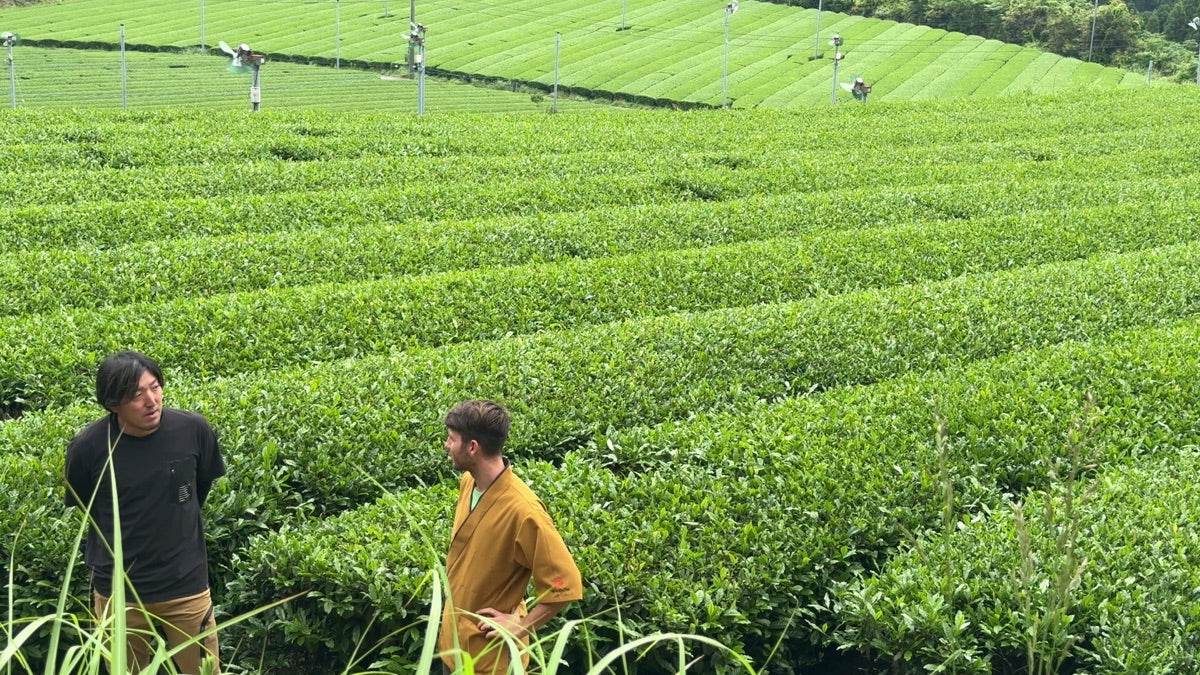
Ureshino tea is the green tea grown in and around Ureshino City, in southwest Saga Prefecture on the island of Kyushu. Nearly all of it is tamaryokucha, a curled-leaf tea made without the final rolling step that gives sencha its straight needles. JA Saga puts Ureshino tea at three percent of Japan's national production, and the town has taken the National Tea Competition's Production Area Award three years running.
Key Takeaways
- Ureshino tea comes from Ureshino City in southwest Saga Prefecture, Kyushu, and is the country's main source of tamaryokucha (JA Saga).
- Tamaryokucha skips seijū, the final rolling pass that straightens sencha. That single omission is why the leaf stays curled, and why it is also called guricha.
- Ureshino City won the National Tea Competition's Production Area Award in 2023, 2024 and 2025, and the Minister of Agriculture, Forestry and Fisheries Award in both the steamed and pan-fired divisions across the same three years.
- Steamed tamaryokucha is brewed at 60 to 70°C (140 to 158°F), pan-fired at 80 to 85°C (176 to 185°F). Same region, same leaf shape, two different kettles.
- We do not currently carry Ureshino tea. This is reporting on a region we admire, not a product page.

Where does Ureshino tea actually come from?
Ureshino City sits in the southwest corner of Saga Prefecture, in the northwest of Kyushu. JA Saga describes the growing area as gentle hill country that holds deep fog, with a day-to-night temperature swing and sunlight levels suited to tea. That is the whole terroir argument in one sentence, and the fog is doing real work in it.

From our tea room
Superior Sencha Green Tea - USDA Organic Japanese First Flush
First-flush loose leaf, USDA Organic, direct from Japanese family farms.
View Superior SenchaFirst flush comes around mid-April, earlier than the calendar most people associate with Japanese tea. The traditional marker, hachijūhachiya, the eighty-eighth night counted from the start of spring, falls around 2 May. Here the hill gardens are already under morning mist weeks before that, and JA Saga credits that mist with keeping just enough moisture on the leaf as the new shoots come in.
The name is worth knowing too. Since 2002, "Ureshino tea" has been the brand name for tea produced across two prefectures, Saga and Nagasaki (Yunomi). The labeling convention is stricter than most people expect: tea that is 100 percent Saga- or Nagasaki-grown is sold as Ureshino tea, while anything from 50 percent to just under 100 percent has to be labeled Ureshino tea blend (CHANOYU).
The town is better known to most Japanese travelers for something else. Its hot spring is counted among the country's three great bijin-no-yu, the waters said to be kind to skin.
What makes tamaryokucha different from sencha?

The difference is one missing machine. Sencha goes through seijū (精揉), a final rolling stage that presses and straightens the leaf into the thin needles most people picture when they think of Japanese leaf teas like sencha. Tamaryokucha skips that stage entirely, so the leaf dries in the comma-like curl it held during earlier rolling (CHANOYU). That shape is the whole reason for the nicknames: guricha and mushi-guri, roughly "curly tea" and "steamed curly".
Within tamaryokucha there are two families, split by how the leaf is first heated to stop oxidation. Mushi-sei is steamed. Kama-iri-sei, the pan-fired style also called kamairicha, is roasted in a kama, an iron pan, in a method developed during China's Ming dynasty, 1368 to 1644 (Japan Today). Both end up curled. They taste nothing alike.
| Attribute | Steamed tamaryokucha | Pan-fired tamaryokucha (kamairicha) | Sencha |
|---|---|---|---|
| Kill-green method | Steam | Roasted in a kama (iron pan) | Steam |
| Final rolling (seijū) | Skipped | Skipped | Applied |
| Leaf shape | Curled, comma-like | Curled, comma-like | Straight needles |
| Brew temperature | 60 to 70°C / 140 to 158°F (JA Saga) | 80 to 85°C / 176 to 185°F (JA Saga) | Not in cited sources |
| In the cup | Deep green, mellow, sweet | Clear gold, kettle aroma, crisp finish | Not in cited sources |
| Share | 95% of tamaryokucha production (Yunomi) | About 5% of Ureshino tea production (JA Saga) | The national default |
Those percentages blur together easily, so here is the discipline I hold myself to. JA Saga's three percent measures Ureshino tea against all Japanese production. Japan Today's three percent measures tamaryokucha against all Japanese production, which is a different denominator that happens to land on a similar figure.
Japan Today notes separately that less than one percent of Japanese tea of any kind is pan-fired today, which puts kamairicha among the genuinely rare Japanese teas. The two five percents need the same care: the chart's is the remainder after Yunomi's ninety-five percent of tamaryokucha, JA Saga's is pan-fired tea inside Ureshino's own output. Different measurements, different questions.
The potters, the Nanjing kama, and Yoshimura Shinbei

Ureshino's tea did not arrive with a monk. It arrived with ceramics.
It starts around 1440, when potters from Ming-dynasty China settled here and grew tea for their own use (Yunomi). Roughly sixty years later, in 1504, a potter named Kōreimin (紅令民) brought a kama over from Ming China and taught the Nanjing-kama pan-firing method. JA Saga marks that year as the start of Ureshino-style kamairicha, and the reason Ureshino-chō is regarded as the birthplace of pan-fired tea in Japan.
The figure who turned a local habit into an industry was Yoshimura Shinbei (吉村新兵衛, 1604 to 1657), from the Saga domain's Hizen Shiroishi district. Around 1650 he cleared his own forested land in the Fudōyama district of Ureshino-chō and sowed tea seed there. He also improved on the Nanjing-kama method and pushed it out to his neighbors. Yunomi dates the real spread of Ureshino tea to 1648 through 1651, which lines up. Every April the town still holds the Chasō Matsuri, the tea-ancestor festival, to honor him and pray for the harvest.
The part I find hard to stop thinking about: one of the tea plants attributed to Yoshimura is still alive. The great tea tree at Fudōyama Saraya-dani (不動山皿屋谷) is estimated at over 350 years old, and in 1926 it was designated a National Natural Monument on the grounds that a tea plant that size is rare anywhere in the world (JA Saga). Not a replanted descendant. The bush.
Why was steamed tamaryokucha built to look pan-fired?

The curl in your steamed tamaryokucha is not an ancient aesthetic. It is an export-market decision from the 1920s. Japan was hunting for new buyers, and turned toward the Soviet Union, which was already buying Chinese pan-fired tea (Japan Today). Russian drinkers knew what pan-fired tea looked like, and it looked curled.
So Japanese producers engineered a steamed tea that looked like a pan-fired one. Steaming scaled better than pan-roasting and the equipment ran faster. Dropping the final rolling pass left the leaf in the right shape for the customer. Shizuoka became the volume leader, turning out almost 8,000 tons between 1934 and 1941 (Japan Today).
Which means the defining visual signature of Ureshino's main product was designed to satisfy a buyer across the sea who never showed up to stay. The market moved on. The leaf shape stayed, and a century later it is the thing that makes the region distinctive. I think about that every time someone tells me tradition and commerce are opposites.
How does Ureshino tea taste, and how should you brew it?

Two teas, two kettles. JA Saga is specific about this, and it is the most immediately useful thing on their page.
- Steamed tamaryokucha: 60 to 70°C (140 to 158°F). Low and slow pulls the sweetness and umami forward and gives you a deep green liquor with a rounded, almost thick texture. Push the temperature up and you trade that away for astringency you did not want.
- Pan-fired tamaryokucha: 80 to 85°C (176 to 185°F). The heat lifts the roast aroma the kama put there in the first place. The liquor comes out clear and golden rather than green, with a crisp finish.
JA Saga also notes the tea is sen ga kiku, meaning it holds up across repeated infusions, with the flavor, aroma and umami shifting each time you pour. That is a good tea to sit with rather than a good tea to rush.
On cultivars, the growing area is reported to be mostly planted to Yabukita, Japan's most widely planted tea cultivar. Saemidori and Asatsuyu also grow there (CHANOYU). If you want to see the processing itself, the city runs two places worth a detour (JA Saga): Chaoshiru (うれしの茶交流館), the tea interpretive center with free admission, and Kinsaran-kan (嬉茶楽館), a training facility with a crude-tea processing room where booked visitors can watch both the steamed and pan-fired lines run.
Do we sell Ureshino tea?
No, and I would rather say that clearly than write around it.
One with Tea does not currently carry anything from Ureshino. Our lineup is built around organic matcha rather than leaf tamaryokucha, and our sourcing sits in other regions entirely. Ureshino is a genuine gap in what we offer, and pretending otherwise would be the easiest way to lose your trust over a tea I cannot ship you.
Here is what I would check if we ever went looking there.
- Whether the grower runs steamed, pan-fired or both, because those are different crafts under one regional name.
- Whether the tea is 100 percent Saga or Nagasaki leaf or a labeled blend, since the distinction is formalized.
- Whether their competition record is specific, a named division and a year, rather than a general claim.
Ureshino City itself has the specific version. Per JA Saga, it took the Production Area Award at the National Tea Competition in 2023, 2024 and 2025. It also took the Minister of Agriculture, Forestry and Fisheries Award in both the steamed tamaryokucha and pan-fired divisions across those same three years.
That checklist is not unique to Kyushu. It is the same one I run on every farm we do buy from, and if you are sourcing for a cafe rather than a shelf at home, the longer version is our guide to choosing a wholesale Japanese tea supplier.
In the meantime, if you want the teas we can vouch for, our organic Japanese matcha comes from farms we have walked, and wholesale inquiries go straight to me.
Frequently asked questions
What is Ureshino tea?
Ureshino tea is green tea grown in and around Ureshino City in southwest Saga Prefecture, Kyushu. Most of it is tamaryokucha, a curled-leaf tea, and JA Saga puts it at three percent of Japan's national tea production.
Is tamaryokucha the same as guricha?
Yes. Guricha and mushi-guri are common nicknames for tamaryokucha, all referring to the curled leaf that results from skipping seijū, the final rolling step used for sencha.
What is the difference between steamed and pan-fired tamaryokucha?
The first heating step. Steamed (mushi-sei) tamaryokucha is steamed and brews deep green and mellow at 60 to 70°C (140 to 158°F). Pan-fired (kama-iri-sei) is roasted in an iron kama and brews clear gold with a roast aroma at 80 to 85°C (176 to 185°F). Pan-fired is the rarer of the two, about 5 percent of Ureshino tea production according to JA Saga.
How old is the great tea tree in Ureshino?
The great tea tree at Fudōyama Saraya-dani is estimated at over 350 years old and is attributed to Yoshimura Shinbei. It was designated a National Natural Monument in 1926.
When is the Ureshino tea harvest?
The first flush is picked around mid-April, when the mountain gardens sit under morning mist. The traditional eighty-eighth-night marker, hachijūhachiya, falls around 2 May.
Sources
- JA Saga (JAさが), "お茶・うれしの茶(嬉野茶)". Retrieved 30 September 2026.
- Yunomi, "History Notes Along with Your Cup of Ureshino Tea". Retrieved 30 September 2026.
- Japan Today, "Tamaryokucha: Japan's rare green tea you've probably never heard of". Retrieved 30 September 2026.
- CHANOYU (山年園), "嬉野茶(うれしの茶)の特徴とは?". Retrieved 30 September 2026.
Share:
Honyama Tea: Shizuoka's Oldest Tea Valley, Named in 1917
Kamairicha: The Complete Guide to Japan's Pan-Fired Tea