



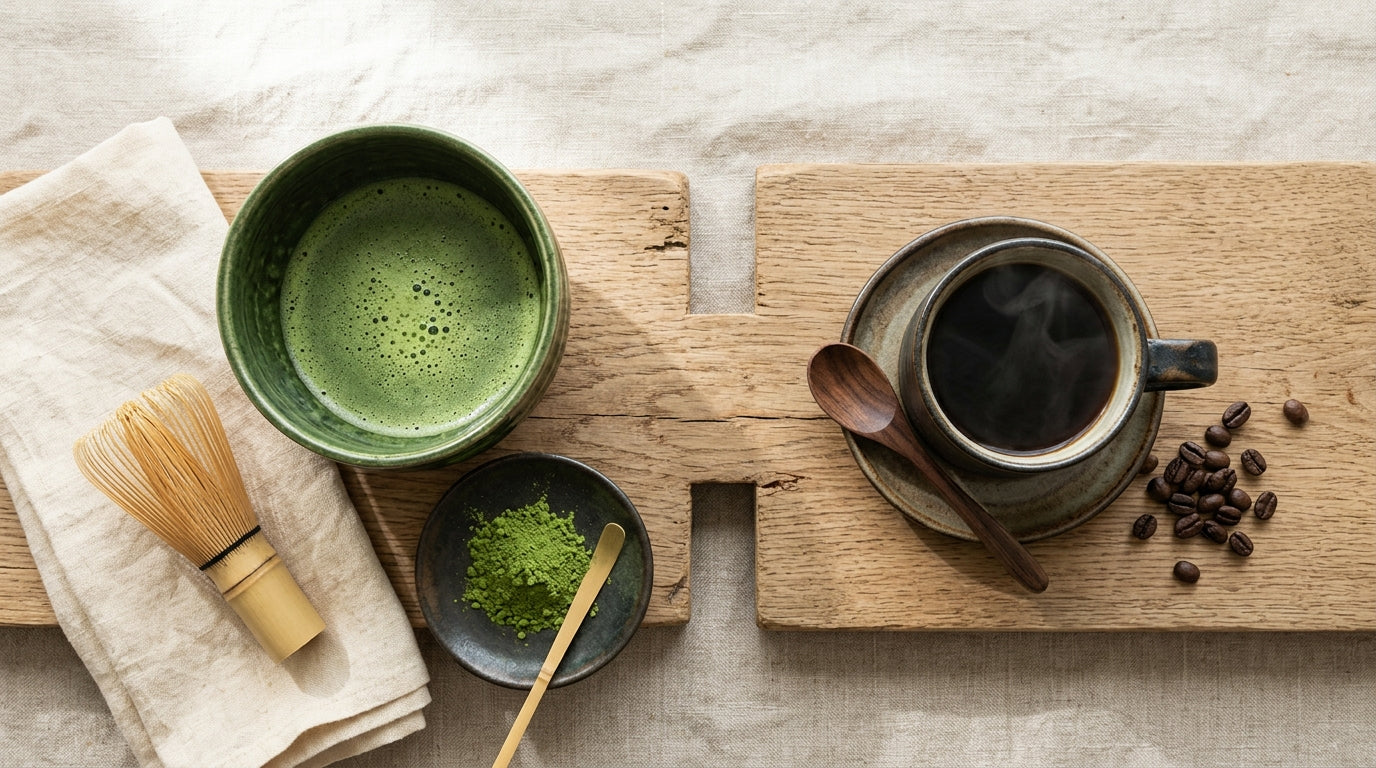
Yes, matcha contains caffeine. A standard 1-teaspoon serving (2 grams) delivers 38 to 88 mg, depending on grade and harvest. That's roughly half a cup of brewed coffee. The difference matcha drinkers notice isn't the dose, it's how that caffeine arrives. The same leaf carries L-theanine, an amino acid that slows absorption and reshapes the energy curve.
I'm Christian, founder of One with Tea. I've measured this with a digital scale at 7 a.m. for years, kept a paper log, and visited the prefectures these leaves come from, including Mohei Honda's farm in Shizuoka, Kurihara Seicha in Yame, Houkouen up in the Shizuoka mountains, and Ichikawa-en on the Makinohara plateau. What follows is what the science says, what the numbers actually look like in your bowl, and what we've learned from sourcing matcha directly from those named producers.
Key Takeaways
- A standard 1-teaspoon serving of matcha (2 grams) contains 38 to 88 mg of caffeine, depending on grade and harvest, per USDA FoodData Central and peer-reviewed quantification data.
- That's roughly half a cup of brewed coffee (95-200 mg per 8 oz, FDA).
- L-theanine in matcha (5-46 mg/g) extends caffeine absorption over 4-6 hours, producing alpha-wave "calm focus" instead of a coffee-style spike-and-crash (Haskell-Ramsay et al. 2008, Biological Psychology).
- First-flush ichibancha (late April to early May) carries the highest caffeine and L-theanine of the year. Later flushes test lower.
- FDA daily caffeine limit is 400 mg from all sources. 1-3 servings of matcha per day stays well within range for most adults.
- 2026 supply context: Japan's green tea exports rose 42% in FY2025, with matcha driving 70% of volume. Demand has stretched supply chains globally, raising the stakes on sourcing integrity.
How much caffeine is in matcha?
Matcha caffeine is unusually concentrated for a tea because you're drinking the whole leaf, ground to powder, suspended in water. Steeped tea leaves the leaf behind. Matcha doesn't.
Here's how the numbers stack up across common serving sizes and grades, using values consistent with the USDA FoodData Central matcha tea reference and peer-reviewed quantification studies indexed at PubMed:
| Serving | Caffeine (mg) | Notes |
|---|---|---|
| 1 tsp matcha (2 g) | 38 to 88 mg | Standard ceremonial-style serving |
| 2 tsp matcha (4 g) | 76 to 176 mg | Latte or stronger usucha |
| 1 g matcha | 19 to 44 mg | Per gram, useful for math |
| 8 oz brewed coffee | 95 to 200 mg | Per FDA caffeine reference |
| 8 oz brewed green tea (sencha) | 25 to 45 mg | Steeped, not powdered |
Grade matters. Ceremonial-grade matcha, which is made from the youngest spring leaves, tends to fall on the higher end of the range. Culinary and latte grades, processed from later harvests, often sit lower. The variation isn't a flaw. It's a feature of how shading and harvest timing affect the leaf's chemistry.
One caveat. Lab values shift slightly between batches, even from the same producer. We'll come back to that when we look at sourcing.
Why matcha caffeine feels different (the L-theanine science)
Caffeine alone gives you a spike. Caffeine plus L-theanine gives you something else. The two molecules together reshape how alertness arrives and how long it stays.
L-theanine is an amino acid concentrated in shade-grown tea leaves, which is why matcha (always shaded for at least 3 weeks before harvest) carries more of it than steeped sencha. Peer-reviewed work indexed at PubMed (Haskell-Ramsay et al., 2008, Biological Psychology) documented that the combination of L-theanine and caffeine produces measurable shifts in attention and reaction time that neither delivers alone. Follow-up studies on cognitive performance and mood, including Owen et al. (2008) in Nutritional Neuroscience, found similar synergy effects, with subjective reports of calmer focus and reduced mental fatigue under task load.
The mechanism, as the literature describes it, works in two directions. L-theanine slows the rate at which caffeine crosses the blood-brain barrier, which softens the initial spike. It also promotes alpha-wave brain activity, the EEG signature associated with relaxed alertness. The result is what tea drinkers have called the "calm focus" state for centuries, now described in the same terms by neuroscience.
Quantification studies indexed at PubMed put L-theanine concentration in matcha somewhere between 5 and 46 mg per gram of powder, with shade-grown ceremonial grades at the top of that range. At a 2-gram (1 tsp) serving, you're getting roughly 10 to 90 mg of L-theanine alongside the 38 to 88 mg of caffeine. Researchers studying the synergy generally use ratios in this same neighborhood, which is one reason matcha (rather than purified extracts) is the version most commonly studied.
Onset is typically 30 to 40 minutes after drinking. Duration runs 4 to 6 hours, longer than coffee for most people. There's no formal crash because the curve flattens out instead of cliff-dropping. In my own logs, peak alertness lands around 75 minutes in, sustained focus runs through hour three, and the taper is gradual enough that the transition out feels like a fade rather than a fall.
That's the practical answer to "why does matcha feel different than coffee even with less caffeine." It's not energy mythology. It's the absorption curve.
Matcha vs coffee, head to head
The most common question I get is whether matcha is "stronger" than coffee. The honest answer is: it depends on what you mean.
By raw caffeine, no. An 8-oz coffee carries 95 to 200 mg, per the FDA caffeine reference. A standard 1-tsp matcha serving carries 38 to 88 mg. Coffee wins on dose.
By effective alertness, the picture flips. Because L-theanine extends caffeine's absorption window over 4 to 6 hours, the practical "I feel sharp" duration of matcha can match or exceed an equivalent coffee. You drink less caffeine, but it works longer and steadier.
Three other practical differences:
- Acidity. Matcha sits around pH 9, mildly alkaline. Brewed coffee sits around pH 5, mildly acidic. People with acid sensitivity often find matcha easier on an empty stomach.
- Crash. Coffee tends to peak around 30 to 45 minutes and fall sharply by hour three. Matcha plateaus and tapers. There's no specific "energy crash" word in the matcha literature because the curve doesn't really crash.
- Body feel. The same caffeine number lands differently. A 90 mg coffee can feel jumpier than a 90 mg matcha because the L-theanine is doing real chemistry, not marketing.
If you want a long-form discussion of switching from coffee to matcha for sustained focus, our tea-for-coffee-drinkers buyer's guide walks through the practical transition.
Matcha vs other tea (sencha, hojicha, gyokuro)
Inside the Japanese green tea family, caffeine varies more than people expect. Most of the difference comes down to one thing: how much shade the leaf got before harvest.
More shade equals more caffeine and more L-theanine. The plant compensates for reduced sunlight by accumulating both compounds. That's why the most shaded teas, gyokuro and matcha, are also the most caffeinated.
| Tea | Caffeine per 8-oz serving | Shading |
|---|---|---|
| Matcha (1 tsp powdered) | 38 to 88 mg | Heavy, 3+ weeks |
| Gyokuro (steeped) | 30 to 50 mg | Heavy, 3+ weeks |
| Sencha (steeped) | 25 to 45 mg | None to light |
| Hojicha (steeped) | 5 to 10 mg | None, plus roasting |
Hojicha is the one to know if you want a low-caffeine tea that still tastes like Japanese green tea. The roasting process degrades much of the caffeine. It's what we drink after dinner.
What changes the caffeine in your bowl
Four variables change the number on a given day, even from the same tin:
- Grade. Ceremonial-grade matcha (first flush, ground from the youngest spring leaves) tends to test higher than culinary or latte grades. The first harvest in late April or early May concentrates more caffeine because the plant pours its resources into those new shoots. Once the plant has produced its first flush, the leaves that follow are working with depleted reserves and lower caffeine.
- Dose. Obvious but often overlooked. Most café lattes use 1 to 2 teaspoons. A traditional usucha is 1 teaspoon. A koicha (thick tea) preparation is 2 teaspoons in less water, which is why the caffeine hit feels stronger even though the powder weight isn't dramatically different. If you've ever wondered why a café latte feels mild and a properly made usucha feels precise, the dose math explains a lot of it.
- Water temperature. Hotter water extracts more caffeine. The traditional 175°F (80°C) preparation is partly about flavor, and partly about controlling extraction. Boiling water pulls more caffeine and more bitter catechins. Cooler water (160°F) does the opposite, gentler extraction, sweeter taste, slightly less caffeine in the same time window. We have a separate guide on matcha water temperature that goes deeper.
- Harvest timing. First flush (ichibancha, late April to early May) carries the highest caffeine and L-theanine of the year. Later flushes (nibancha and beyond) test lower. Sourcing data published by the Ministry of Agriculture, Forestry and Fisheries (MAFF) of Japan tracks these seasonal differences. The Global Japanese Tea Association maintains additional public data on harvest-timing variation.
If you want consistency, buy from a producer that names the harvest. Vague "ceremonial grade" labels with no harvest date can vary widely batch to batch. The current 2026 supply pressure has made this even more important. With ichibancha allocations tighter, some brands are blending in later-flush tencha and calling it ceremonial. The caffeine and the flavor both shift downward when that happens.
One more variable that doesn't quite fit the list: storage. Matcha is alive in the sense that its compounds degrade with light, heat, and oxygen. A tin that sat on a warm shelf for 6 months has lost some of its L-theanine and freshness, even if the caffeine is more stable. Buy small tins, store them sealed in the fridge after opening, and use within 30 to 60 days for the cleanest cup.
Is it safe to drink matcha every day?
For most healthy adults, yes. The FDA's general caffeine guidance is up to 400 mg per day from all sources combined. At 1 to 3 servings of matcha per day, you're looking at roughly 38 to 264 mg from matcha, well inside that range for most people.
A few groups should check with a doctor before making matcha a daily ritual:
- Pregnant or breastfeeding women (FDA recommends limiting caffeine, typical guidance is under 200 mg per day, but consult your provider)
- Anyone on medications affected by caffeine (some heart medications, certain antibiotics, lithium, theophylline)
- People with diagnosed heart-rhythm or thyroid conditions
- People with caffeine sensitivity who already react to small doses
This isn't medical advice. It's the same caution you'd give for coffee. If a substance has caffeine, and you have a condition where caffeine matters, talk to a doctor before adding more.
When to drink matcha for the energy you want
Because matcha runs on a 4-to-6-hour curve, timing matters more than with coffee. A few patterns we've found work, drawn from years of personal logs and customer feedback:
- Morning ritual. One serving between 7 and 9 a.m. lifts the morning without spiking. Peak alertness lands around 8 to 9 a.m. and tapers naturally toward noon. This is my own daily pattern: 1 teaspoon at 7 a.m., peak at 8:15, fades clean by 11.
- Pre-workout. 30 to 40 minutes before training. The L-theanine smooths the caffeine effect, so you get steady output without the jitter that ruins fine motor control.
- Afternoon focus block. A second serving around 1 to 2 p.m. extends focus into late afternoon without interfering with sleep for most people. If you're caffeine-sensitive, drop the second serving back to noon or earlier.
- Evening. Generally skip it. The duration is the issue. Caffeine half-life runs about 5 hours, and matcha's extended absorption can push that out further. If you want a green-tea ritual after dinner, hojicha is the move.
Frequently asked questions
Does matcha contain caffeine?
Yes. A standard 1-teaspoon serving (about 2 grams) contains 38 to 88 mg of caffeine, depending on grade and harvest timing. That's roughly half a cup of brewed coffee. The full leaf is consumed, so matcha is more caffeine-dense than steeped green tea, where the leaf is discarded.
Is matcha more caffeinated than coffee?
Cup for cup, no. An 8-oz coffee delivers 95 to 200 mg of caffeine, versus 38 to 88 mg in 1 teaspoon of matcha. But matcha contains L-theanine, which extends absorption over 4 to 6 hours, so the effective alertness duration can match or exceed coffee without the sharp drop.
Why does matcha give different energy than coffee?
Matcha pairs caffeine with L-theanine, an amino acid that smooths the absorption curve. The combination produces alpha-wave brain activity associated with calm focus, while coffee delivers caffeine alone, a faster spike and steeper drop. The total caffeine is lower, but the duration is longer.
Can matcha cause jitters?
Less commonly than coffee. The L-theanine in matcha attenuates the jitter response by extending caffeine absorption over a longer window. People sensitive to caffeine may still feel some effect at 2 or more servings per day, especially on an empty stomach or with a high-grade ceremonial matcha.
Is it safe to drink matcha every day?
For most adults, yes. The FDA's general caffeine guidance is up to 400 mg per day from all sources. Matcha at 1 to 3 servings per day stays well within that range. Pregnant or breastfeeding women, anyone on medications affected by caffeine, or people with a heart or thyroid condition should consult a doctor.
How much matcha can I drink in a day?
A reasonable range for most adults is 1 to 3 cups per day, which is 1 to 3 teaspoons of powder. Beyond 3 servings, watch for caffeine sensitivity. Daily caffeine intake from all sources combined should stay under the FDA's 400 mg guidance.
Does green tea have the same caffeine as matcha?
No. Steeped green tea (sencha) carries 25 to 45 mg of caffeine per 8-oz cup, versus 38 to 88 mg in a 1-teaspoon matcha serving. The difference is that matcha drinkers consume the whole leaf as powder, while sencha drinkers steep and discard. For a low-caffeine Japanese green tea, hojicha (roasted green tea) runs 5 to 10 mg per cup.
When is the best time to drink matcha for energy?
For most people, between 7 and 9 a.m. or 30-40 minutes before exercise. Matcha's 4-to-6-hour caffeine curve means a morning serving lifts attention without spiking, then tapers cleanly toward noon. A second serving around 1-2 p.m. extends focus into late afternoon. Skip it after 4 p.m. to protect sleep.
How One with Tea sources matcha
Caffeine numbers are only useful if you trust where the powder came from. The 2026 matcha shortage has put pressure across the supply chain, with some brands quietly pushing lower-grade harvests as ceremonial. We wrote about that in detail in our 2026 matcha shortage breakdown. The short version: harvest timing affects caffeine content, so a "ceremonial" tin from a later flush isn't just a flavor downgrade, it's a different chemistry. Less L-theanine relative to caffeine. A flatter, less-defined energy curve. The taste loses umami because the same shading molecules that produce L-theanine also produce the savory note that defines real first-flush matcha.
Here's what we do at One with Tea, in plain language:
- USDA-certified organic. Every lot, every harvest. We don't blend organic with non-organic.
- Named producers. Mohei Honda in Shizuoka. Kurihara Seicha in Yame. Jiro-san's mountain plots near Uji. We've been to these farms. We know the names of the people who pick the leaves and the names of the families who built these tea gardens generations ago.
- Third-party heavy-metal lab testing. Lead, cadmium, mercury, arsenic. Caffeine values typically run alongside the heavy-metal panel, which is one reason we have caffeine confidence at the lot level. Lab reports are published at our lab results page.
- First-flush harvest priority. When we say ceremonial, we mean ichibancha. Late April to early May. The leaves the tradition is built on.
- Stone-milled in small batches. Granite stone mills produce roughly 30 to 40 grams of matcha per hour. There's a reason we can't scale this on demand. The slow grind keeps the powder cool, which protects the L-theanine and the volatile compounds that carry the aroma.
If you want the full breakdown of how to evaluate any matcha brand, the organic matcha buyer's guide is the canonical resource we maintain. It walks through the questions to ask before you buy a tin: where does it come from, when was it harvested, has anyone tested it for what shouldn't be in there, and does the brand actually answer those questions in writing.
None of this is marketing. It's the bare minimum we hold ourselves to before we can put a tin in the mail. The reason caffeine numbers vary across brands isn't randomness, it's whether the brand cares about the variables we just walked through. We do, because the people drinking this tea care.
Where to start
If you're new to matcha and want a clean starting point, our USDA organic ceremonial 60g tin is the version we drink ourselves. First-flush, named producer, third-party tested.
One teaspoon, 175°F water, a real bamboo whisk. That's the practice. The caffeine takes care of itself when the leaf is right and the ritual is honest. Slow down for the 3 minutes it takes to whisk a bowl. The energy that follows lands differently when you've built it with attention rather than pressed a button.
Tea has been a practice for centuries before it was a productivity tool. The science we covered above explains why the practice works. The practice itself is yours to keep.
Looking for ceremonial matcha sourced honestly from named Japanese regions?
USDA Organic and JAS certified, third-party lab tested, direct from family farms.
Shop Matcha CollectionInquire About WholesaleRelated reading: The best matcha powder for weight loss · Best matcha for beginners
Share:
Best Tea Gift Sets 2026: A Founder's Wellness Guide
Best Temperature for Matcha: 175°F (80°C) Tested 2026