



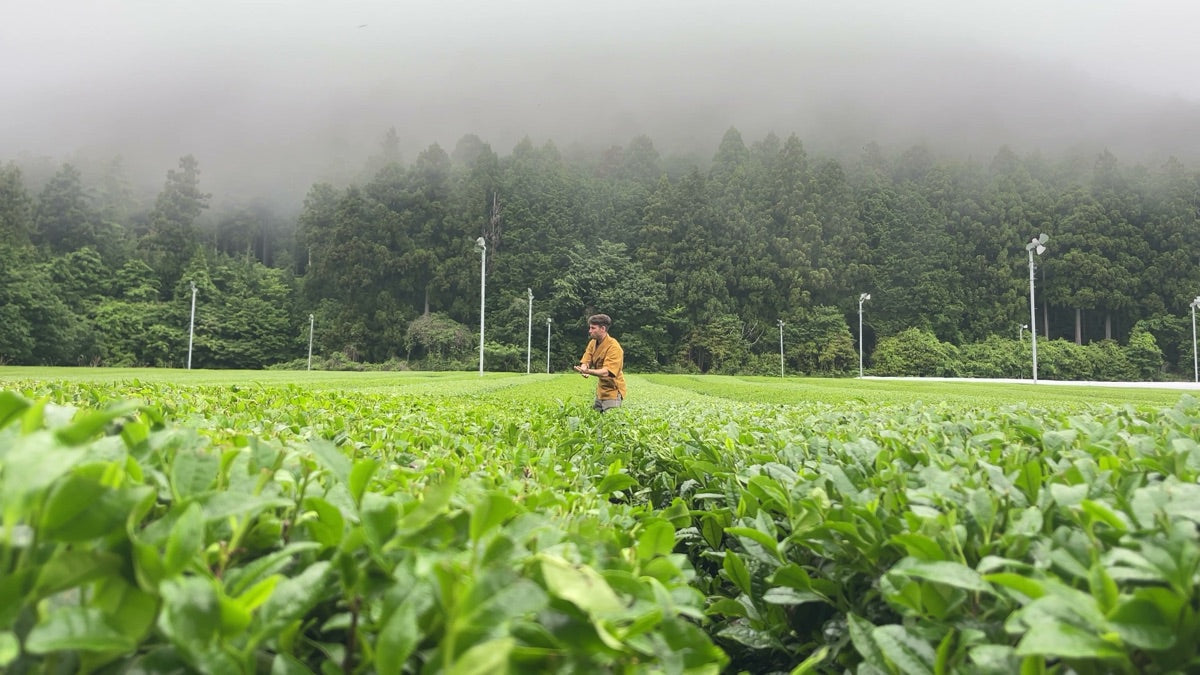
Ryoufuu (りょうふう, 涼風), also written Ryofu, is a Japanese green tea cultivar registered on 3 July 1997 as Cha Norin No. 45. Breeders at the national tea research station in Kanaya, Shizuoka crossed Houryoku, a hardy selection with Indian tea in its ancestry, with Yabukita in 1972. They wanted a tougher, later partner for the cultivar that covered 74 percent of Japan's tea gardens at the time. They got one. Then one of its own breeders told growers plainly that Ryoufuu lacks Yabukita's refinement, Asatsuyu's sweetness and Okuyutaka's elegance, and asked them to consider it, knowing that, as one candidate in a mix of cultivars.

From our tea room
Superior Sencha Green Tea - USDA Organic Japanese First Flush
First-flush loose leaf, USDA Organic, direct from Japanese family farms.
View Superior SenchaThat honesty is why I wanted to write about it. Most cultivar descriptions read like brochures. Ryoufuu's paper trail is a 1999 registration paper full of the breeders' own measurements, plus a note from one breeder that works almost like a warning label. So this piece follows those two documents first, then the few people who have tasted it and written it down. If you want the wider family first, our guide to Japanese tea cultivars maps where Ryoufuu sits.
Key Takeaways
- Ryoufuu (りょうふう, 涼風) was registered as Cha Norin No. 45 on 3 July 1997, bred at Kanaya, Shizuoka under the line name Kanaya No. 17.
- It is a cross of Houryoku x Yabukita, made in 1972. Houryoku is an unregistered Shizuoka selection grown from Tada-line Indian hybrid seed.
- It is a mid-late cultivar, plucked about 2 to 4 days after Yabukita, so growing the two together spreads out the harvest.
- In the breeding trials it was more resistant to anthracnose than Yabukita (3.7 against 5.8, lower is better), and NARO now puts its first and second flush yield at equal to Yabukita or 10 to 20 percent higher.
- The kanji mean "cool breeze", chosen for a clean, brisk flavour. Its breeders recorded that tasters split on that strong flavour, and they still do.

What is the Ryoufuu tea cultivar?
Ryoufuu is a mid-late Japanese sencha cultivar bred at the national tea research station in Kanaya, Shizuoka, and registered in 1997 as Cha Norin No. 45. The official Cha Norin registry gives it a single row: former line name Kanaya No. 17 (金谷17号), parentage Houryoku x Yabukita (ほうりょく×やぶきた), bred at Kanaya, registered use sencha (Cha Norin registered cultivar list, checked 2026-09-14).
The breeders announced it two years later in 「煎茶用中晩生品種'りょうふう'の育成」, published with the English title "New Released Green Tea Cultivar 'Ryofu'" (Kondo and colleagues, Tea Research Journal No. 87, 1999). NARO, the national agriculture and food research organisation that runs the Kanaya station today, still profiles it in its current cultivar handbook (NARO Tea Cultivar Handbook, 6th edition, updated August 2022, p. 20) and on its cultivar page.
| Attribute | Detail |
|---|---|
| Japanese name | りょうふう (涼風), romanised Ryoufuu or Ryofu |
| Registration | Cha Norin No. 45 (茶農林45号), 3 July 1997 |
| Plant variety protection | Registered August 2001, no. 9204 |
| Line names | 煎47-436 (1975 to 1979), F1 139 (1981 to 1987), Kanaya No. 17 (from 1990) |
| Parentage | Houryoku (seed parent) x Yabukita (pollen parent), crossed 1972 |
| Bred at | Tea Research Station, Kanaya, Shizuoka (now NARO) |
| Registered use | Sencha |
| Season | Mid-late. Plucked 2 to 4 days after Yabukita |
| Habit | Slightly upright, a little more vigorous than Yabukita |
| Strengths | Medium or better resistance to anthracnose, gray blight and bacterial shoot blight. Bright green leaf. Stable yield |
| Cautions | Weak to white peach scale, somewhat weak to blister blight (NARO, 2022). Astringency comes out easily in processing. Shoots are slow to open |
You'll see the name spelled three ways in English. The breeders' paper and NARO-derived pages use Ryofu, My Japanese Green Tea uses Ryoufuu, and Japanese Tea Sommelier writes Ryôfû. They are all the same plant, りょうふう.
Two near-misses are worth knowing. Ryokufu (緑風) is a different cultivar altogether, a natural crossbreed selected by a private breeder and granted plant variety registration in 2002, according to Japanese Tea Sommelier's cultivar table. And because 涼風 is an everyday Japanese word for a cool breeze, a tea sold as "Ryofu" may simply be a product name. Look for the hiragana りょうふう, or the parentage Houryoku x Yabukita, before assuming it is this cultivar.
Why Kanaya bred a partner for Yabukita

Ryoufuu exists because Japan had put most of its tea on one plant. The 1999 paper opens with the number: Yabukita occupied 74 percent of Japan's tea-garden area at the time. The breeders call Yabukita an excellent cultivar, with good processed quality and wide adaptability. But concentrating on a single cultivar caused problems, they wrote. The list: the risk of late frost damage, outbreaks of pests and plant pathogens, one uniform flavour, labour shortages and overwork because everyone plucks in the same window, and tea factories overbuilt to handle that single peak (Kondo et al., 1999).
The answer they wanted was timing. Early and late cultivars that could be grown alongside mid-season Yabukita were, in the paper's words, "strongly desired." A farm with two cultivars that ripen a few days apart can pluck one field and then the other, instead of racing every hillside at once.
What I like about that list is how practical it is. Flavour is on it, but so are tired workers and factories sized for one frantic week a year. Our piece on Japan's dependence on Yabukita tells the bigger story. Ryoufuu is one of the concrete answers the Kanaya breeders built, alongside other Yabukita crosses from the same station such as Meiryoku.
Houryoku x Yabukita: a 25-year breeding record

Ryoufuu took 25 years to go from a hand-pollinated flower to a registered cultivar. In 1972, breeders at the Tea Research Station in Kanaya crossed Houryoku (ほうりょく) as the seed parent with Yabukita as the pollen parent. The paper gives the logic in one line: Houryoku for its strong resistance to plant pathogens, Yabukita for its good processed-tea quality (Kondo et al., 1999).
Who is Houryoku? Most tea drinkers have never heard of Ryoufuu's mother, and there is a reason. The paper describes Houryoku as a seedling of a Tada-line Indian hybrid (多田系印度雑種の実生). NARO's handbook lists its pedigree as an Assam-type seed parent crossed naturally with an unknown father, bred by Shizuoka Prefecture. It was never registered as a Cha Norin cultivar. In the registry it appears only once, as Ryoufuu's parent. My Japanese Green Tea traces it to the seeds Tada Motokichi brought back from Assam and dates its selection to 1943, while Japanese Tea Sommelier's cultivar table gives 1956. I can't settle that from the sources I found, so I'll leave it at the 1940s or 1950s.
The 1999 paper sets out the rest step by step:
- 1972: Houryoku crossed with Yabukita at Kanaya.
- 1973: Seed collected and sown. Seedlings raised in a greenhouse.
- April 1975: Planted out in the field and put through individual selection as number 煎47-436, until 1979.
- June 1980: Cuttings taken for nursery selection.
- 1981 to 1987: Line comparison trial under the name F1 139, testing growth and processing quality.
- 1988: Cuttings sent to five national regional adaptability sites (Ibaraki, Mie, Kyoto, Kochi and Kumamoto), plus Shizuoka for a blister blight test and Kagoshima for a frost-cracking test.
- 1989: Cuttings sent to 11 prefecture-run trial sites and other breeding stations.
- 1990: Tested from now on under the line name Kanaya No. 17.
- By 1996: Results in from tea research sites in 20 prefectures.
- January and March 1997: Reviewed by the new-cultivar candidate committee and the national vegetable and tea research council.
- 3 July 1997: Named Ryoufuu and registered as Cha Norin No. 45.
That trial network is the part I find most reassuring. By the time Ryoufuu had a name, it had been grown from Ibaraki, near the northern edge of commercial tea growing, all the way to Kagoshima in the far south. Both of its parents came out of Shizuoka, which is covered in our guide to the Shizuoka tea region. It became a protected plant variety in August 2001 (no. 9204), and NARO's handbook lists taking its plant material out of Japan as prohibited.
What the breeding trials measured

At Kanaya, Ryoufuu came out hardier, later to bud and heavier-yielding than Yabukita, with first-flush quality slightly ahead (Kondo et al., 1999). The paper measures it against Yabukita and against Kanayamidori, the station's mid-late control cultivar.
| Measure | Ryoufuu | Yabukita | Kanayamidori |
|---|---|---|---|
| First-flush budding, 1982 to 1986 mean | 4.0 days later | 5 April | 4.8 days later |
| First-flush plucking, 1984 to 1986 mean | 0.3 days later | 9 May | 1.8 days later |
| Winter leaf scorch, 1983 to 1987 (1 very strong, 9 very weak) | 3.6 | 4.2 | 2.8 |
| Cut-branch freezing test, minus 12°C for 2 hours (same scale) | 3.4 | 4.0 | 3.2 |
| Anthracnose, 1981 to 1986 (1 very resistant, 9 very susceptible) | 3.7 | 5.8 | 3.5 |
| First-flush yield index, young bushes (Yabukita = 100) | 123 | 100 | 146 |
| Total annual yield index, young bushes | 127 | 100 | 134 |
| First-flush quality index, 1984 to 1986 | 104 | 100 | 103 |
The season
The "four days later" figure you'll see on English pages is the budding date. At Kanaya, Ryoufuu budded 4 days after Yabukita on average, but its plucking came only 0.3 days later in 1984 to 1986. Across the trial stations the gap was 2 to 6 days at budding and 0 to 4 days at plucking. NARO's handbook now puts plucking at 2 to 4 days after Yabukita, and adds a practical warning: Ryoufuu's shoots are slow to open, so a grower who judges plucking time by how open the shoots look will pluck too late.
The hardiness
In winter, Ryoufuu showed slightly less leaf scorch than Yabukita and slightly more than Kanayamidori, and it barely dropped or browned its leaves. At the Ibaraki trial site, near the northern limit of commercial tea, its average cold damage over 1991 to 1996 was lower than Yabukita's. Anthracnose, a fungal leaf infection, was the clearest gap: a score of 3.7 against Yabukita's 5.8, and equal to or lower than Yabukita at every trial site (Kondo et al., 1999). NARO's handbook today rates its resistance to anthracnose, gray blight and bacterial shoot blight as medium or better.
The yield
On young bushes in their fourth to sixth year at Kanaya, Ryoufuu's yield index against Yabukita was 123 for the first flush, 150 for the second, 115 for the third and 127 for the whole year. Young bushes flatter a vigorous cultivar, so NARO's current guidance is the better everyday figure: first and second flush equal to Yabukita or 10 to 20 percent higher (NARO, 2022).
The wider trial is more mixed than English summaries suggest. At 13 of the 15 sites that reported first-flush yields, Ryoufuu matched or beat Yabukita. At Ibaraki and Kyoto it came in at 96. Summer yield beat Yabukita at every site that measured it. Some of the big numbers also say as much about a weak Yabukita plot as a strong Ryoufuu one: in Saga, Ryoufuu's index of 262 was set against a Yabukita plot that gave only 34 kg per 10 a (Kondo et al., 1999, Table 17).
The cup, as the breeders scored it
First-flush sencha from Ryoufuu scored an index of 108 for appearance, 102 for aroma, liquor and taste together, and 104 overall against Yabukita, averaged over 1984 to 1986. The leaf colour was a bright green, better than Yabukita's. The liquor was clear, and the taste strong and clean (滋味は強く,すっきり). Second-flush quality averaged 112, ahead of both Yabukita and Kanayamidori, and summer tea scored equal to or better than Yabukita in all five prefectures that tested it. The paper's English abstract sums it up: "The color of processed tea is brightly green. The color of liquor is clear golden yellow. The taste of the processed tea is a little astringent, but strong body and brisk."
The honest caveats
The Shizuoka Prefectural Tea Experiment Station tested blister blight, a fungal leaf blight, from 1990. In August 1993 Ryoufuu actually carried more lesioned leaves than Yabukita (126 against 90 per square metre), and by October slightly fewer (636 against 656), with the susceptible control at 920. The paper judged it about as resistant as Yabukita. NARO's current handbook is more cautious: it calls Ryoufuu somewhat weak to blister blight and weak to white peach scale, a scale insect, and advises control where either is common. It also notes bark-split frost damage at about Yabukita's level, and a tendency toward fewer buds, so growers prune slightly deeper.
The breeders' verdict
Put together, the breeders' own summary holds up. Ryoufuu can be grown nationwide, its slightly upright habit suits machine harvesting, its yield and quality were stable across regions and years, and planted next to Yabukita it stretches the plucking season (Kondo et al., 1999).
Cool breeze: where the name comes from

Ryoufuu means "cool breeze," and the breeders explain why. Section 7 of the 1999 paper says the name りょうふう, written 涼風, came from the tea's clean, refreshing flavour (さっぱりとした香味), the sense of briskness it gives (爽快感), and the image of new shoots swaying in a cool breeze (新芽が涼風に揺らぐ様). NARO's handbook gives the same kanji, and My Japanese Green Tea translates it simply as "cool breeze."
You may also see "fresh wind" online. As far as I can tell, that comes from a play on words in a 2016 tasting note by Japanese Tea Sommelier, who doubted this cultivar would bring a "fresh wind" to the whole Japanese tea industry. It's a good line. It just isn't what the name means.
I think the name tells you what the breeders were aiming for. Not sweet, not rich, not a heavier Yabukita, but something that feels clean and a little bracing. If you know Soufuu, another Kanaya cultivar with a breezy-sounding name, don't mix the two up. Different parents, different decade.
Individuality, not selfishness: the breeder's warning
The most unusual document about Ryoufuu is a short note from Ikeda Namiko, one of its breeders, reprinted on O-CHA NET, the World Green Tea Association's site. It reads less like a launch announcement and more like advice from someone who doesn't want growers to make an expensive mistake.
She sets out what Ryoufuu does well. It grows well, its yield is stable, its processed quality sits within an acceptable range, and it suits a market where tastes are becoming more varied. Then she says what it is not. Ryoufuu does not have Yabukita's refinement (上品), Asatsuyu's sweetness and richness, or Okuyutaka's elegance. If you want a sweet, rich reference point, our profile of Asatsuyu shows what she was comparing it to.
Her central line is "individuality and selfishness are different" (個性とわがままとは違います). A cultivar that is merely unusual and also causes problems in the field is, in human terms, being selfish, she writes: its uses are limited, and planting it on a large scale is risky. So she frames Ryoufuu as one candidate in a mix of cultivars, to be chosen knowing exactly what it is. The English version of the page is shorter and drops this passage.
I have read a lot of cultivar descriptions, and I rarely see a breeder argue against overplanting their own plant. It is the same message as the 1999 paper's quiet line about tasters, only said in plain language to the people who would pay for the mistake.
What Ryoufuu tastes like: clean, chestnut or peaty?
Ryoufuu sencha is strong, clean and brisk, with astringency close to the surface, and tasters do not agree on its aroma. The 1999 paper said so first. At the trial sites its taste "has umami, but because the flavour is strong, evaluations tended to divide." Saga (1994 and 1995) and Nagasaki (1996) noted slight or bitter astringency, and still scored the taste equal to or above Yabukita (Kondo et al., 1999). NARO's handbook says the same thing today: the refreshing aroma is distinctive and opinions on it can split, and astringency and bitterness come out easily during processing.
Mimasaka sencha, reviewed in 2016. Florent of Japanese Tea Sommelier tasted a Ryoufuu sencha from Mimasaka, in Okayama, steamed for about 50 seconds and finished with a medium hi-ire (the final drying and firing). The dry leaf smelled fragrant, fresh, mineral and sweet. The liquor's scent was warm, sweet, slightly peaty, and it evoked leather. There was a brief, sharp astringent touch, a diffuse umami with mineral and candied-fruit notes, and a long, powerful aftertaste. He called it "a sencha far from perfect," but rich, with enough force and personality (Japanese Tea Sommelier, 22 January 2016).
Mimasaka sencha from Kaita, 2018. A Japanese tea instructor writing at hama926.com tasted a Ryoufuu sencha from the Kaita area of Mimasaka. The liquor was a clear yellow, close to a clear gold. There were no off-notes and the cup was clean, with sweetness balanced by a gentle astringency. The spent leaves smelled sweet, like boiled chestnuts, and the tea stayed clean into the third steep (hama926.com, 5 October 2018).
So is Ryoufuu peaty or clean? On the evidence, "peaty and leathery" is one taster's impression of one tea, not the cultivar's signature. The breeders, NARO and the 2018 taster all describe something cleaner. My own reading, and it is only that, is that the first tea's hi-ire finish may account for some of its warmth. What every source does agree on is strength. This is not a soft cup.
Mimasaka and the rare single-origin Ryoufuu
As a single-cultivar sencha, Ryoufuu is best documented from Mimasaka, in north-east Okayama. But it isn't a Mimasaka cultivar. It was bred in Shizuoka for use across Japan, and Mimasaka is simply one place that grows it.
The Kaita area of Mimasaka has produced tea since the Edo period, according to Mimasaka City. Japanese Tea Sommelier's 2016 post notes that Mimasaka bancha seems to be the best-known local tea, and describes a small sencha output, few producers with successors, and one producer who takes over abandoned plantations and grows a relatively large number of cultivars, Ryoufuu among them. A grower's product page in Kaita describes its Ryoufuu sencha as a rare cultivar with a refreshing aroma, moderate body and a clear, cool taste. At the 2016 World O-cha Festival, a Mimasaka Ryôfû "greatly fascinated the curiosity of visitors," as Japanese Tea Sommelier put it.
Okayama also appears in the 1999 paper. The Okayama Prefectural Agricultural Experiment Station's Northern Branch was one of the trial sites, and Ryoufuu did well there: a first-flush yield index of 182 against Yabukita's 117 kg per 10 a, a summer index of 274, a first-flush quality index of 101, and a promise rating of 3.7 out of 5. The highest ratings went to Kumamoto and Saga (5.0) and Kagoshima (4.7), and the lowest, 3.0, to Kyoto, Kochi, Shiga and Nagasaki (Kondo et al., 1999, Tables 17, 20 and 22). No source I found connects that trial to the plantings in Kaita, so I won't draw the line for you.
How much Ryoufuu is grown in Japan overall, I couldn't find. The one recent institutional mention, a 2016 NARO research bulletin, describes it as a mid-late cultivar with good growth and yield that is "spreading steadily" (Ikeda et al., NIVTS Research Bulletin No. 15, 2016). As a single-origin tea it is still a find, which is why it sits comfortably next to the teas in our guide to rare Japanese teas.
How to brew Ryoufuu sencha

No breeder or institution publishes brewing parameters for Ryoufuu. The two tasters who published methods started at 80 to 85°C for 40 seconds to about 1 minute, and one of them went hotter and faster with each later steep (Japanese Tea Sommelier, 2016; hama926.com, 2018):
| Taster | Leaf | First infusion | Later infusions |
|---|---|---|---|
| Japanese Tea Sommelier (2016) | 3.5 g | About 85°C, 40 to 50 seconds | Not specified |
| hama926.com (2018) | 4 g (the whole sample) | 80°C, about 1 minute | Second 85°C for 15 seconds, third 90°C for 5 seconds |
Neither gives a water volume, so read these as starting points rather than recipes. The pattern is familiar from other sencha: a gentle first steep, then hotter and faster ones as the leaf opens. NARO's handbook note that astringency and bitterness come out easily is about processing, not brewing, but it points the same way. If your cup turns sharp, try a cooler first infusion before anything else.
Then slow down with it. The 2018 taster found the chestnut note in the spent leaves, not the cup, which is easy to miss if you tip them out straight away. Smell the dry leaf, the wet leaf and the cup, one after another. A tea whose aroma divides people is worth a moment of your own attention before you decide which side you're on.
Frequently asked questions
What does Ryoufuu mean?
Ryoufuu (りょうふう) is written 涼風, meaning "cool breeze." Its breeders chose the name for the tea's clean, refreshing flavour and the image of new shoots swaying in a cool breeze. It does not mean "fresh wind."
What are Ryoufuu's parents?
Ryoufuu is a cross of Houryoku (seed parent) and Yabukita (pollen parent), made in 1972 at the Kanaya tea research station in Shizuoka. Houryoku is an unregistered Shizuoka selection grown from Tada-line Indian hybrid seed, chosen for its resistance to plant pathogens.
Is Ryoufuu the same as Ryokufu?
No. Ryoufuu (りょうふう, 涼風) is Cha Norin No. 45, registered in 1997. Ryokufu (緑風) is a different cultivar, a natural crossbreed selected by a private breeder and granted plant variety registration in 2002.
When is Ryoufuu plucked compared with Yabukita?
Ryoufuu is a mid-late cultivar. NARO puts its plucking at 2 to 4 days after Yabukita. At the Kanaya breeding station it budded about 4 days after Yabukita, and its shoots are slow to open, so growers should not judge plucking time by how open the shoots look.
What does Ryoufuu sencha taste like?
Its breeders described a bright green leaf, clear liquor and a strong, clean, brisk taste with a little astringency, and noted that tasters split on its strong flavour. One Mimasaka sencha reviewed in 2016 struck a taster as slightly peaty and leathery, while a 2018 Mimasaka sencha tasted clean, with spent leaves that smelled of boiled chestnuts.
Where is Ryoufuu grown?
Ryoufuu was bred for use across Japan and trialled in 20 prefectures before registration. As a single-cultivar sencha it is best documented in the Kaita area of Mimasaka, Okayama. A 2016 NARO bulletin described it as spreading steadily, but no planted-area figure is published in the sources we found.
A note from me
To be straightforward with you: we don't sell Ryoufuu, and I haven't tasted it myself. Everything above comes from the 1999 paper, NARO's handbook, the breeder's note and the tasters I've cited. I write these cultivar pieces because the plants are the least told part of Japanese tea, and I'd rather show you the record than polish it.
What stays with me is that line about individuality and selfishness. It would have been easy for Ryoufuu's breeders to sell it as the next great cultivar. Instead one of them told growers what it wasn't, and trusted them to decide.
I find that a gentle teaching, well beyond tea. Being different isn't a virtue on its own. It becomes one when it's honest about what it offers and what it asks of the people around it. When I sit down with a cup, I try to meet it that way too, tasting what's there rather than what I hoped would be.
If you want to keep following the family tree, start with Yabukita, Ryoufuu's father, and then Harumidori, another Yabukita cross from the same generation of Japanese breeding.
Sources
- Kondo S., Ikeda N., Tanaka J., Takeda Y., Takyu T., Watanabe A., Amma S., Katsuo K., Masuda K., Yanase Y., Yamaguchi S., 「煎茶用中晩生品種'りょうふう'の育成」 (New Released Green Tea Cultivar 'Ryofu'), 茶業研究報告 (Tea Research Journal) No. 87, pp. 21-38, 1999, DOI 10.5979/cha.1999.21, via J-STAGE. Primary source: breeding aim and history, Tables 3 to 8, 11, 12, 17, 20 to 22 and 24, naming. Read in full, including the scanned tables. Retrieved 2026-09-14.
- Cha Norin registered cultivar list (茶農林登録品種一覧), publicly mirrored copy. Rows for Ryoufuu (No. 45), Yabukita (No. 6), Kanayamidori (No. 30), Meiryoku (No. 35), Harumidori (No. 48) and Soufuu (No. 49). Retrieved 2026-09-14.
- NARO, 茶品種ハンドブック (Tea Cultivar Handbook), 6th edition, updated August 2022, p. 20 and pedigree appendix. Current characteristics, growing and processing cautions, plant variety protection. Retrieved 2026-09-14.
- NARO, りょうふう cultivar page. Summary and plant variety registration no. 9204. Retrieved 2026-09-14.
- Ikeda Namiko, りょうふう, O-CHA NET (World Green Tea Association). The breeder's note to growers. Retrieved 2026-09-14.
- Ryofu, O-CHA NET English version (shortened). Retrieved 2026-09-14.
- Ikeda N. et al., NIVTS Research Bulletin No. 15, 2016, pp. 19-27. Ryoufuu described as spreading steadily. Retrieved 2026-09-14.
- The Ryoufuu Tea Cultivar, My Japanese Green Tea. "Cool breeze" translation, Houryoku background. Retrieved 2026-09-14.
- Mimasaka sencha, Ryôfû, Japanese Tea Sommelier, 22 January 2016. Mimasaka context, tasting notes, brewing. Retrieved 2026-09-14.
- The Japanese tea cultivars, Japanese Tea Sommelier, 22 August 2022. Table rows for Ryôfû, Hôryoku and Ryokufû. Retrieved 2026-09-14.
- World O-cha Festival 2016, Japanese Tea Sommelier, 22 November 2016. Visitor reaction to a Mimasaka Ryôfû. Retrieved 2026-09-14.
- お茶好きによるお茶好きのための品種茶「りょうふう」試飲レポート, hama926.com, 5 October 2018. Tasting notes and brewing. Retrieved 2026-09-14.
- Ryoufuu sencha product page, grower in Kaita, Mimasaka. Confirms a Mimasaka Ryoufuu sencha described as a rare cultivar. Retrieved 2026-09-14.
- 海田茶 (Kaita tea), Mimasaka City. Tea growing in Kaita since the Edo period. Retrieved 2026-09-14.
Share:
Izumi Tea Cultivar: Japan's Export Green Tea Reborn as Black Tea
Shunmei Tea Cultivar: The Early Sencha That Lost to Saemidori