


by Christian, founder of One with Tea
Meiryoku is a Japanese sencha cultivar registered as 茶農林35号 (Chanorin No. 35), bred at the national tea research station at Kanaya in Shizuoka and entered in the register in 1986 (茶農林登録品種一覧). Its parents are recorded as やぶきた×Z1, Yabukita crossed with a line known only as Z1, and before it had a name it was simply Kanaya No. 6.
Here's what makes it worth an article. When Meiryoku was bred, tasters worried it had too little umami and that the cup was thin. That was the complaint. Decades later, the same character is described as clean and free of quirks, and it reads as a strength rather than a defect. The tea didn't change. We did.
Key Takeaways
- Meiryoku is 茶農林35号, bred at Kanaya in Shizuoka from Yabukita and a line called Z1, registered in 1986 for sencha, not matcha.
- At breeding time it was criticised for weak umami and a thin cup. That same quality is now valued as clean and without quirks.
- It is unusually easy to farm. It shrugs off two of tea's major leaf diseases and needs almost no spraying for them, and it handles cold well.
- It spread through Shikoku on drought toughness rather than flavour, and it is grown in cold highland districts of Kochi.
- We do not sell a single-cultivar Meiryoku. You are far more likely to drink it inside a blend than to see it named on a tin.

What is Meiryoku?
Meiryoku is a mid-season green tea cultivar bred for sencha. The national register lists it as 茶農林35号, gives its pedigree as やぶきた×Z1, records its former line name as 金谷6号 (Kanaya No. 6), places its breeding at Kanaya in 1986, and states its intended use as 煎茶, sencha (茶農林登録品種一覧).

From our tea room
Superior Sencha Green Tea - USDA Organic Japanese First Flush
First-flush loose leaf, USDA Organic, direct from Japanese family farms.
View Superior SenchaThat last detail matters more than it looks. Meiryoku was never a matcha plant. It was bred to be steamed, rolled and dried as leaf tea. When people ask us whether a cultivar is a matcha cultivar, the register usually answers it in one column, and here the answer is no.
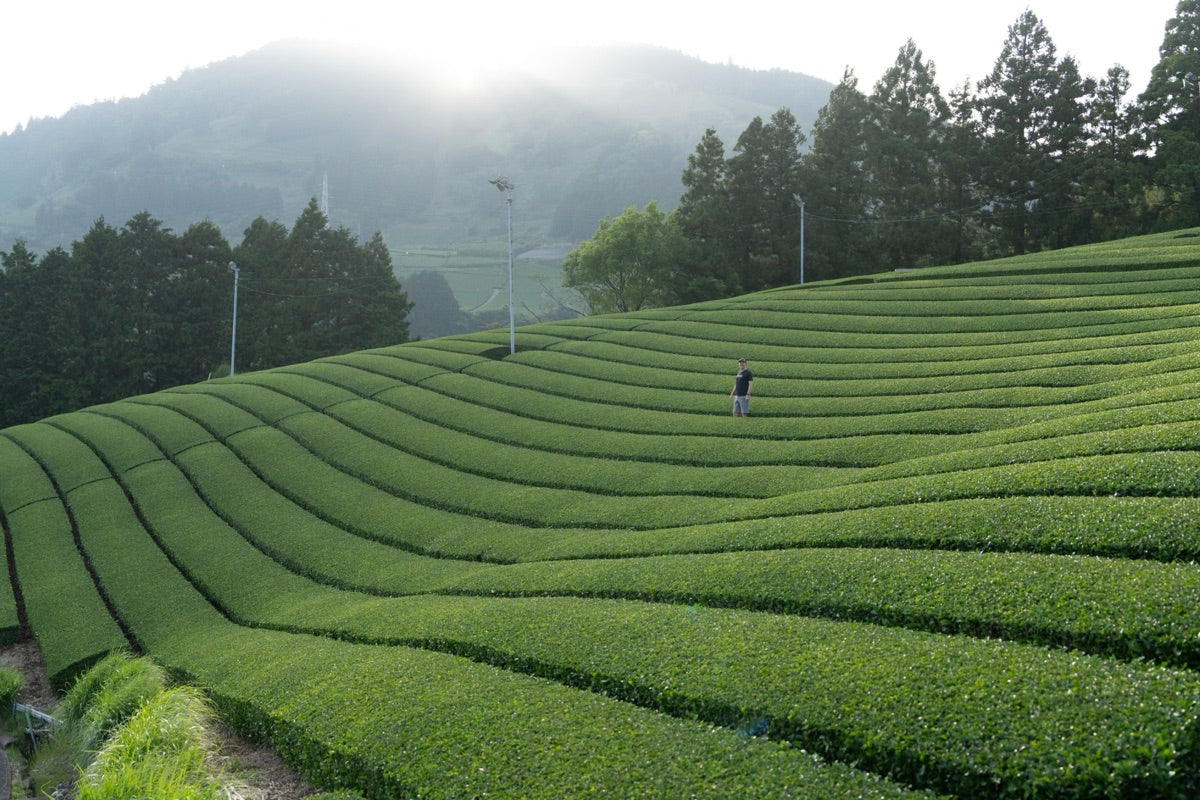
Kanaya sits on the edge of the Makinohara plateau in Shizuoka, and it is the address behind a long list of Japanese cultivars. If you have read our piece on the Shizuoka tea region, you already know the landscape this plant came out of.
We track the production side: prefecture by prefecture production figures.
Where the name Meiryoku comes from

Meiryoku is written 茗緑, and it points at colour. 緑 is green, and the name was given for the bright, clean green the cultivar produces. The World Green Tea Association's profile describes its colour as bright and beautiful and its aroma as refreshing (世界緑茶協会).
Naming a plant after its colour is a quiet admission of what the breeders were proudest of. Not depth, not aroma, not umami. Colour. Read the name and you already have a hint about where this cultivar's strengths were understood to sit.
Why breeders worried about Meiryoku's flavour, and why that verdict flipped

This is the part of Meiryoku's story I find genuinely interesting, and it is the reason this article exists.
The World Green Tea Association's profile, reprinted from the monthly journal Cha published by the Shizuoka Tea Industry Conference, puts it plainly. At the time it was bred, there was concern that Meiryoku had little umami and that its taste was thin. Then it says the verdict reversed. That same quality came to be read as clean and free of quirks, which suited contemporary tastes, and it is now evaluated favourably (世界緑茶協会).
Nothing about the plant changed. The panel changed. A cup that reads as "lacking" against a standard built on thick umami reads as "clean" against a standard built on drinkability. Over those decades, Japan's domestic palate moved toward lighter, everyday, less insistent tea.
A single-cultivar specialist that sells Meiryoku today rates it umami 3 out of 5 and astringency 3 out of 5. Koku, the word for body or richness, gets only 2 out of 5. Their description is a well-balanced tea, natural and unaffected, liked across ages (心向樹). Low body, middling everything else. The old criticism and the modern compliment are describing the same cup.
I want to be careful here, because this is exactly the kind of story that tempts people to invent numbers. You will find claims online that Meiryoku carries more amino acids than Yabukita. I could not source that, and it sits badly against a primary description of weak umami, so I am not going to repeat it.
Z1: the parent that never got a name
Meiryoku's mother is Yabukita, the cultivar that covers most of Japan's tea land. We have written about Yabukita and how one plant became most of Japanese tea, so I will not repeat it here.
The father is the interesting one. The register does not give a name. It writes Z1, a breeding code, where for other cultivars it happily writes やぶきた or あさつゆ or ゆたかみどり. Z1 never received a cultivar name or a Chanorin number of its own, yet it is a parent of two registered cultivars. Besides Meiryoku, it is the mother of 茶農林41号 ふうしゅん, Fuushun, crossed with Kanayamidori and registered in 1991, also at Kanaya (茶農林登録品種一覧).
Unnumbered plants that matter are a running theme in Japanese tea, and we covered it properly in our piece on Samidori, the Uji cultivar with no number. What is different here is that you can taste the parent. Z1 is sold as a tea in its own right, described as vigorous and powerfully flavoured with an appealing coffee-like bitterness, rated koku 3 out of 5 (心向樹).
So the bold, bitter, unnamed parent produced a child known for tasting of nothing in particular. Breeding is not blending, and that is the whole lesson in one line.
One caution. Some sources online identify Z1 as the cultivar Yamatomidori. The register writes only a code, and the specialist shop above lists Z1 and Yamatomidori as two separate teas. I cannot verify the claim, so I am leaving Z1 as the register leaves it.
What Meiryoku asks of the grower

If Meiryoku had been bred for the drinker it might have disappeared. It was bred for the person farming it, and on that scorecard it does well.
It grows vigorously with many branches, comes into full production early, is easy to train, and is easy to grow. Its cold resistance is strong. It is strongly resistant to anthracnose (炭疽病) and ring spot (輪斑病), two of the important leaf diseases, and control measures for those are almost unnecessary. Red-scorch disease (赤焼病) can appear on young plants, but it rarely shows on mature ones (世界緑茶協会).
As an organic brand, that paragraph is the one I read twice. A plant that does not need spraying for its two big diseases is a plant that makes organic farming less of an argument and more of a default.
There are two catches, and the same source is honest about both.
The first is appetite. Meiryoku is what growers call 肥料食い, a fertiliser eater. Fed the same as Yabukita, both its taste and its colour come out thinner. Over-fertilising has been a real problem in the Japanese tea industry, and the article's advice is not to chase richness with more feed. Make your rich teas from other cultivars, and work with Meiryoku's refreshing aroma and taste instead (世界緑茶協会).
The second is timing, and it is unforgiving. Meiryoku is classed as mid-season but it is strictly one to two days earlier than Yabukita. Its buds grow fast and resist opening out, so the picking window is easy to miss. Picked slightly young the leaf rolls well and the internal quality is better. Past the right moment, quality drops off extremely, so the recommendation is to pick another one to two days earlier still (世界緑茶協会).
Then comes the part that explains why anyone plants it. Meiryoku yields heavily, so even picked early it still secures more volume than Yabukita. The grower gets to market two to three days ahead, and even if the unit price slips a little, the revenue comes out ahead (世界緑茶協会). That is not a flavour argument. It is a farm business argument, and it is the honest reason this plant exists.
Where Meiryoku actually grows, and why a drought put it there

Meiryoku is a small cultivar. In the account we are working from, the planted area in Shizuoka is 26.8 hectares, with about 13 hectares in Kagawa and about 7 hectares in Kochi (世界緑茶協会).
The Shikoku numbers have a story behind them. According to the same profile, Meiryoku's spread through Shikoku began with a drought, which the account dates to 1993. In Kagawa, Meiryoku held up when water ran short, and from then on the prefecture actively promoted it, growing the area to about 13 hectares. Kochi designated it a recommended cultivar in 1998, and it is grown across roughly 7 hectares in cold highland districts including Higashitsuno. It has also been introduced in Okinawa (世界緑茶協会).
A note on that year, because precision matters. The account says 1993. The drought Japan actually remembers is the 1994 Heisei drought, which hit Shikoku hardest. I am reporting the year the source gives rather than asserting it myself.
Either way the pattern holds, and it is unusual. Most cultivars spread because somebody liked the cup. Meiryoku spread because it survived a bad year, then kept going into cold uplands and a subtropical island. Cold hardy, drought hardy, disease resistant. Those are the traits that carried it, and none of them are about taste.
Highland tea is its own subject. If you want to see what elevation does to a cup, our visit to Houkouen's mountain garden at 350 metres in Ryogochi is the clearest example we have.
What does Meiryoku taste like, and will you see it on a tin?
Expect a bright, clean cup with a refreshing aroma and good colour, moderate umami, moderate astringency, and noticeably little body. The specialist rating of koku 2 out of 5 is the number that tells you the most (心向樹). If you like a sencha that gets out of its own way, this is that. If you drink tea for thick, savoury depth, it is not.
Will you see the name? Almost certainly not. At the scale above, Meiryoku is a rounding error against Yabukita, and small-area cultivars usually disappear into blends where their job is to lift colour or bring the harvest forward. Our guide to what sencha actually is covers how those blends get built.
To be direct about our own shelf: we do not sell a single-cultivar Meiryoku. We are not going to invent a connection to a plant we do not stock. What we do sell is organic Japanese tea from named growers. If you want to understand what is actually in your cup, start with the full cultivar guide.
Frequently asked questions
What is Meiryoku tea?
Meiryoku is a Japanese green tea cultivar registered as 茶農林35号, bred at Kanaya in Shizuoka and entered in the national register in 1986 for use as sencha. Its recorded parentage is Yabukita crossed with a line called Z1.
Is Meiryoku a matcha cultivar?
No. The national cultivar register lists its intended use as 煎茶, sencha, which is leaf tea rather than the shaded tencha that becomes matcha.
What does Meiryoku mean?
It is written 茗緑 and refers to a bright green colour, which is the quality the cultivar was named for.
Is Meiryoku high in amino acids?
We could not verify that claim. The available primary description says the opposite, that at breeding time it was considered low in umami with a thin taste, so we do not repeat the amino acid claim.
Why is Meiryoku easy to grow?
It grows vigorously, comes into production early, handles cold well, and is strongly resistant to anthracnose and ring spot, so control measures for those two diseases are almost unnecessary. It does need more fertiliser than Yabukita to avoid a thinner taste and colour.
When is Meiryoku harvested?
It is classed as mid-season but picks one to two days earlier than Yabukita. Growers are advised to pick one to two days earlier still, because quality falls sharply once the window passes.
Where is Meiryoku grown?
Mainly Shizuoka, with smaller areas in Kagawa and in cold highland districts of Kochi, where it was named a recommended cultivar in 1998. It has also been introduced in Okinawa.
Can I buy single-cultivar Meiryoku?
A few Japanese single-cultivar specialists sell it, but it is rare. We do not stock it, and you are far more likely to drink it inside a blend than to see it named.
A note from me

I have walked the Makinohara plateau, the landscape Kanaya sits on the edge of. I have also sat in mountain gardens in Shizuoka with growers who name every cultivar in every row. Not once has anyone poured me a cup and said the word Meiryoku. That is not a slight against the plant. It is what a 26.8 hectare cultivar looks like from the ground.
What stayed with me while writing this is how much a tasting note depends on who is holding the cup and when. Meiryoku got marked down for being quiet. Then quiet became something people wanted. There's a lesson in that which goes well past tea, and it is worth sitting with for a moment before the next sip.
Sources
- 附表1 茶農林登録品種一覧 (Register of Chanorin tea cultivars), the registry table giving Meiryoku's number, line name, pedigree, breeding year, station and intended use.
- めいりょく, 公益財団法人 世界緑茶協会 (World Green Tea Association), reprinted from the monthly Cha, Shizuoka Tea Industry Conference, by Namiko Ikeda. Quality assessment, cultivation and processing notes, and planted areas.
- めいりょく, 心向樹 (Shinkoju), single-cultivar tea specialist. Tasting ratings for umami, astringency and koku.
- Z1, 心向樹 (Shinkoju). Tasting description of the parent line.
Share:
Kanayamidori: The Shizuoka Cultivar That Found Its Home in Kyushu
Matcha Tested for Heavy Metals: What 2026 Lab Reports Show