



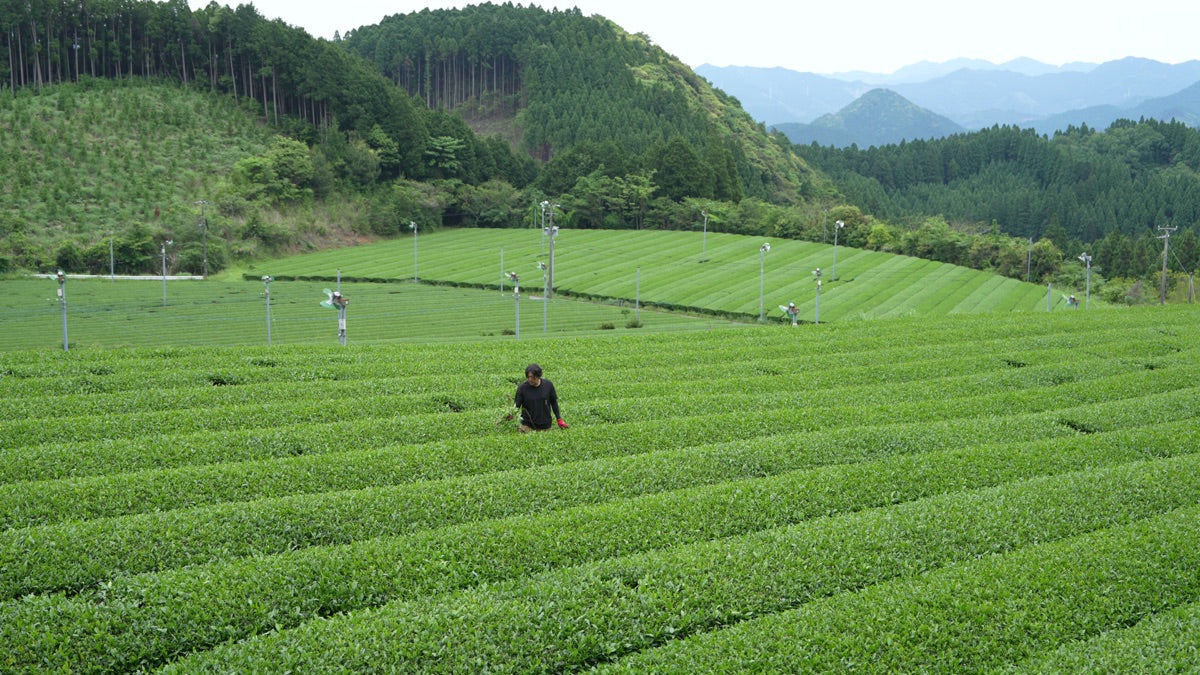
by Christian, founder of One with Tea
Okuhikari is a Japanese green tea cultivar bred and registered by Shizuoka Prefecture in 1987, from Yabukita crossed with a Chinese-type line recorded only as 静Cy225 (中村順行, University of Shizuoka Tea Science Research Center). It buds five days after Yabukita, it is built for cold, and it makes a cup whose colour is rated superb.
Here is the part that made me want to write it up. Okuhikari has one honest fault, and the fault is geographic. On ordinary ground the tea tastes more astringent than its beautiful liquor leads you to expect. Move it uphill and that astringency softens. So this is a plant that is only fully itself on steep, cold, awkward land, and a group of growers in Kawane took that literally. They stopped treating it as a cultivar and started treating it as an address.
Key Takeaways
- Okuhikari is a Shizuoka Prefecture cultivar registered in 1987, bred from Yabukita and a Chinese-type line coded 静Cy225.
- It buds five days after Yabukita, and unlike most late cultivars it is also genuinely cold-hardy rather than just well-timed.
- Its liquor colour is rated extremely good, but it carries more astringency than that colour suggests, and mountain ground is what softens it.
- It is fragile in exactly two ways: red-scorch and red leaf blight. Everything else on the disease list, it shrugs off.
- Kawane growers in upper Shizuoka built a regional brand on it, 天空の茶産地 "奥光", marketing their district as a tea country in the sky.
- We do not sell a single-cultivar Okuhikari. This is a sencha plant, and you are unlikely to see the name on a tin outside Japan.

What is the Okuhikari tea cultivar?
Okuhikari is a late-season Japanese green tea cultivar bred for sencha, registered in 1987 by Shizuoka Prefecture. The breeding record gives its pedigree as やぶきた × 静Cy225, rates its season as late at plus five days, rates its yield as medium, and describes its quality as deep green with strong lustre, an individual aroma, an extremely good liquor colour, and a taste that runs somewhat soft (中村順行, University of Shizuoka Tea Science Research Center).

From our tea room
Superior Sencha Green Tea - USDA Organic Japanese First Flush
First-flush loose leaf, USDA Organic, direct from Japanese family farms.
View Superior SenchaThe fuller profile of Okuhikari, written by the same researcher, 中村順行, and reprinted by the World Green Tea Association from the monthly journal Cha, puts the lateness at five to six days behind Yabukita. It describes an upright plant with strong vigour, large long-elliptical mature leaves in a glossy deep green, and a yield on a par with Yabukita rather than merely medium (世界緑茶協会).
I am giving you both yield readings on purpose. One record says medium, the other says level with Yabukita, and I would rather hand you the disagreement than quietly pick the flattering number.
One more structural detail that shapes everything downstream: Okuhikari is a heavy-bud type, 芽重型. It does not throw many shoots, but the shoots it throws are heavy. That single trait explains most of what growers have to do to it, and we will come back to it.
| Trait | Shizuoka breeding record | World Green Tea Association profile |
|---|---|---|
| Registered | 1987, Shizuoka Prefecture | not stated |
| Pedigree | やぶきた × 静Cy225 | not stated |
| Season vs Yabukita | late, plus five days | late, five to six days later |
| Yield | medium | on a par with Yabukita |
| Plant habit | upright, strong vigour | upright, and more so than Yabukita |
| Bud type | heavy-bud type, few buds | heavy-bud type, needs pruning for bud count |
| Cold | strong against red-wither and split-type freeze injury | stronger than Yabukita on both, and dodges frost by budding late |
| Strong against | blister blight; somewhat strong against anthracnose and ring spot | anthracnose, ring spot and blister blight |
| Weak against | red-scorch, red leaf blight | very weak against both |
| Liquor colour | extremely good | bright, powerful, extremely good |
| Taste | runs somewhat soft | more astringent than the colour suggests, softened on mountain ground |
| Recorded area | 101.8 hectares in Shizuoka, 2008 | not stated |
Okuhikari's parents: half Yabukita, half Chinese
Okuhikari's mother is Yabukita, which will surprise nobody. Yabukita is the parent of most of modern Japanese tea, and we have written about how one plant became the majority of a national crop.
Okuhikari's father is the interesting half. The Shizuoka breeding record writes 静Cy225, a Shizuoka breeding code for a Chinese-type line, and a merchant profile dates the cross to 1964 with the cultivar bred out in the 1985 financial year (葉桐). That merchant dating is worth treating as a merchant dating rather than as record. The registration year of 1987 is the figure I would stand behind.
What matters more than the dates is where this puts Okuhikari in the family. The Shizuoka breeding programme sorts its work into groups, and Okuhikari sits in the Japanese-crossed-with-foreign group, alongside Soufuu and Fujikaori, rather than in the Japanese-crossed-with-Japanese group where most famous green tea cultivars live (中村順行).
That grouping is worth pausing on. Reaching outside the Japanese gene pool for a parent is how breeders have historically gone looking for traits the domestic lines were short of, cold tolerance among them, and it is a route that keeps producing cultivars with unusual aromatics. If you have read our piece on Soufuu and its jasmine-like aroma, you have already met one of them. I would not claim the records prove Okuhikari's individual aroma comes from its Chinese parent, because they do not say so. I would only say that its two most-remarked traits, the cold hardiness and the aroma that does not taste like Yabukita, are both things this branch of the programme was reaching for.
Why Okuhikari only makes sense on a mountain

Late budding is normally a scheduling trick. The shoots emerge after the late frost window has closed, so the frost never meets anything tender. That is real, and it is why so many Japanese cultivars are bred late. We made this argument properly in our piece on Okumidori and Gokou, and we were careful there to say that late budding buys you timing, not toughness. Okumidori's own trial data rates its tolerance of split-type freeze injury as only moderate.
Okuhikari is the counter-example to that rule, and this is why it is worth its own article. Okuhikari gets the timing advantage of a late cultivar, and it is also rated stronger than Yabukita against red-wither and against split-type freeze injury (世界緑茶協会). The schedule and the constitution point the same direction. On a cold hillside, that combination is the whole argument for planting it.
The disease profile is where it gets sharp. Okuhikari is rated strong against blister blight and somewhat strong against anthracnose and ring spot in the breeding record, and the World Green Tea Association profile simply calls it strong against all three. Then it collapses in exactly two places. It is very weak against red-scorch and very weak against red leaf blight.
Read that shape and the planting decision writes itself. A cultivar that laughs off cold and the common leaf diseases, and fails against two specific bacterial and fungal problems, belongs where cold is the daily threat and where those two are manageable with attention. That is mountain land. It is also, not coincidentally, land that grows tea badly by every other measure.
The fault line: a cup that looks better than it tastes, until you move it uphill

Okuhikari's cup looks better than it tastes on the wrong ground, and that is the honest centre of this plant. A cultivar article that only lists strengths is an advert, so here is the fault.
The made leaf takes a hard, tight, sword-like needle, 剣のたった堅く締まった茶, in a deep green with a bright lustre. The liquor is bright, it has power, and it is rated extremely good. And then the same profile says the taste shows somewhat more astringency than the liquor colour would suggest, and adds that in mountain districts it is softened (世界緑茶協会).
That one sentence is the hinge of this whole plant. The gap between how good the cup looks and how it lands on the tongue is Okuhikari's problem, and altitude is the fix. Not a processing trick, not a blending correction. Ground.
There is a processing lever, and it costs something. The same source suggests that if the astringency makes the tea hard to sell, leaning towards a deeper steam helps. Then it immediately notes that the deep green colour makes Okuhikari a poor fit for fukamushi. So the fix works against the cultivar's single best asset. If you want to see what committed deep steaming looks like when a tea is actually suited to it, we walked through it with Ichikawa-en in Makinohara.
What I like about this cultivar is that it is not versatile and it does not pretend to be. Most plants get sold on adaptability. Okuhikari is the opposite. It has one right answer, and if you are not standing on a slope you are not going to find it.
What Okuhikari asks of the grower

Two things, and both come from the plant's shape (世界緑茶協会).
- Train it wider than you would Yabukita. Okuhikari grows markedly more upright, so growers are told to shape the bush outward rather than let it climb.
- Prune for bud count, not bud size. Because it is a heavy-bud type with a low bud count, the pruning has to raise the number of shoots. Left alone, Okuhikari gives you fewer, heavier buds than a picking machine wants.
Then there is the red-scorch problem, which is not theoretical. Because Okuhikari is so weak to it, young plants and naturally-trained gardens need careful, thorough control. A cultivar that is easy in its mature years can still be demanding in its first ones, and a grower planting a new mountain block is signing up for that early attention.
Okuhikari was also meant to be planted in sequence rather than alone. The profile recommends it specifically for combination planting after mid-season Yabukita (世界緑茶協会). The reason that matters, and this part is my reading rather than the record's, is that a five to six day gap lets one crew and one factory work two harvests instead of colliding with themselves. That is the same logic behind most of the cultivar mix across the Shizuoka tea region, and it is a different kind of value from anything that shows up in a cup.
If that pattern feels familiar, it is the same one we found in Meiryoku: a plant whose case is made to the farmer first and the drinker second.
How Kawane turned a cultivar into a place
Kawane growers turned Okuhikari from a cultivar into a regional identity, which is something I have not seen any other Japanese tea cultivar do.
In the upper Ōi river country of Shizuoka, growers in the Kawane district took Okuhikari and made it the axis of a regional identity. The Kuboo area markets itself as 天空の茶産地 "奥光", which reads as a tea-producing country in the sky, writing the cultivar's name in kanji as 奥光. The stated aim is to position it as the pivot of Kawane tea's whole marketing strategy and to drive the district's revival. The slogan attached to it translates as: turn the mountain land into a village in the sky (中村順行, University of Shizuoka Tea Science Research Center).
Look at what that move actually does. Okuhikari's limitation is that it needs altitude. Kawane's limitation is that it is steep, cold, remote country where flat-land economics do not work. Put the two limitations together and they cancel. The thing that makes the tea hard to grow anywhere else is the thing that makes it worth growing there, and the district gets to sell its geography instead of apologising for it.
Growers in Kawane-honchō do sell it under their own names and enter it in competitions (土屋農園). The same mountain logic runs through our profile of Houkouen's mountain tea at 350 metres, where the altitude is the product rather than an obstacle to it.
The area figures are modest and they should be read as dated. The Shizuoka lecture puts Okuhikari's production at 101.8 hectares within the prefecture in 2008, and the prefectural series in the same document runs across its readings between 61 and 103 hectares, with the two most recent readings at 100 and 101. Every one of those is a snapshot from the year it was taken and none of them is a current figure. Against a prefecture measured in the tens of thousands of hectares, Okuhikari is a rounding error that a whole valley built an identity on.
What does Okuhikari taste like, and will you see it on a tin?

The honest answer to the first question is that the record describes the aroma as individual and unlike Yabukita's, and stops there. It does not tell you what it smells of (世界緑茶協会). I find that restraint more useful than a confident adjective, because the people who actually sell it do not agree with each other.
- A Shizuoka merchant selling an unsprayed Okuhikari grown at 250 metres describes soft astringency with a clean, refreshing sweetness, and a sharp flavour they compare to citrus and kiwi (葉桐).
- A Kawane-honchō grower describes the opposite temperature: a mild, rounded taste with an aroma that suggests herbs (土屋農園).
Sharp citrus and rounded herbs are not the same tea. Both descriptions are first-hand, and both are from people with the leaf in front of them. What that spread tells you is that Okuhikari is strongly expressive of where and how it is grown, which is exactly what you would expect from a plant whose flavour depends on altitude.
You will find it picked around mid-May in Shizuoka, later than the famous first-flush window that most imported Japanese tea is sold on.
As for the tin: probably not. Okuhikari is a sencha cultivar, so it belongs to the world of leaf tea rather than shaded tencha and matcha. We do not sell a single-cultivar Okuhikari. Outside Japanese single-cultivar specialists and the Kawane growers themselves, the name mostly travels inside blends, unnamed. That is the normal fate of a hundred-hectare cultivar, and it is why the hub page we keep for Japanese tea cultivars exists at all.
Frequently asked questions
What is Okuhikari tea?
Okuhikari is a Japanese green tea cultivar bred and registered by Shizuoka Prefecture in 1987, from Yabukita crossed with a Chinese-type line coded 静Cy225. It is a late cultivar grown for sencha, best suited to mountain districts.
Is Okuhikari a matcha cultivar?
No. It is grown and processed as sencha, which is leaf tea, not the shaded tencha that gets milled into matcha.
How late is Okuhikari compared with Yabukita?
Five days later in the Shizuoka breeding record, and five to six days later in the World Green Tea Association profile. That places its picking in Shizuoka around the middle of May.
Is Okuhikari frost-resistant?
It is unusually well protected on both counts. Budding late means the new shoots emerge after the worst of the frost window, and the plant itself is rated stronger than Yabukita against red-wither and split-type freeze injury. Most late cultivars only get the timing advantage.
What diseases affect Okuhikari?
It is rated strong against blister blight and strong or somewhat strong against anthracnose and ring spot depending on which record you read. It is very weak against red-scorch and red leaf blight, and young plants in particular need thorough control for red-scorch.
What does the name Okuhikari mean?
It is written 奥光 in the Kawane regional branding. 光 means light, and 奥 carries the sense of deep or inner, which suits both a late-season plant and the remote upland country it is grown in.
Why does Okuhikari taste better in the mountains?
Its recorded fault is that the taste carries more astringency than the excellent liquor colour would lead you to expect. The same source notes that in mountain districts this is softened, which is why its recommended growing area is upland rather than plain.
Can I buy single-cultivar Okuhikari?
A handful of Shizuoka merchants and Kawane growers sell it by name. We do not stock it, and outside Japan it is far more likely to reach you inside a blend than on a label.
A note from me

I keep coming back to how narrow this plant is. Breeders usually chase width, a cultivar that behaves anywhere and forgives most mistakes. Okuhikari does not. It gives you an outstanding-looking cup that tastes slightly wrong on the wrong ground, and something quite different on the right one.
What Kawane did with that is the bit worth borrowing. They had a plant with a condition attached and they made the condition the story. The tea is from the sky. Come and see where it grows. That is not marketing invented over a plant, it is marketing that matches what is true about it, which is the only kind that survives contact with a customer.
We source matcha, so Okuhikari is not going to appear in our tins. I wrote it up because the cultivar hub should carry the plants that explain how Japanese tea actually thinks, not only the ones we sell. If you want the wider map, start at Japanese tea cultivars, and if you want the plant this one is half made of, read Yabukita.
Sources
- 中村順行, 静岡県立大学茶学総合研究センター, 「静岡県におけるチャの品種育成とその活用」: dfns.u-shizuoka-ken.ac.jp. Registration year, pedigree, season rating, resistance ratings, yield, quality description, prefectural area figures, and the Kawane 天空の茶産地 case study. Retrieved 2026-09-09.
- 公益財団法人 世界緑茶協会 (World Green Tea Association), 「おくひかり」, reprinted from 月刊「茶」 (静岡県茶業会議所), by 中村順行: o-cha.net. Plant habit, leaf and bud description, disease profile, appearance, liquor and taste verdict, cultivation and processing cautions. Retrieved 2026-09-09.
- 葉桐 (Hagiri), Shizuoka tea merchant, product page for an unsprayed Okuhikari: hagiricha.com. Merchant source. Cross year, breeding year, named parent line, picking date, tasting impression, growing altitude. Retrieved 2026-09-09.
- 土屋農園 (Tsuchiya Nōen), grower in Kawane-honchō: tsuchiya-nouen.com. Merchant source. Second tasting impression and Kawane growing location. Retrieved 2026-09-09.
Share:
Matcha Tested for Heavy Metals: What 2026 Lab Reports Show
Tsuyuhikari: The Shizuoka Cultivar Bred for Character