



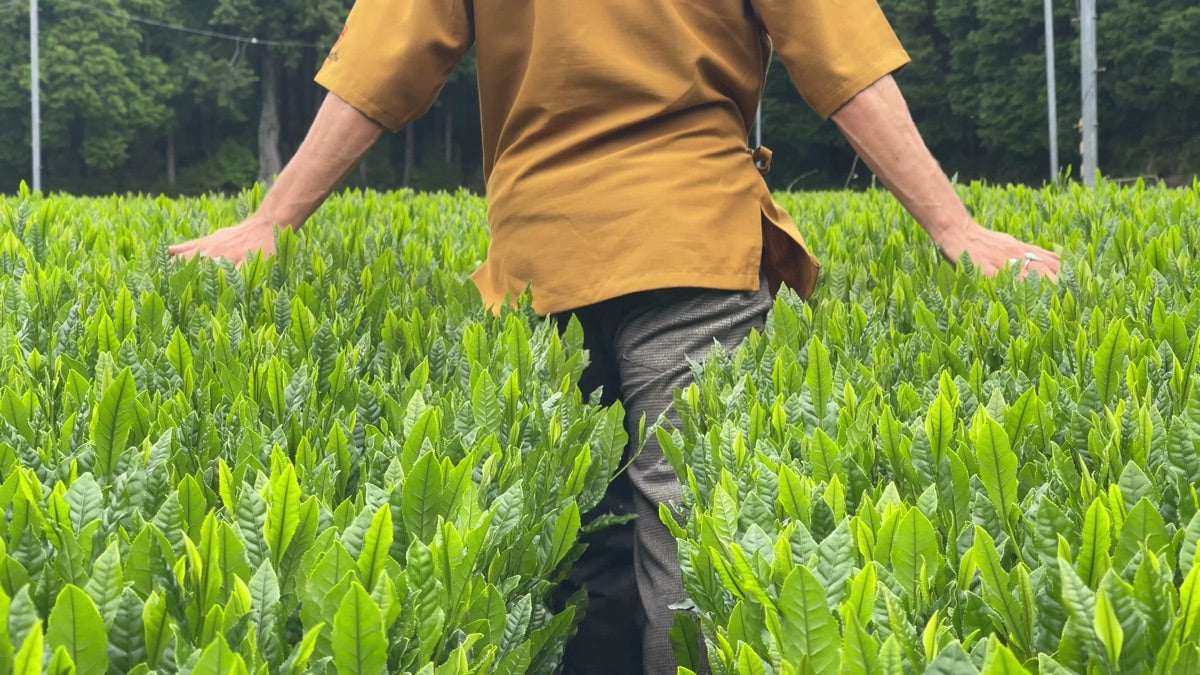
Matcha syrup is sweetened matcha made ahead, so one pour both doses and sweetens the drink. For a cafe, I'd start with 3 g of matcha and 12 g of sugar in every 30 ml pour, made to volume so each pour carries the same dose. Hold the batch covered at 41°F (5°C) or below, stir it before every pour, and plan to pour out what's left at close.
This guide is for cafe and boba operators, not home brewers. I'm Christian, founder of One with Tea, and I'll cover the dose, the method, and how long a batch can sit under the FDA Food Code. If you're still settling the dose itself, start with our guide to how much matcha powder goes in a cup.
Key Takeaways
- Pour 30 ml (about 1 fl oz) per drink. Made to volume, that pour carries 3 g of matcha and 12 g of sugar.
- Keep the matcha off the heat. A 2026 review of matcha processing reports that high temperatures and prolonged heating convert chlorophyll into duller pheophytins, so I'd cool the sugar syrup fully before the matcha goes in (Foods, 2026).
- Matcha is ground leaf, so it settles. Stir or shake the syrup before every pour.
- Hold it at 41°F (5°C) or below and pour out the rest at close. This recipe hasn't been lab-tested, and whether it counts as time/temperature control for safety (TCS) food is your health department's call.
- A bigger pour also sweetens the drink: 60 ml carries 24 g of sugar.

What is matcha syrup?
Matcha syrup is a sweetened matcha base made ahead, so one pour sets both the dose and the sweetness of a drink. In this recipe, each 30 ml pour carries 3 g of matcha and 12 g of sugar. It sits between unsweetened concentrate and the bottled syrups sold for coffee bars.
Our matcha concentrate guide covers the unsweetened version, where sugar stays a separate decision. For bottled syrups, read the ingredient list before the front label. US labels list ingredients in descending order of predominance by weight (21 CFR 101.4), so sugar before matcha means more sweetener than tea. Our Latte Grade (Organic) is 100% organic matcha, with no sugar, creamer or milk powder, so sweetness stays your call.
Matcha is made from tencha leaf that has been destemmed and deveined, then milled into an ultrafine powder (“Beyond Composition: Processing-Driven Transformations and Functional Trade-Offs of Matcha Tea in Foods,” Foods, 2026). It's ground leaf, so it disperses rather than dissolves. Sugar dissolves. Matcha doesn't. Every step below follows from that.
House syrup or dosing powder per drink: which fits your bar?
Make a house syrup if you sell one sweetness level on a high-volume iced menu. Dose powder or concentrate per drink if you sell sweetness levels or unsweetened orders. A syrup ties 12 g of sugar to every 3 g of matcha, which makes the pour fast and the sweetness fixed.
| Factor | House syrup | Powder dosed per drink |
|---|---|---|
| Speed at the bar | One stirred pour | Weigh or scoop, then disperse, in every drink |
| Sweetness control | Fixed: 12 g of sugar per 3 g of matcha | Set drink by drink |
| Unsweetened and alternative-sweetener orders | Needs a second, unsweetened base | Handled in the build |
| Sweetness levels | One level per batch | Any level you can build |
| Waste at close | Leftover syrup is poured out | Nothing mixed ahead |
| Date marking and holding | A batch to hold cold, label and discard on time | No batch to date-mark. Our storage guide advises finishing an opened package within 30 to 60 days for best flavor |
| Dose accuracy | Set once at the batch, if you top up to volume and stir | Set at every drink, by scale or scoop |
| Drinks it suits | Iced lattes, sodas and milk tea at one sweetness | Sweetness levels, unsweetened orders, straight whisked drinks |
There's a middle path: pair unsweetened concentrate with the simple syrup you already pour. You keep a batched dose and your own sweetness levels, at the cost of two pours per drink instead of one.
How much matcha syrup goes in each drink?

Pour 30 ml (about 1 fl oz) of matcha syrup per drink. Made to volume, that pour carries 3 g of matcha and 12 g of sugar, or 0.1 g of matcha and 0.4 g of sugar per ml. It sits at the low end of the 3 to 4 g latte dose in our matcha preparation guide. The 12 g of sugar is my starting point, a recipe choice and not a standard, so set it from your own menu and keep the matcha dose where it is.
If your recipe runs closer to 4 g, pour 40 ml: 4 g of matcha and 16 g of sugar, and every batch figure below grows by a third. At 0.1 g per ml, the matcha is in the same range as the guide's koicha, 4 g in 30 to 45 ml of water, so expect a thick pour and test it on your own pump.
Make it to volume
Make it to volume, not by adding a fixed amount of water. The sugar and matcha take up room of their own. Add 1.2 L of water to 480 g of sugar and 120 g of matcha and you'll overshoot the line, so every pour carries less than 3 g of matcha and 12 g of sugar. Mix in a marked container and top up to the line.
Scale the pour for bigger cups
A boba or milk tea cup can be larger than a latte cup, and the pour grows with the cup. At 0.1 g of matcha and 0.4 g of sugar per ml, 45 ml carries 4.5 g of matcha and 18 g of sugar, and 60 ml carries 6 g and 24 g. A bigger pour also sweetens the drink. Want a larger dose without the extra sugar? Dose powder or concentrate and sweeten separately.
Check your pump or jigger
Don't assume a pump or jigger delivers what it says. Pour ten times into a marked jug, read the total, and divide by ten. Dose in grams is pour in ml × 0.1, so a 20 ml pour is 2 g of matcha and 8 g of sugar. Write the pour count on the recipe card. No jug? Weigh ten pours of water, since 1 g of water is 1 ml.
Batch sizes
| Drinks in the batch | Matcha | Sugar | Top up to | Matcha share of a 1 kg bag |
|---|---|---|---|---|
| 20 | 60 g | 240 g | 600 ml | 6% |
| 40 | 120 g | 480 g | 1.2 L | 12% |
| 60 | 180 g | 720 g | 1.8 L | 18% |
| 80 | 240 g | 960 g | 2.4 L | 24% |
At 3 g a drink, 1 kg of matcha makes about 333 drinks, the same figure our matcha for cafes page plans around. Those drinks also use about 4 kg of sugar (333 × 12 g, rounded).
How do you make matcha syrup for a cafe?

To make matcha syrup for a cafe, dissolve the sugar in warm water, let it cool completely, then blend in sifted matcha and top up to the volume line, 30 ml per drink. For 40 drinks, that's 120 g of matcha and 480 g of sugar, topped up to 1.2 L. The matcha never goes near heat.
- Weigh the matcha and the sugar on a gram scale. That's 3 g and 12 g per drink.
- Dissolve the sugar in an equal weight of warm water. For 40 drinks, that's 480 g of sugar into 480 ml of warm water. Stir until clear, then let it cool completely before any matcha goes in. That's a precaution, since the Foods review reports heat dulling matcha's green in food processing (Foods, 2026).
- Sift the matcha, then make a paste. Sifting breaks up the small clumps that form naturally, as our preparation guide notes. Blend or whisk it with a little of the cooled syrup until no dry pockets are left.
- Combine, then top up to the volume line. Add cold filtered water to the line: 30 ml per drink, or 1.2 L for 40 drinks.
- Bottle it covered and label it with the time you made it and the time to discard it.
- Hold it at 41°F (5°C) or below, as if it were TCS food. That's the cold-holding temperature the Food Code sets for TCS food (FDA Food Code 2022, §3-501.16).
- Stir or shake before every pour. The powder is ground leaf, and it settles.
- Keep milk, citrus and fruit out of the batch. They go in at the build.
Skip the stove. On the day I checked the results for this keyword (US Google, October 7, 2026), one recipe heats the matcha in a saucepan with the sugar over medium heat, and another stirs a matcha paste into warm syrup. For a cafe, I'd keep the matcha off the heat.
The 2026 Foods review reports that high temperatures and prolonged heating accelerate the conversion of chlorophyll into pheophytins, with color dulling and brown hues as the result (Foods, 2026). It covers food processing such as baking, not warm sugar syrup, so cooling the syrup first is a precaution on my part, not a measured threshold.
Separately, our own guide to the best temperature for matcha says water hotter than about 185°F (85°C) scorches the fine powder and turns it bitter. I haven't tested those recipes, so I can't speak to their taste. I can tell you why I'd keep matcha away from the stove.
How long does matcha syrup last?
Plan on one shift, or one day at most, held covered at 41°F (5°C) or below, and pour out what's left at close. This recipe hasn't been lab-tested or shelf-life tested, so I won't hand you a longer number.
Don't count on the sugar to keep it. The 1:1 syrup in step two is half sugar by weight, but the matcha and top-up water share the finished mix, so sugar is a smaller share. Hold it as a perishable.
What the FDA Food Code says
The FDA Food Code is a model code that FDA offers for adoption by local, state and federal governments. It is not federal law on its own, so the version your inspector enforces may differ. Under the 2022 edition, three rules matter:
- Cold holding: time/temperature control for safety (TCS) food is held at 41°F (5°C) or below (§3-501.16).
- Time instead of temperature, up to 4 hours: for TCS food held without temperature control, the food starts at 41°F or below, you keep written procedures ready for your inspector, you mark the time 4 hours out, and you serve or discard it by then (§3-501.19).
- Date marking, for TCS food only: refrigerated, ready-to-eat TCS food held more than 24 hours is marked with the day by which it must be consumed, sold or discarded. The maximum is 7 days at 41°F, with the day of preparation counted as Day 1 (§3-501.17). Made on Monday means Sunday at the latest. That is a legal ceiling for TCS food, not a shelf life for this syrup, and the plan I'd run is one shift, or one day at most.
So is a matcha syrup TCS? That's a call for your local health department. The Food Code's definition includes a plant food that has been through a heating step. It also uses tables of water activity (aw) and pH, where some combinations are not TCS and others are marked "Product Assessment required." A matcha syrup falls somewhere in that picture, and this recipe's aw and pH haven't been measured. So I'd hold it as if it were TCS. If you want a hold longer than a shift, ask your health department what they'd want to see for the recipe.
What happens to color and flavor
Color and flavor are the part of the clock you can see. The 2026 Foods review reports that chlorophyll degrades into duller pheophytins under hot and acidic conditions, and that oxygen exposure during processing and storage contributes to pigment degradation (Foods, 2026). Products with heavy chlorophyll loss often look dull or brownish and taste more bitter. So I'd keep the syrup cold and lidded. The review names acidic foods such as fermented dairy and yogurt as a driver, and citrus is acidic too, so I'd add it at the build and keep it out of the bottle. The same review says excessive amounts of matcha can intensify bitterness in foods that contain it, so weigh the pour.
Here's the plan I'd run. Batch for a shift or a day and pour out the rest at close. If you want a longer hold, get your health department's answer first, including whether they want the recipe's water activity and pH measured.
Once you have an approved hold, set a lidded jar aside in the fridge and compare it with a fresh batch at the end of that hold, checking color, smell and taste with your team. A tasting only tells you about quality. It says nothing about safety, so a syrup that tastes fine past its approved date still gets discarded. Day 7 is the Food Code's date-marking ceiling for TCS food, not a promise that this syrup is good that long.
How do you build lattes, sodas and milk tea with matcha syrup?
Build with the syrup first and the milk or sparkling water last. A 30 ml pour puts 3 g of matcha and 12 g of sugar in the cup before anything else goes in, so the rest of the drink is volume. Stir or shake the syrup before every pour, even mid-rush, and test each build on your own bar.
- Iced latte: syrup, ice, then milk. The sugar is already in the pour, so taste before you add anything sweet.
- Matcha soda: syrup, ice, sparkling water, then stir once. Keep citrus for the build, never the batch.
- Milk tea: scale the pour to the cup, and the sugar scales too. 45 ml is 4.5 g of matcha and 18 g of sugar, and 60 ml is 6 g and 24 g. If your menu runs sweetness levels, the syrup can't flex, so use powder or concentrate for those drinks.
Which matcha grade works best for syrup?

Use Latte Grade (Organic) for the volume drinks you pour all day and Ceremonial (Organic) for straight whisked drinks and signature drinks where the tea leads. Both are USDA Organic and stocked in our US inventory. A house syrup is a volume tool, so Latte Grade is where I'd start.
Run a blind tasting with your own milk and syrup before you commit. Our guide to the best matcha for cafes and restaurants covers grade choice, and the matcha latte profit margin worked example covers the cost side.
The same numbers drive your order. At 80 syrup drinks a day and 3 g each, a bar uses 240 g of matcha and 960 g of sugar a day, so 1 kg of matcha lasts a little over 4 days. Four weeks open seven days a week comes to 6.72 kg, rounded up to a 7 kg order. Our matcha order calculator runs that math for any menu: enter drinks per day, grams per drink and open days. Keep the open bag sealed and cool, as covered in our guide to storing matcha powder.
Frequently asked questions
How much sugar goes in matcha syrup?
In this recipe, 12 g of sugar goes in with every 3 g of matcha, so each 30 ml pour carries both. A 40-drink batch is 480 g of sugar and 120 g of matcha, topped up to 1.2 L. Cool the sugar syrup completely before the matcha goes in.
Does matcha syrup need to be refrigerated?
Yes, hold it at 41°F (5°C) or below, the FDA Food Code's cold-holding temperature for time/temperature control for safety (TCS) food. Whether this syrup counts as TCS is your local health department's call, and the recipe hasn't been lab-tested, so hold it as if it did. Pour out what's left at close.
How much matcha syrup goes in a latte?
A 30 ml (about 1 fl oz) pour carries 3 g of matcha and 12 g of sugar, one drink's dose. Add ice and milk to your cup size. If your recipe uses 4 g of matcha, pour 40 ml, which brings 16 g of sugar.
Can you use matcha syrup in sodas and milk tea?
Yes. For a soda, build syrup, ice, then sparkling water, and stir once. For milk tea, scale the pour to the cup: 45 ml carries 4.5 g of matcha and 18 g of sugar, and 60 ml carries 6 g and 24 g. The sugar scales too.
Is matcha syrup the same as matcha concentrate?
No. Concentrate is matcha and water, so sweetness stays your call. Matcha syrup adds sugar, so each pour carries both: 3 g of matcha and 12 g of sugar per 30 ml here. US labels list ingredients by weight in descending order, so sugar before matcha on a bottle means more sweetener than tea.
Wholesale matcha for your syrup program
If you're setting up a matcha syrup program, our wholesale terms are built for it. In-stock bulk starts at 1 kg and ships from our US inventory, so you can test a syrup on your menu without a big first order. Samples are available on request, and the sample terms come with your written quote.
When you buy through a broker, you're trusting a middleman's word on quality. When you buy from us, you're buying from someone who stood in the field where your tea was grown.
Submit the quote request form and my current price sheet opens right away. I read every quote request myself, and your written quote follows within 2 business days.
See matcha for cafes Request a quote and samples
Running a boba or milk tea shop? Grades and terms for your menu are on matcha for bubble tea shops. Want your order size first? The order calculator turns your daily drinks into kilograms.
The regional picture is here: our map of Japanese tea production by prefecture.
Share:
Matcha Concentrate for Cafes: Batch It Before the Rush
How to Make Matcha Without a Whisk at Cafe Volume