



Matcha concentrate is matcha powder mixed into a small amount of water before service, so every drink gets one measured pour instead of its own whisk. For a cafe, the working recipe is 3 g of matcha per drink, made to volume at 1:10 (1 g of matcha per 10 ml of finished concentrate), so every 30 ml pour carries one dose. Hold the batch covered at 41°F (5°C) or below, stir it before every pour, and plan for it to be gone within one rush, about four hours.
This guide is written for cafe and boba operators, not home brewers. It covers the ratio, the method, how long a batch lasts and why, and how to size each batch from your own sales. I'm Christian, founder of One with Tea. We import organic Japanese matcha and sell it wholesale, so I care as much about how your matcha tastes at 2 pm as at 7 am. If you're still settling the dose itself, start with our guide to how much matcha powder goes in a cup.
Key Takeaways
- Pour 30 ml (about 1 oz) of concentrate per drink. Made to volume at 1:10, that pour carries 3 g of matcha.
- Matcha is milled leaf, not an extract, so it settles. Stir or shake the batch before every pour.
- Hold it at 41°F (5°C) or below. If it sits on the bar without refrigeration, the FDA Food Code caps that at 4 hours from when it leaves the fridge, with written procedures and a discard time marked.
- The CDC's 1996 iced tea guidance says brew at 195°F and store no longer than 8 hours. Matcha is mixed cooler than that and the leaf stays in, so don't lean on brewed tea's limits.
- Batch for the rush, not the day. Heat, acid and oxygen all dull matcha's green (Foods, 2026), so keep milk, sweetener and citrus out of the batch and add them at the build.

What is matcha concentrate?
Matcha concentrate is a dense mix of matcha powder and water, made ahead so a barista can pour a measured dose into milk, water or ice. It does the job a shot of espresso does in a latte: the strong part of the drink, ready before the order comes in.
Two different things share the name. The first is what this guide covers: concentrate a cafe batches from its own powder at the start of a shift. The second is the bottled product on store shelves, a finished liquid with its own ingredient list that you dilute by the ratio on the label. They behave differently behind the bar, and there's a section on choosing between them further down.
Batched concentrate is still just matcha. Matcha is made from tencha leaf that has been destemmed and deveined, then milled into an ultrafine powder (Foods, 2026). That powder is ground leaf, so it disperses through the water rather than dissolving into it. Leave a batch standing and the powder sinks, which is why the stir before each pour matters more than any other step in this guide.
How much matcha concentrate goes in each drink?

Pour 30 ml (about 1 fl oz) of matcha concentrate per drink. Mixed at 1:10, that pour carries 3 g of matcha. It's the dose I plan with, and it sits at the low end of the 3 to 4 g latte dose in our matcha preparation guide. If your recipe runs closer to 4 g, pour 40 ml instead, and every batch figure below grows by a third.
The 1:10 ratio is close to the thick-tea ratio in the same guide, where koicha uses 4 g of matcha in 30 to 45 ml of water. That makes the concentrate strong enough to carry through milk, and a 1 oz jigger pours one dose. It's also thick. If it clings to the jigger on your bar, make the batch to 45 ml per drink instead (1:15) and pour 45 ml. The dose stays 3 g.
One detail separates a consistent batch from a drifting one: make it to volume, not by adding a fixed amount of water. The powder takes up space of its own, so 120 g of matcha stirred into 1.2 L of water gives you a little more than 1.2 L, and each 30 ml pour carries slightly under 3 g. Put the matcha in a marked container and top up with water to the total volume instead. 120 g in 1.2 L total is 0.1 g per ml, so every 30 ml pour from a stirred batch holds 3 g.
Boba and milk tea cups often run larger than a latte. Keep the batch the same and scale the pour: at 0.1 g per ml, 45 ml carries 4.5 g of matcha and 60 ml carries 6 g. One batch then serves every cup size on the menu, and each size's dose becomes a line on the recipe card instead of a second concentrate.
| Drinks in the batch | Matcha | Top up to | Share of a 1 kg bag |
|---|---|---|---|
| 20 | 60 g | 600 ml | 6% |
| 40 | 120 g | 1.2 L | 12% |
| 60 | 180 g | 1.8 L | 18% |
| 80 | 240 g | 2.4 L | 24% |
At 3 g a drink, 1 kg of matcha makes about 333 drinks. That's the same figure our matcha for cafes page plans around.
How do you make matcha concentrate for a cafe?
To make matcha concentrate for a cafe, weigh 3 g of matcha per drink, sift it, whisk it into a smooth paste with a splash of warm water, then top up with cold water to 30 ml per drink, a 1:10 ratio made to volume. For 40 drinks, that's 120 g of matcha in 1.2 L total. Bottle it covered, label it, hold it at 41°F (5°C) or below, and stir before every pour. One person can batch it in a few minutes before opening, and it's the reason a matcha latte can leave the bar as fast as an espresso drink.
- Weigh 3 g of matcha per drink on a gram scale. Scoops pack differently from barista to barista. A scale doesn't.
- Sift it into the container. Matcha clumps in the bag, and sifting is what our preparation guide recommends for smooth matcha. Lumps that go into the batch come out in the cup.
- Make a paste with a splash of warm water. About 175°F (80°C) works, the temperature in our guide to the best temperature for matcha. Blend or whisk until no dry pockets are left. A smooth paste disperses evenly when the rest of the water goes in.
- Top up with cold filtered water to the volume line, 30 ml per drink. The cold top-up means the batch goes into the fridge cool rather than hot. For a fully cold batch, skip the warm paste and use a blender.
- Bottle it covered and label it. Write the time you made it and the time it gets poured out. If the bottle will live on the bar instead of in the fridge, chill it to 41°F (5°C) first. The Food Code's 4-hour clock starts when the batch leaves cold holding, not when you mixed it, and the bottle has to be marked with the time 4 hours out (FDA Food Code 2022, §3-501.19).
- Keep it cold between pulls. Store it at 41°F (5°C) or below, the Food Code's cold-holding temperature.
- Stir or shake before every pour. The powder settles. A dose poured from the top of an unstirred bottle is weaker than one poured from the bottom.
- Leave the milk, sweetener and citrus out. Add them when you build the drink. The batch stays plain matcha and water, which keeps it simpler to hold and flexible across the menu.
How long does matcha concentrate last?

Batched matcha concentrate lasts about 4 hours, roughly one rush. Hold it covered at 41°F (5°C) or below, plan for each batch to be gone within those 4 hours, and pour out whatever is left at the end of the shift. While the batch stays cold, the 4 hours are a quality choice. Once it sits on the bar unrefrigerated, 4 hours from leaving the fridge is also the FDA Food Code's standard limit for food held without temperature control (FDA Food Code 2022, §3-501.19). Either way, color and flavor usually fade before a safety limit arrives, because heat, acid and oxygen degrade matcha's chlorophyll (Foods, 2026).
What the FDA Food Code says
The FDA Food Code is a model code that FDA offers for adoption by local, state and federal jurisdictions, so the version your inspector enforces may differ in places. Under the 2022 edition, time/temperature control for safety (TCS) food has three ways to stay compliant:
- Cold or hot holding: 41°F (5°C) or below, or 135°F (57°C) or above (§3-501.16).
- Time instead of temperature, up to 4 hours: the food starts at 41°F or below, gets marked with a time 4 hours out, and is served or discarded by then, under written procedures your inspector can ask to see (§3-501.19).
- A 6-hour variant: allowed only if the food never rises above 70°F (21°C) and you monitor it (§3-501.19).
Whether a batch of matcha and water counts as TCS is a call for your local health department. The Food Code's definition of TCS food includes plant food that has been heat-treated, yet the same code lists iced tea dispensers among equipment that holds food that is not TCS. A batch made with warm water sits somewhere between the two. Hold it as if it were TCS, and the question never comes up on inspection day.
Milk settles it. The Food Code's TCS definition includes animal food that is raw or heat-treated, and a milk-based premix kept longer than 24 hours also needs a date mark, with a 7-day maximum at 41°F (§3-501.17). That's a legal ceiling, not a quality target, and one more reason to keep milk out of the batch.
What the CDC said about iced tea
In 1996, the CDC sent state and territorial epidemiologists a memo on bacterial contamination of iced tea, and the Food Code still lists that memo, dated January 10, 1996, among its references (FDA Food Code 2022, Annex 2). Its guidance was to brew iced tea at 195°F for 3 to 5 minutes, store it for no longer than 8 hours, and clean the tea brewer, storage dispenser and faucet daily (Food Safety News, 2010). Iowa State University Extension puts brewed tea at no more than 8 hours at room temperature and three days in the fridge (Iowa State University Extension, 2018).
The memo also noted that tea has little history of disease transmission, so this is about good habits, not alarm. The risk it describes is coliform bacteria, which tea leaves can carry and which may grow if iced tea is brewed at inadequate temperatures or in an improperly cleaned urn, or if it is stored for too long.
Matcha doesn't fit that model neatly. It's mixed at about 175°F rather than 195°F, and the leaf stays in the drink instead of being strained out. So don't borrow brewed tea's three days for a matcha batch. Keep it cold and keep it to the shift.
What happens to color and flavor
The quality clock usually runs out before the safety one. Matcha's bright green comes mainly from chlorophyll. A 2026 review in the journal Foods reports that heat and acidic conditions convert chlorophyll into duller compounds called pheophytins, and that oxygen exposure degrades the pigment further. Matcha products with heavy chlorophyll loss tend to look dull or brownish and taste more bitter (Foods, 2026). Behind the bar, that translates into three habits: keep the batch cold, keep the lid on, and keep lemon, yuzu and fruit purées out of the bottle.
The best test is your own. Make a batch at open, seal a small jar of it in the fridge, and taste it beside a fresh one at the four-hour mark with your team. Your grade and your palate set the window inside that limit.
How big should each batch be?
Size each batch of matcha concentrate to the drinks you sell before the next batch, not to the whole day. Pull a week of sales from your point-of-sale system, count matcha drinks by hour, and add up the window each batch has to cover. Then multiply by 3 g.
Say a shop sells 80 matcha drinks a day, 50 of them before 10:30 am. The morning batch is 50 × 3 g = 150 g of matcha, topped up to 1.5 L. The second batch covers the other 30 drinks: 90 g, topped up to 900 ml. If the afternoon is slow and unpredictable, make a half batch and mix another if it runs out. Pouring out a little concentrate costs less than pouring out a lot.
The same numbers drive your order. At 80 drinks a day and 3 g each, the shop goes through 240 g a day, so 1 kg lasts a little over 4 days, and four weeks open seven days a week comes to 6.72 kg, rounded up to a 7 kg order. Our matcha order calculator runs that math for any menu: enter drinks per day, grams per drink and open days, and it gives you kilograms per month and a 4-week order. Between batches, keep the open bag sealed and cool, as covered in our guide to storing matcha powder.
Should you batch your own or buy a bottled concentrate?
If matcha is a real menu item rather than a novelty, batch your own. A bottled concentrate saves the morning prep, but it sets the ingredients, the sweetness and the dose for you, and the tea is the one thing a matcha menu sells on.
Bottled does make sense in a few cases: matcha is a small slice of your sales, there's no scale behind the bar, or you need identical drinks across several locations with rotating staff.
| Factor | Batched from powder | Bottled concentrate |
|---|---|---|
| What's in it | Matcha and water | Whatever the ingredient list says |
| Sweetness | Your recipe decides | Set by the manufacturer, so check the label |
| Dose per drink | You set it, for example 3 g | Fixed by the label's dilution ratio |
| Grade and origin | You choose the grade, and your supplier can tell you where it grew | Only what the label or the manufacturer discloses |
| Prep | A few minutes per batch | None |
| Holding | One rush, held cold | As the label states after opening |
If you do compare bottled options, read the ingredient list before the front of the bottle. US food labels must list ingredients by their common name in descending order of predominance by weight (21 CFR 101.4). If sugar or a syrup appears before matcha, there's more sweetener in the bottle than tea.
The same test works on powders sold for lattes, some of which are premixes with sugar or milk powder blended in. Our Latte Grade (Organic) is 100% organic matcha, with no sugar, creamer or milk powder, so the sweetness in your concentrate stays your decision.
Which matcha grade works best for concentrate?

Use a latte grade for milk drinks and a ceremonial grade where the tea is the whole drink. Milk and ice soften a concentrate, so the drink you pour most rarely needs your most expensive tea. A straight iced matcha or a signature drink with little else in the glass puts every note of the leaf on show, and that's where ceremonial earns its place.
- Latte Grade (Organic) for the lattes and iced matcha drinks you pour all day.
- Ceremonial (Organic) for straight whisked matcha and signature drinks where the tea leads.
Both are USDA Organic and stocked in our US inventory. Before you commit to a grade, run a blind tasting with your baristas, using your own milk and your own batch method. Our guide to the best matcha for cafes and restaurants goes deeper on grade choice, and the matcha latte profit margin worked example covers the cost side.
Frequently asked questions
Can you make matcha concentrate the night before?
You can, if it stays at 41°F (5°C) or below, but it won't pour like a fresh batch. The CDC's 8-hour iced tea limit is about tea held at room temperature, and Iowa State University Extension's three days in the fridge is written for brewed tea, not a drink with the whole leaf still in it. The real reason to batch in the morning is quality: color and flavor drift the longer a batch sits.
Does matcha concentrate need to be refrigerated?
Hold it at 41°F (5°C) or below, the FDA Food Code's cold-holding temperature for TCS food. If you keep it on the bar without refrigeration, the Food Code allows up to 4 hours from the time it leaves cold holding, with written procedures and a discard time marked on the container. Your local health department has the final word.
How much matcha concentrate goes in a latte?
With a batch made to volume at 1:10, 30 ml (about 1 oz) of concentrate carries 3 g of matcha, one drink's dose. Add milk and ice to your cup size, and if your recipe uses more matcha, pour more concentrate rather than changing the batch.
Can you make matcha concentrate with cold water?
Yes. Matcha is ground leaf, so it disperses rather than dissolves, and a blender disperses it in cold water just as it does in hot. Cold water suits iced menus because the batch goes straight into the fridge with no cooling step.
Is matcha concentrate the same as a matcha premix?
No. A batched concentrate is matcha and water. A premix is a powder blended with other ingredients, such as sugar, creamer or milk powder. US labels list ingredients in descending order of predominance by weight, so the ingredient list tells you which one you're buying.
Wholesale matcha for your morning batch

If you're setting up a matcha concentrate program, our wholesale terms are built for it. In-stock bulk starts at 1 kg and ships from our US inventory, so you can test a batched matcha drink on your menu without a big first order. Samples are available on request, and the sample terms come with your written quote.
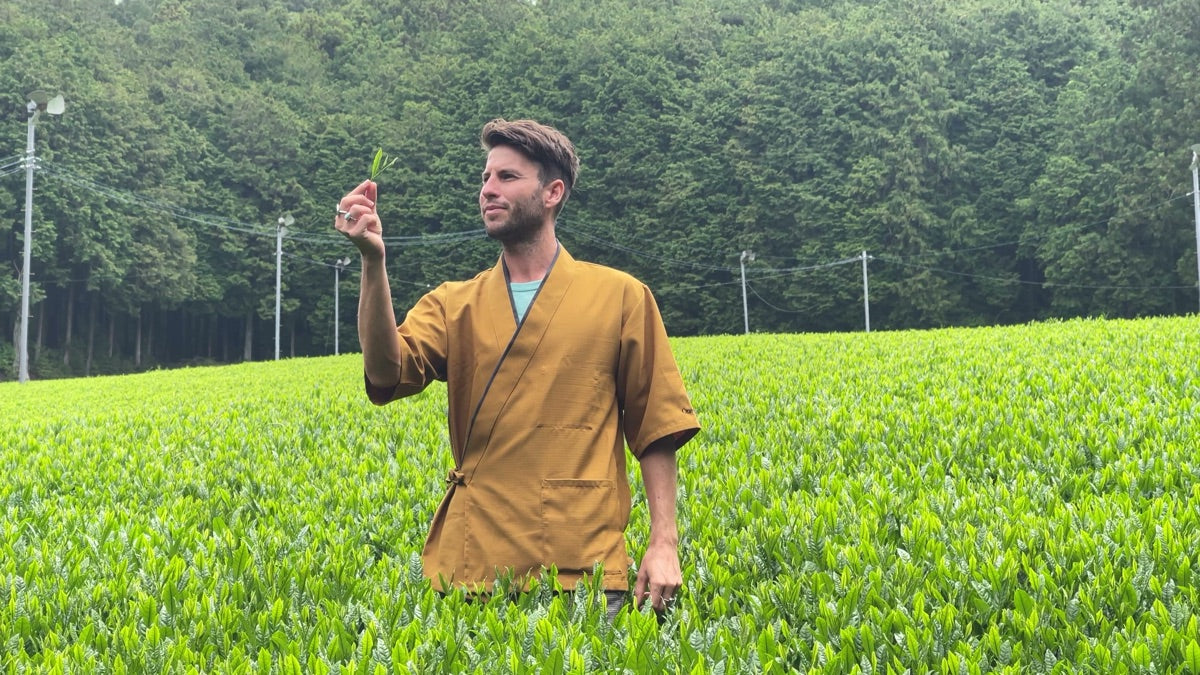
When you buy through a broker, you're trusting a middleman's word on quality. When you buy from us, you're buying from someone who stood in the field where your tea was grown.
Submit the quote request form and my current price sheet opens right away. I read every quote request myself, and your written quote follows within 2 business days.
See matcha for cafes Request a quote and samples
Running a boba or milk tea shop? Grades and terms for your menu are on matcha for bubble tea shops. Want your order size first? The order calculator turns your daily drinks into kilograms.
Share:
Matcha Distributor vs Direct From a Producer (2026)