



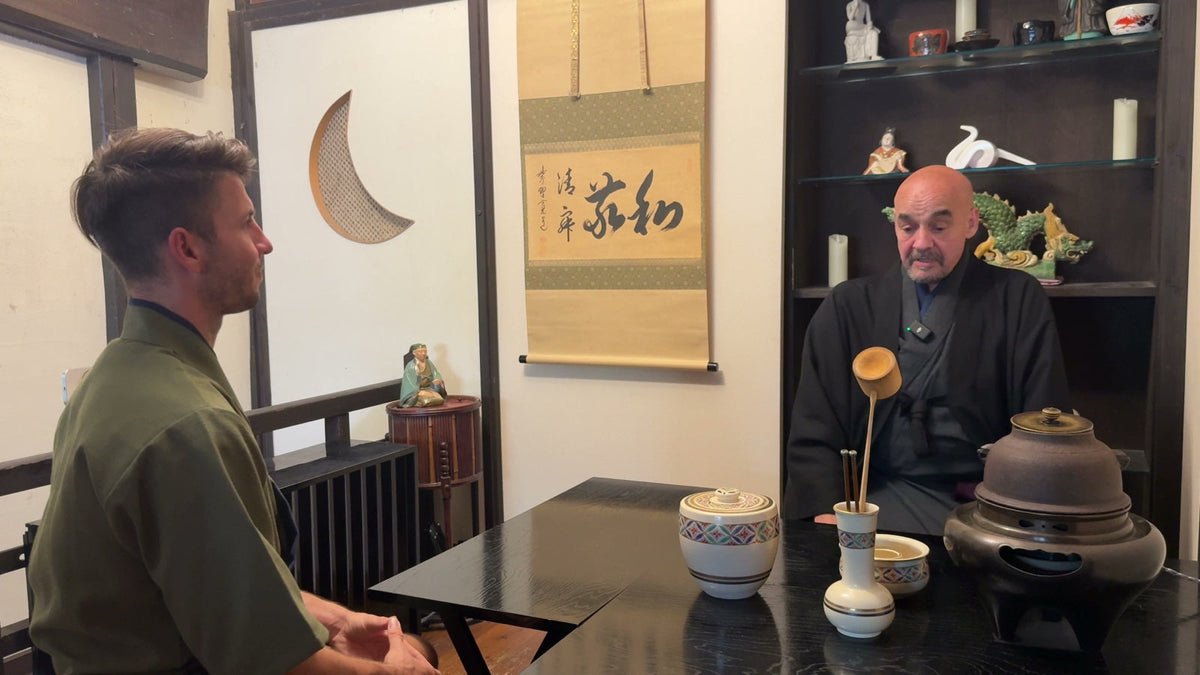
A chawan (茶碗) is a bowl for drinking powdered green tea. It has no handle and no spout, and it is wide enough that you can whisk matcha inside it rather than steep leaves and pour them off. The Omotesenke school, one of the three schools founded by the descendants of Sen no Rikyu, defines it in exactly those terms in its own glossary: "a bowl for drinking powdered green tea" (Omotesenke Fushin'an, Chanoyu Glossary, retrieved 2026-08-28).
That is the short answer. The longer one is more interesting, because almost everything written in English about the chawan comes from shops selling them. We went to the museums instead, and pulled the measurements off six real accession records.
Key Takeaways
- A chawan is a handleless bowl for whisked matcha. The word itself is older and broader than that, and historically covered ordinary ceramics and even rice bowls, which is why a matcha bowl is sometimes specified as a matcha-jawan.
- Measured across six museum and collection records, chawan run roughly 4.4 cm to 8.9 cm tall and 10.2 cm to 15.9 cm across. A standard coffee mug is around 8 cm across with straight walls, which is the real reason a mug fights the whisk.
- Shape follows season. A shallow wide hira-chawan is a summer bowl because tea cools fast in it, and a tall tsutsu-chawan holds heat for winter.
- Tea practitioners rank the wares "first Raku, second Hagi, third Karatsu." Raku is fired low and cooled fast, which produces a porous body that insulates against hot tea, so the aesthetic choice is also a functional one.
- A crazed glaze is not a flaw. Tea seeps into the fine cracks and the bowl changes color over years of use, differently for every owner.
What Is a Chawan, Exactly?
Start with the thing most guides skip. "Chawan" does not only mean matcha bowl.
JAANUS, the Japanese art and architecture dictionary hosted by Columbia University, records the word as "a generic term for ceramic wares called tojiki from the 9th to 16th century." It was "initially used for tea drinking and considerably later for rice" (JAANUS, Columbia University, retrieved 2026-08-28). In modern Japanese a chawan on a dinner table is usually a rice bowl. The tea bowl you whisk matcha in is sometimes called a matcha-jawan to remove the ambiguity.
So when you search for a chawan and get rice bowls, that is not a bad search. That is the word doing its job.
JAANUS sorts tea bowls into three origin families: Chinese imports (karamono), Korean bowls (korai chawan), and Japanese-made bowls (kuniyaki). The Omotesenke glossary tracks the same arc as a change in taste. Chinese celadon, white porcelain and tenmoku bowls were used from the Heian into the Kamakura period. Then, "from the middle of the Muromachi period, with the flourishing of wabicha, Korai tea bowls from Korea were mainly used."
For the global comparison, see the worldwide production picture.
The bowl is the one object in the room that changes hands. It is picked up, turned, drunk from, turned back, and looked at. Everything below follows from that.
How Big Is a Chawan? Six Bowls, Measured
Most guides give you a recommended diameter with no source behind it. Here are six actual bowls, each with an accession record you can open.
| Bowl | Ware and date | Height | Diameter |
|---|---|---|---|
| Hira-chawan by Shiro Shimizu | summer form, 2015 | 4.4 cm | 15.9 cm |
| Chawan, acc. 1928.1562 | Karatsu, Meiji | 5.7 cm | 10.5 cm |
| Tea bowl, W.61-1922 | dry lacquer, Edo | 7.6 cm | 10.2 cm |
| Chawan, acc. 1928.1563 | Mishima, c. 1800 | 8.2 cm | 14.5 cm |
| Tea bowl, Ido type, 1954/1.539 | 17th century, Edo | 8.9 cm | 13.3 cm |
| Ido teabowl | c. 2000, Heisei | 8.9 cm | 15.2 cm |
Sources, in order: Mitsui Fine Arts, Spencer Museum of Art, Victoria and Albert Museum, Spencer Museum of Art, University of Michigan Museum of Art, Asian Art Museum of San Francisco. All retrieved 2026-08-28.
That gives a defensible working range of roughly 4.4 to 8.9 cm tall and 10.2 to 15.9 cm across. Not a rule handed down from anywhere, just what six real bowls actually measure.
Why Does the Shape Change With the Season?
Because the tea cools at a different rate in a different bowl, and that is the point.
The convention is that a shallow, wide hira-chawan is a summer bowl, and a tall, narrow tsutsu-chawan is a winter bowl. As the Japanese Wiki Corpus puts it, tsutsu chawan "is used in winter because it is deep and keeps the tea hot longer." Hira chawan "is used in summer because it is shallow and allows the tea to cool rapidly" (Japanese Wiki Corpus, retrieved 2026-08-28). Mitsui Fine Arts describes its Shimizu hira-chawan the same way, as a bowl for the summer tea ceremony with a wider lip than a winter bowl.
Worth being honest about the sourcing here. We went looking for this rule in the tier-one places and did not find it stated as ceremony doctrine. Omotesenke's own seasonal almanac discusses seasonal gatherings at length and never mentions bowl shape or heat retention. So treat the seasonal rule as a well-attested convention rather than scripture.
What you can measure is the geometry itself, and the gap is not subtle.
How Do You Read a Chawan?
Every part of the bowl has a name, and the names tell you where to look.
The art historian Meghen Jones lays out the full anatomy in "How to Read a Teabowl: Chanoyu Principles" (Japan Past & Present, 2025). The rim is the kuchizukuri, the interior view the mikomi, the torso the do, the hip the koshi. The foot is the kodai, its underside the kodai ura. At the bottom sits the chadamari, which she translates as "tea pool," the area where brewed tea collects. JAANUS gives a shorter five-part version of the same scheme.
Here is a distinction worth getting right, because a lot of writing online gets it wrong. You will read that the chadamari exists to help you whisk, that it pools the powder or gives the whisk something to work against. Both academic sources describe it as where the tea collects and is left, a thing you look at when the bowl is empty, not a mixing feature. Jones names a separate zone for the whisk entirely: the chasenzuri, the area the bamboo actually touches, alongside the chakinzuri, the area touched by the cloth. The bowl distinguishes between where the whisk works and where the last drops settle. That is a finer piece of design thinking than the shopping-guide version.
Then turn the bowl over. The kodai is the foot ring, the part that touches the tatami and supports the bowl, and it is where connoisseurs look hardest, because it is the least disguised surface on the object. Jones notes that its underside "reveals handmade qualities," and that the Korean bowls prized in wabi tea have comparatively high, large feet. The craft writer Fumiko Tokimori calls the foot the place where "glimpses of the artisan's intentions can be seen." It is made either by carving it out after molding (kezuri kodai) or by attaching a separate coil of clay (tsuke kodai) (KOGEI STANDARD, 2024).
How much did the foot matter? The V&A holds an Edo-period tea bowl made of dry lacquer, imitating Bizen pottery. It was given "a deep footring in imitation of one that has been deeply carved into the clay." Someone built a fake ceramic foot into a lacquer bowl, because a bowl without a convincing kodai was not a serious bowl.
Raku, Hagi, Karatsu: The Wares That Made the Bowl
There is a saying among tea practitioners: first Raku, second Hagi, third Karatsu. It appears on the official craft pages of the Traditional Craft Industries Promotion Association, the national body behind Japan's designated traditional crafts, in its entry on Hagi ware, alongside the observation that "tea bowls are the most difficult to make" (kougeihin.jp, retrieved 2026-08-28).
We keep the full record: our sourced chronology of tea, 486 dated entries.
Raku is the one at the top, and the reason is physical as much as aesthetic. JAANUS describes it as a light ceramic ware developed in Kyoto in the Momoyama period, hand-molded rather than thrown. It is fired briefly in a small single-chamber updraft kiln, then cooled quickly in the open air. The result is "porous ware that holds heat and insulates against hot tea." So the most prized bowl in Japanese tea is also the one that is kindest to your hands.
The founder is Tanaka Chojiro (1516 to 1592), whose work begins in the late 1570s. His family traces fourteen generations in direct succession. The story that Rikyu himself commissioned the first Raku bowls is recorded by JAANUS as legend, so we will leave it there.
Hagi comes out of the same historical moment from the other direction. The kougeihin entry records that Mori Terumoto, who traveled to the Korean Peninsula with Toyotomi Hideyoshi, came back with the potter brothers Lee Shak-gwang and Lee Gye, and that Lee was given the name Saka Koraizaemon by the local lord. That lineage still works in Hagi City today, more than four hundred years on.
Which brings up the part of this history worth sitting with. The bowls that became most prized in Japanese tea were, in origin, not made for tea and not made in Japan.
The Korean Bowls That Changed Everything
The Asian Art Museum of San Francisco puts it carefully, and the care is the point: an Ido teabowl's "distinctive shape is said to derive from Korean bowls made for everyday use, such as for holding rice, in the 1500s and 1600s." The museum adds that the name Ido probably comes from a Korean place name, possibly a kiln site, "though the exact etymology remains unclear."
The University of Michigan Museum of Art tells the same story with more edge. These bowls were "in widespread use among Korean peasant farmers," and they fit the emerging Japanese taste for rusticity and simplicity, the wabi aesthetic, matching the criteria for found art associated with Sen no Rikyu (1522 to 1591). The originals were acquired during Hideyoshi's invasion attempts in the 1590s.
You will see this written flatly everywhere as "Ido bowls were Korean rice bowls." The museums that hold them will not say it that plainly, and we are not going to either. What is solid: ordinary Korean vessels, made without any thought of ceremony, were recognized by Japanese tea people as more beautiful than the expensive Chinese imports they had been using. Rikyu's whole aesthetic turns on that recognition. Omotesenke defines wabi as "seeking spiritual sufficiency and beauty amidst material poverty."
An entire tradition of connoisseurship began with somebody looking at a farmer's bowl properly. If you want one idea to take away from this article, take that one.
Can You Just Use a Cereal Bowl?
You can. It will work badly, and the reason is geometry rather than tradition.
JAANUS records that a chasen, the bamboo whisk, is cut from a single piece of bamboo roughly 2 to 2.5 cm thick and 9 to 12 cm long, split into fine strips that curve outward from the core (JAANUS, chasen). The working head is wider than that stock, because the tines flare. Now set that against the bowls in the table above, at 10.2 to 15.9 cm across and 4.4 to 8.9 cm deep, with walls that open outward.
A standard coffee mug is around 8 cm across with vertical walls and a small flat base. The whisk head has nowhere to sweep, so you end up stirring rather than whisking, and matcha needs a fast wrist motion across a wide floor to break up the clumps and pull air into the tea. That is reasoning from the measurements, not a sourced rule, and we would rather say so than invent a number. You will find articles quoting exact rim angles in degrees for this. We could not source any of them to anything, so they are not in here.
A wide soup bowl or a large ramen bowl gets you most of the way. The bowl is not the expensive part of starting matcha, and it is not where we would tell you to spend first. Good organic matcha in a soup bowl beats mediocre matcha in a museum piece, every single time.
For the whisk side of this, prong counts, seasoning a new chasen, the actual whisking motion and how to care for the bamboo, we wrote that up separately in our guide to using a matcha whisk. The full preparation walkthrough is in how to make matcha, and if you are choosing between thin and thick styles, koicha versus usucha covers how that changes what you want from a bowl. The scoop gets its own piece too, in what a chashaku actually does.
How to Care for a Chawan
Straightforward, and worth saying that the strict version of these rules is retailer lore rather than documented tradition. We looked for a museum conservation source and there isn't one. What follows is practical guidance, with the one credible source we did find noted where it matches.
- Rinse it warm, straight after use. Matcha comes off easily before it dries.
- Skip the dishwasher. Tokodo, a Japanese ceramics boutique, advises against it because it "can scratch the ceramics" (Tokodo, retrieved 2026-08-28).
- Don't leave it soaking. Same source: soaking risks damage and lets odors and stains absorb into the body.
- Dry it fully before it goes away. Leave it somewhere well ventilated until completely dry. A porous bowl put away damp is how you get a musty bowl.
- Go easy on soap. Worth noting Tokodo does not actually forbid it, it recommends wiping grease off first and using a soft sponge. We use plain hot water on ours out of habit.
Now the part that makes an old bowl worth more than a new one. Many tea wares are deliberately porous with a finely cracked glaze, called crazing or kannyu. The national craft body describes the mechanism plainly for Hagi ware: "tea, sake, and other liquids easily seep in through the fine cracks called crazing in the glaze. This is why the glaze changes over time with prolonged use." Colors from absorbed tea accentuate the crackle pattern. In their words, "the way the color soaks into the bowl varies greatly depending on how the user handles it."
Read that last clause again. The bowl keeps a record of how you have used it. Two identical bowls, ten years apart, will not look the same, and the difference is you.
And when one breaks, it does not have to be finished. Kintsugi, "golden joinery," repairs broken pottery with lacquer dusted with gold or silver. The New Orleans Museum of Art dates the practice to over five hundred years ago (NOMA, 2020). It tells the origin story of the shogun Ashikaga Yoshimasa, whose broken Chinese tea bowl came back stapled with ugly metal, prompting craftsmen to find something better. The story is a legend rather than documented history, so take it as a story. The idea holds either way: the repair is highlighted as part of the object's history instead of hidden.
Frequently Asked Questions
What is a chawan?
A chawan is a Japanese bowl for drinking powdered green tea, with no handle and no spout. It is wide and open enough to whisk matcha directly in it. The Omotesenke school defines it as "a bowl for drinking powdered green tea." Note that in everyday Japanese the same word often means a rice bowl, so matcha bowls are sometimes called matcha-jawan.
What size chawan should I get?
Six bowls measured from museum and gallery records run 4.4 to 8.9 cm tall and 10.2 to 15.9 cm across. Anything in that range gives a bamboo whisk room to move. Wide and relatively shallow is more forgiving than tall and narrow when you are learning.
Can I use a regular bowl for matcha?
Yes. A wide soup bowl works reasonably well. A coffee mug does not, because at roughly 8 cm across with straight walls and a small base there is nowhere for the whisk head to sweep, so you stir instead of whisking and the matcha stays lumpy.
What is the difference between a chawan and a chasen?
The chawan is the bowl, the chasen is the bamboo whisk that goes in it. They are a pair, not alternatives. We cover the whisk in detail, including prong counts and how to season a new one, in our guide to using a matcha whisk.
Why is my chawan changing color?
If it has a crazed glaze, that is expected and it is not damage. Tea seeps through the fine cracks and stains the body over time. The craft association describes this as the reason the glaze changes with prolonged use, and notes the pattern varies with how each person uses the bowl.
Can you put a chawan in the dishwasher?
Better not to. A ceramics specialist advises against dishwashers because they can scratch the surface, and against soaking because the porous body absorbs odors and stains. Rinse by hand in warm water and let it dry completely.
Which is the most prized tea bowl ware?
The traditional ranking among tea practitioners is "first Raku, second Hagi, third Karatsu." Raku's standing is partly functional, since low firing and rapid cooling produce a porous body that holds heat and insulates the hands against hot tea.
Bringing It Home
I have handled bowls in Japan that cost more than my first car, and I have whisked good matcha into a chipped bowl in a farmhouse kitchen while the farmer talked over me. The second one is the memory I kept. The bowl matters, and it matters less than what goes in it.
If you are building a practice, start with the tea. Get an organic ceremonial matcha worth the attention, whisk it in whatever wide bowl you own, and pay attention to what happens in the two minutes it takes. If a chawan finds you later, it will mean more for having waited. Cafes and studios sourcing in volume can talk to us through wholesale.
Then slow down and look into the bowl before you drink. That pause is the whole practice, and it has never needed expensive equipment.
With love,
Christian
Founder, One with Tea
Sources
- Omotesenke Fushin'an, "Chanoyu Glossary," omotesenke.jp, retrieved 2026-08-28.
- JAANUS, "chawan," Columbia University, projects.mcah.columbia.edu, retrieved 2026-08-28.
- JAANUS, "chasen," Columbia University, projects.mcah.columbia.edu, retrieved 2026-08-28.
- JAANUS, "rakuyaki," Columbia University, projects.mcah.columbia.edu, retrieved 2026-08-28.
- Traditional Craft Industries Promotion Association, "HAGI Yaki (Pottery)," kougeihin.jp, retrieved 2026-08-28.
- Meghen Jones, "How to Read a Teabowl: Chanoyu Principles," Japan Past & Present, 2025, japanpastandpresent.org.
- University of Michigan Museum of Art, tea bowl, Ido chawan type, acc. 1954/1.539, umma.umich.edu, retrieved 2026-08-28.
- Asian Art Museum of San Francisco, "Ido teabowl," searchcollection.asianart.org, retrieved 2026-08-28.
- Spencer Museum of Art, University of Kansas, chawan acc. 1928.1562 and 1928.1563, spencerart.ku.edu, retrieved 2026-08-28.
- Victoria and Albert Museum, tea bowl W.61-1922, collections.vam.ac.uk, retrieved 2026-08-28.
- Mitsui Fine Arts, Shiro Shimizu, "Hira-chawan (shallow tea bowl)," 2015, mitsuifinearts.com, retrieved 2026-08-28.
- Fumiko Tokimori, "The Art of Appreciating Tea Bowls 02," KOGEI STANDARD, 2024, kogeistandard.com.
- Japanese Wiki Corpus, "Chawan," japanesewiki.com, retrieved 2026-08-28.
- Tokodo Inc., "Treatment and Maintenance," tokodo.co.jp, retrieved 2026-08-28.
- Mel Buchanan, "Object Lesson: Kintsugi reflects beauty in flaws, strength in healing," New Orleans Museum of Art, 2020, noma.org.
Share:
Kyusu: The Complete Guide to the Japanese Teapot
Cold Coffee Is Driving Café Sales. Signature Matcha Drinks Are How You Win