



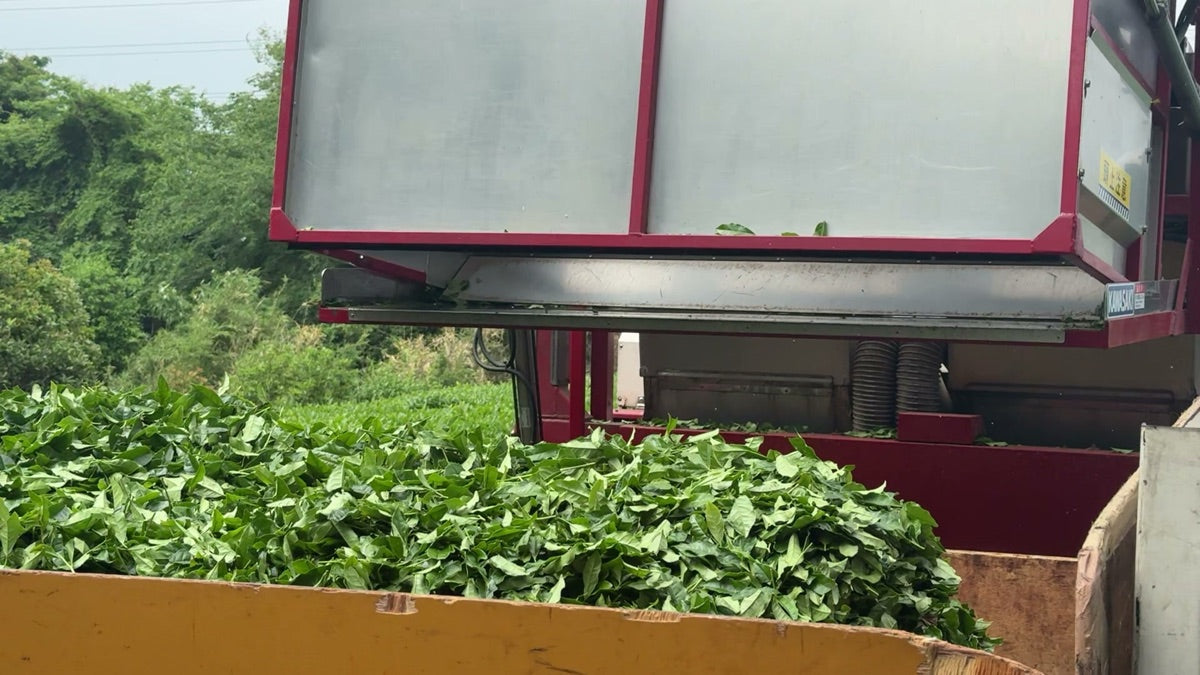
If you're buying matcha direct from Japan, neither a farm nor a Japanese tea trading company is the better route by default. In matcha sourcing, what decides it is who holds the physical lot when you accept the quote, because that party decides whether the sample matches the shipment, whether the price holds and who answers if the lot fails.
We sell matcha at One with Tea, so read this with that bias in mind. I'm writing for cafes, brands and wholesale buyers ready to buy matcha direct from Japan. If you haven't yet decided between a US distributor and buying closer to Japan, start with matcha distributor vs buying direct.
Key Takeaways
- Ask who holds the physical lot on the day you accept the quote; that answer matters more than whether the seller is a farm or a trading company.
- Japan's tea chain narrows from thousands of growers to a few hundred finished-tea businesses (Norinchukin Research Institute, May 2026), so far fewer businesses finish tea than grow it.
- Tea prices can turn within one season: in Shizuoka, general crude-tea prices (not matcha) opened the 2026 new-crop trading 14.0% below a year earlier (Norinchukin Research Institute), yet Japan's agriculture ministry reports the 2026 first flush traded about 70% higher there (MAFF, July 2026). Those are general tea prices, not matcha prices, and they are why a quote's expiry date matters.
- Farm-direct suits single-origin traceability; a trading company suits consistency, several grades and export paperwork. Either way, insist on one lot number across sample, bag and lab report.

What is the difference between farm-direct and a trading company?
In this guide, farm-direct means you buy from the business that grew the leaf and made the tencha, and a trading company is a business that sells you tea it did not grow or finish. In Japan, crude tea is made at crude-tea factories run by farmers, agricultural co-ops and companies (Norinchukin Research Institute, May 2026, PDF in Japanese).
For matcha, that crude tea is tencha: leaf from tea gardens covered for about 2 to 3 weeks, steamed and dried without rolling. Matcha is tencha ground to a fine powder on a stone mill or similar machine (MAFF, July 2026).
A trading company, as I use the term, may buy from tea markets, merchants or producers. Downstream of the crude-tea factory sit Japan's tea merchants, who finish crude tea by sifting, cutting, sorting, firing and blending it (Norinchukin Research Institute). The difference that matters is who owns the lot on the day you sign: the seller, or someone the seller still has to buy from.
Who holds a matcha lot on its way to export?

A matcha lot can pass through several hands before export. Mapped for Japanese tea in general, the chain runs grower, crude-tea factory, tea market or brokerage, then tea merchant. Japan counted 12,929 tea-growing operations in 2020 and 654 businesses producing finished tea in 2023 (Norinchukin Research Institute, May 2026), so the chain narrows fast.
- Grower: grows and picks the fresh leaf, and may also run the factory.
- Crude-tea factory: turns fresh leaf into crude tea, which for matcha is tencha.
- Tea market or brokerage: where price is set, quality is judged and payment is settled (Norinchukin Research Institute).
- Tea merchant: finishes the tea; for matcha, finishing includes grinding tencha into powder (House of Councillors research office, December 2025, PDF in Japanese).
- Exporter: may be the merchant, a trading company or the farm itself.
On a tea factory floor in Shibushi, Kagoshima, we filmed tea being poured into white tasting cups beside black bowls of dry leaf laid out on a table. I think of that table whenever a quote names a grade but no lot.
My reading of the chart: thousands of growers narrow to a few hundred finishing businesses, so far fewer businesses finish tea than grow it, whatever the label says. Japan's agriculture ministry points the same way: the tea wholesalers and retailers answering its survey reported crude-tea purchases equal to about 65% of Japan's 2025 crude-tea production (MAFF, July 2026).
The counts come from different years, so they show the shape of the chain, not one year's flow. What does that mean for you? A farm can sell you its own lot; anyone further along sells a lot that has passed through at least one more pair of hands.
Why does it matter who holds the lot when you get a quote?

Whoever holds the lot is the only party that can tie your sample, your price and your fallback to one physical batch of tea. Lots are a working identifier, not jargon: FDA's prior notice for imported food asks for a lot, code number or other identifier where the food is required to have one (FDA).
The sample and the shipment
Only the holder can promise that your sample came from the lot you'll receive. A seller who hasn't bought yet may only be able to sample the grade, not your lot, so ask for the lot number on the sample bag and match it to the invoice on arrival.
The price
Crude-tea prices are set at market, and one season can move them a long way. The first new-crop tea trading of 2026 opened at 6,573 yen/kg in Kagoshima on April 6, up 58.9% year on year; 9,019 yen/kg in Shizuoka on April 20, down 14.0%; and 20,879 yen/kg in Kyoto on April 24, up 22.1% (Norinchukin Research Institute, May 2026).
Those are general new-crop tea prices, not matcha or tencha prices, and I won't guess at the causes. Opening day wasn't the season, either: over the 2026 first flush, MAFF reports crude tea trading at about double the previous year's price in Kagoshima and about 70% higher in Shizuoka (MAFF, July 2026). A seller who doesn't yet hold the lot is quoting against a price that can move before they buy.
Substitution
In June 2025, the Japan Tea Export Promotion Council recorded trouble sourcing raw material: some pre-orders went unfilled, and some buyers of standard products were offered substitutes instead (House of Councillors research office, December 2025). A seller still buying may have to take what the market offers, so ask who approves a substitute before it ships, and get it in writing.
When is farm-direct the better route?

Farm-direct is the better route when single-origin traceability and a direct relationship matter most, and you can live with a farm's limits. Supply is one of them: tencha is 8.6% of Japan's tea production in MAFF's July 2026 figures (MAFF, July 2026), so one farm may have little to spare for a new buyer.
Consistency is a second limit: one farm's leaf can vary from harvest to harvest, and that variation is part of what you buy. Milling is a third. Grinding is its own step, and a December 2025 parliamentary research report found grinding mills short, with some tea merchants considering outsourcing grinding to flour-milling companies outside the tea trade (House of Councillors research office, December 2025). Ask a farm who milled the tea, not only who grew it.
You also won't be the only buyer at the gate. Through August 2025, the export council kept recording buyers trying to buy directly at production sites and asking for introductions to producers, and in April 2025 it noted matcha orders that could not all be accepted (House of Councillors research office, December 2025). Don't be surprised if a farm says no, or quotes a later harvest.
Be honest about what a farm is: a grower first, not an export desk. Choose farm-direct if you want one named origin, can wait for the next harvest and can carry more of the export work yourself.
When is a Japanese tea trading company the better route?
A trading company is the better route when you need consistency across seasons, several grades or regions on one order, or one counterparty for export documents. Competition for good lots is real on every route. In the same MAFF survey of tea wholesalers and retailers, responses representing about 80% of purchase volume expected to buy more 2026 first-flush crude tea than in 2025 (MAFF, July 2026).
Consistency is the strongest case for a Japanese tea trading company. Blending is a merchant's finishing step, so a seller buying from merchants can offer a blend aimed at a steadier cup from season to season (more in single-origin vs blended matcha).
Breadth is the other case. One order can cover several grades or regions, and one counterparty may prepare the export documents. That helps, but it doesn't replace what a US importer has to clear on your side.
The trade-off is distance. The further the seller is from the lot, the more you rely on their word, so the questions in the next section matter more, not less. Choose a trading company if you need the same cup every month, several grades or export help, and you'll check the lot behind every quote.
What should you ask a matcha sourcing partner before you accept a quote?
Ask six questions before you accept a matcha quote, and every one comes back to the lot: who holds it today, what it is, and what happens if it changes. Use them on farms and trading companies alike.
| Question | A good answer sounds like | Ask again if you hear |
|---|---|---|
| Do you hold this lot today, or do you buy it after I confirm? | "We hold it; here's the lot number and what's left." | "We'll get it once you confirm," with no lot named. |
| Who made the tencha, and who milled it? | A named business and place for each step. | "Our partner farm," and nothing on milling. |
| Is my sample from the lot you'll ship, and what is its lot number? | Yes, with that lot number printed on the sample bag. | A sample "representative of the grade." |
| How long does this price hold, and what would change it? | A date in writing and what would reopen it. | "Prices are stable," with no date. |
| If the lot sells out or fails testing, what happens, and do I approve any substitute? | You choose, in writing, before anything ships. | "We'll send something equivalent." |
| Does the lab report carry the same lot or batch number as the bag? | Yes, one number on report, bag and invoice. | A grade report with no lot number. |
For minimums, lead times and quote terms, see the bulk matcha supplier guide.
Where does One with Tea sit in the chain?

One with Tea sits between the producers and you: we're a US brand that imports matcha, not a farm and not a trading company. Our relationships with growers are built and maintained from the farm side, not through middlemen. Mohei Honda in Shizuoka and Kurihara Seicha in Yame are two of the producers named on our About page. I personally verify growing conditions every season, and we import in small, frequent batches to keep everything as fresh as possible.
In-stock bulk ships from US inventory with no international leg, so for in-stock orders the answer to this article's question is us: the lot is already in our US inventory, and you can ask for a sample from the lot you'd receive. A made-to-order run reserves a lot for you. Samples are available on request, with the sample terms in your written quote. Our lab results page lists what every report includes, product name and batch number among them, and wholesale buyers get the reports on request.
If your volume is small or irregular, in-stock bulk is the simpler route.
Whether you end up with a farm, a trading company or us, ask for a sample from the lot you'd actually buy.
Christian
Frequently Asked Questions
Is farm-direct matcha always better quality?
No: quality comes from the leaf, the processing and the milling, and tea from the same farm can reach you either way. Judge the sample, not the route, by whisking it with water alone, no milk and no sweetener.
What is a lot number on matcha?
A lot number, sometimes called a batch number, identifies tea from one production run, so every bag from that run carries the same number. Two bags of the same grade can carry different lot numbers, and they can taste and test differently, which is why the number matters more than the grade name.
Why do matcha quotes expire so quickly?
A seller quoting on leaf it hasn't bought is pricing against a market that can move within one season, so a short validity window protects the seller. Ask for the expiry date in writing and whether the price is tied to a named lot.
Does "Product of Japan" tell you who holds the lot?
No. A country of origin names where the tea was produced, not who grew it, made the tencha, milled it or holds the lot today, so ask for each by name before you sign.
Share:
Matcha Tastes Like Grass or Bitter: A Cafe Fix List
How to Vet a Matcha Supplier: 10 Checks Before You Order