



To vet a matcha supplier, run ten checks across the product, the organic paperwork, the supplier's FDA record and the written quote. Lean hardest on the seven backed by public records or by lab and certifier documents, not the supplier's word. I sell matcha wholesale at One with Tea, so run every check here on us too.
If you're still deciding what kind of supplier you want, start with my guide to choosing a Japanese matcha supplier.
Key Takeaways
- Seven of the ten checks rest on evidence the supplier doesn't write: three public records and four documents a lab or certifier issues.
- A COA counts only if its lot or batch number matches the one printed on your bag.
- Organic status lives in a public USDA database, and certification covers specific products, so confirm it grade by grade.
- Minimum, lead time and payment terms rest on the supplier's word, so they belong in the written quote.

What does it mean to vet a matcha supplier?
Vetting a matcha supplier means checking its claims against evidence the supplier does not control, before any money moves. If you import food, FDA already expects this. Under its Foreign Supplier Verification Programs (FSVP) rule, importers must approve foreign suppliers based on an evaluation of the food's risk and the supplier's performance (FDA).
The evaluation covers the supplier's compliance with FDA food safety rules and has to be repeated on a schedule FDA sets. Buying from US stock? Then someone else is the importer, so ask who.
The way I sort them, the ten checks split by who produces the proof. Three are public records you look up yourself: organic status, import alerts and warning letters. Four rest on a lab or certifier: the COA, the lab's confirmation, the operation certificate and the National Organic Program (NOP) Import Certificate. Only three rest on the supplier's own word: origin and milling, minimum and lead time, and payment and quote terms.
Why does the split matter? A checklist that only asks the supplier is a checklist the supplier grades. Put your effort into the seven answers the supplier can't write.
What are the ten checks?
The ten checks cover the matcha itself (1 to 3), its organic paperwork (4 to 6), the supplier's FDA record (7 and 8) and the written quote (9 and 10).
| # | Check | Ask for | Walk away if |
|---|---|---|---|
| 1 | The COA matches your lot | A COA with the lot or batch number on your bag | The COA has no lot number, or a different one. |
| 2 | The lab is named and real | Lab name, test date and accreditor | No lab is named, or the lab won't confirm the report. |
| 3 | Origin names a producer, a prefecture and a mill | Names in writing, including who milled the tencha | "Product of Japan" and nothing more. |
| 4 | The certificate covers your grade | Written confirmation, grade by grade, of what is organic | Organic claimed for every grade, no certificate shown. |
| 5 | The status is current in the Organic Integrity Database | The operation's legal name, to look up yourself | The operation isn't listed as certified. |
| 6 | Each organic shipment has an NOP Import Certificate | The certificate number for your lot's shipment | "We don't need one for Japan." |
| 7 | No open FDA import alert | Supplier, producer and exporter names to search | Any of them is on a red or yellow list. |
| 8 | A clean warning-letter history | What was fixed after any letter, and when | A letter, with no answer on what changed. |
| 9 | Minimum and lead time, with what starts the clock | Minimum in kilograms, and what starts the clock | "A few weeks," with no starting point. |
| 10 | Payment, quote validity and importer of record | Deposit, balance, price expiry and importer of record | No expiry date, or no importer named. |
How do you check the matcha itself?

You check the matcha itself by tying the lab report to your lot, confirming the lab behind it and getting origin down to a producer, a prefecture and a mill.
1. The COA matches your lot
A certificate of analysis (COA) tested on some other lot says nothing about yours. The lot or batch number on the COA must be the one on your bag. Lot numbers carry regulatory weight: FDA's prior notice for imported food asks for a "lot, code number or other identifier" where the food is required to have one (FDA).
Our own reports show the minimum to expect (see our lab results page). Each lists the product name and batch number, test date, lab name, results for heavy metals, pesticide residues, microbial counts and radiation, measured values beside regulatory limits, and a pass or fail status for each required test.
2. The lab is named and real
The COA should name the lab that ran the tests and the test date. Ask who accredits the lab, and for which tests. If anything looks off, contact the lab yourself and ask whether the report is theirs.
FDA keeps an online public registry of labs accredited under its Laboratory Accreditation for Analyses of Foods (LAAF) program. Owners and consignees must use one in certain circumstances, for example testing to get a food removed from an import alert (FDA). Use the registry as one more lookup, not a pass mark.
3. Origin names a producer, a prefecture and a mill
Origin evidence names the producer, the prefecture and who milled the tencha, because milling is a separate step. A December 2025 paper from Japan's House of Councillors research office reports that mills for grinding tencha are in short supply. Some tea merchants, it says, are considering having grinding done by flour-milling companies outside the tea trade (PDF in Japanese). So "Product of Japan" alone tells you little: ask who milled it.
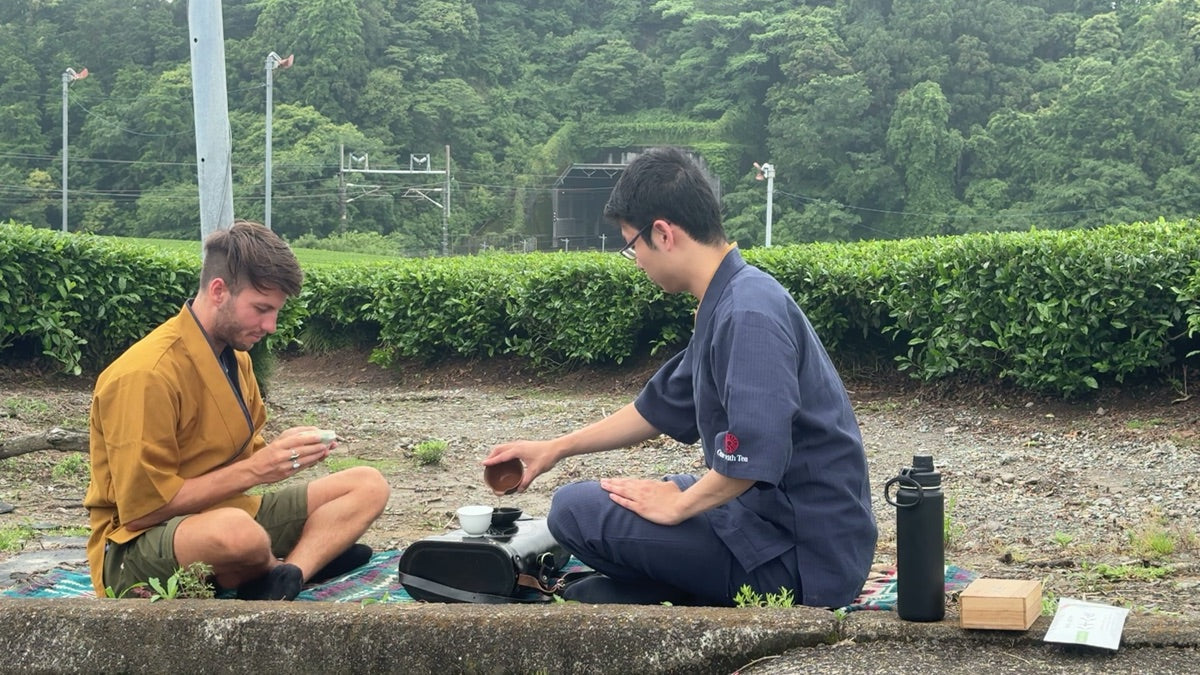
I've tasted tea with producers at the edge of their fields in Shizuoka and at a factory tasting table in Shibushi, Kagoshima. A supplier who has done the same can usually name the farm without looking it up.
How do you check organic certification?

You check organic certification by confirming the certificate covers your grade, looking up the operation's status yourself and asking for the import certificate on your shipment. Asking is normal: USDA's organic enforcement FAQ says sellers of organic products must confirm the certification status of their own suppliers (USDA AMS).
4. The certificate covers your grade
An organic operation certificate shows that a farm or business is certified as an organic operation. The certifier issues it out of the Organic Integrity Database, with a 10-digit NOP identification number (USDA AMS). A seller can hold one while some of its grades are not organic.
In our own range, Latte Grade (Organic) and Ceremonial (Organic) are USDA Organic, certified by QCS; Superior and Royal, our premium ceremonial grades, are not organic certified. Ask any supplier to confirm certification grade by grade, on the quote.
If your matcha is certified organic under JAS (the Japanese Agricultural Standard), it can be sold as organic in the US without a second certification. The US-Japan equivalence arrangement allows this within its terms (USDA AMS).
5. The status is current in the Organic Integrity Database
Look the operation up yourself in the USDA Organic Integrity Database, which gives up-to-date status for businesses certified to USDA or a trade partner's organic standards (USDA AMS). Search the company's legal name as well as the brand, since a listing can sit under a company name with the brand as a dba. A listing names the products the operation is certified for (ours lists each one), so match the grade on your quote against it. Operations exporting from Japan under the equivalence arrangement are listed under the Trade Partners tab (USDA AMS).
6. Each organic shipment has an NOP Import Certificate
Since March 19, 2024, each organic shipment imported into the US must be associated with an NOP Import Certificate issued by an accredited certifier in the database. A separate certificate is issued for each product or Harmonized Tariff Schedule (HTS) code (USDA AMS). You can't look one up: the certificates aren't public, since they may contain proprietary trade information. Ask the importer for the certificate number that covered the shipment your lot arrived on.
How do you check a supplier's FDA record?
You check a supplier's FDA record by searching FDA's public import alerts and warning letters for the supplier, the producer and the exporter by name. Before importing, FDA says, importers should determine whether their products are subject to detention without physical exam, or DWPE (FDA).
7. No open FDA import alert
FDA can place a product on an import alert after discovering a violation, then detain future shipments under DWPE without testing or physically examining them (FDA). A detained shipment is refused unless the importer can overcome the appearance of the violation.
FDA's import alerts page is searchable by keyword, firm name or product. Firms on an alert's red or yellow list are subject to DWPE under it; firms on its green list are exempt. Some alerts work the other way round: under an alert with a green list, firms that are not on it are not exempt from DWPE.
8. A clean warning-letter history
FDA publishes its warning letters on a searchable page, and notes that matters in a letter may have changed after later contact between FDA and the recipient (FDA). So a letter is a reason to ask what was fixed, not an automatic no. The FSVP rule's own test fits here: the supplier's food safety history, including how responsive it was in correcting past problems (FDA).
Food facilities must also register with FDA under Bioterrorism Act rules in effect since December 12, 2003 (FDA). Ask whether the facility that packs your matcha is registered.
What should the quote put in writing?

The quote should put in writing everything that rests on the supplier's word alone: minimum, lead time, payment terms, price validity and importer. No public record backs these, so get them on paper before you pay.
9. Minimum and lead time, with what starts the clock
Get the minimum in kilograms and the lead time, plus what starts the clock: the order, the deposit or artwork approval. A lead time with no starting point is a hope, not a date.
10. Payment, quote validity and importer of record
Get the deposit and the balance, and when each falls due. Get how long the price holds and who is importer of record. Then ask who approves a substitute if the lot sells out or fails testing, because a validity date only means something once you know who actually holds the lot.
For the full list of answers to get in writing, see the bulk matcha supplier guide.
How does One with Tea answer these checks?

One with Tea answers the ten checks with documents I can hand over and records you can look up without me. Wholesale buyers get our lab reports on request, each carrying the product name, batch number, test date and lab name. I'd rather you hold the paper than take my word.
On organic, Latte Grade (Organic) and Ceremonial (Organic) are certified by QCS, and Superior and Royal are not. Our organic imports run under NOP import certificates, and the producers behind our organic grades hold JAS organic certification.
On terms, the written quote follows the price sheet within 2 business days, holds for 21 days and states price, minimum and lead time. In-stock orders start at 1 kg and ship from US inventory in 2 to 3 business days, with lead time confirmed in your quote. They are paid in full before shipping. Made-to-order runs take 4 to 6 weeks from a 50% deposit, with transit quoted on top, and on runs shipped from Japan you are the importer of record.
Samples are free, one set per business, with every grade available at 30 g each.
Before you ask me anything, run checks 5, 7 and 8 on us yourself. When I searched our own name in the Organic Integrity Database on October 16, 2026, it returned Lovepixel INC dba One with Tea, certified by QCS. Each certified product is listed by name, Organic Ceremonial Matcha and Organic Latte Grade Matcha among them. Then search us on FDA's import alert and warning letter pages.
Whoever you buy from, the checks only work before you pay. If you'd like to start with us, ask for a quote and run all ten checks on us.
Christian
Frequently Asked Questions
Is a COA enough to vet a matcha supplier?
No: a COA speaks for one lot and one lab, and says nothing about organic status, the FDA record or the quote terms. Count it as checks 1 and 2 at most, and only once its lot number matches your bag and the lab confirms the report.
Can I look up a supplier's NOP Import Certificate?
No, the certificates aren't public: the exporter provides each one to the US importer for entry into the US Customs and Border Protection import system. What you can look up is the exporting operation's certification status in the Organic Integrity Database, then ask the importer for the certificate number on your shipment (USDA AMS).
How often should I re-vet a matcha supplier?
If you import, FDA's FSVP rule sets the floor: re-evaluate each supplier at least every three years, or sooner when new information comes to light (FDA). In my own practice, I re-run checks 1 and 6 on every new lot, because a new lot needs its own matching COA and can arrive under a different import certificate.
Is JAS organic matcha accepted as organic in the US?
Yes, within the terms of the US-Japan organic equivalence arrangement, though crops or products using crops in transition to organic may not be marketed in the US under it (USDA AMS). Each shipment under the arrangement still has to be associated with an NOP Import Certificate, so JAS certification alone doesn't replace the paperwork behind the shipment.
Share:
Matcha Sourcing: Farm-Direct vs Trading Company (2026)
How to Evaluate a Matcha Sample Before You Commit to a Lot