



By Christian Mauerer, Founder of One with Tea · Published August 9, 2026
Key takeaways
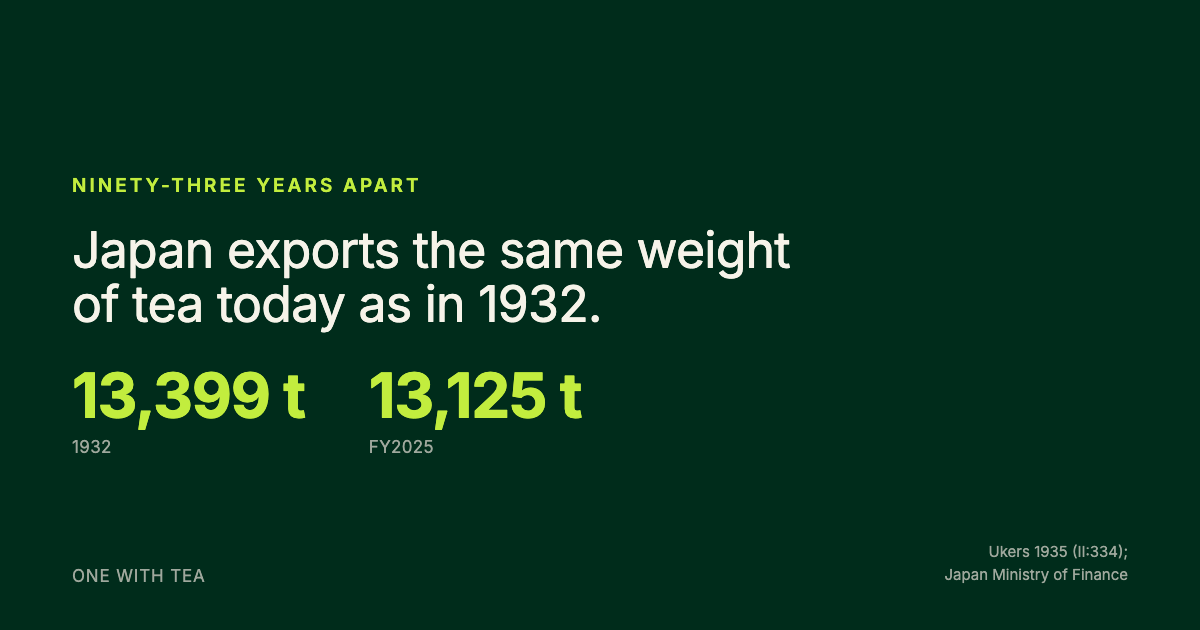
- Japan exported about 13,399 tonnes of tea in 1932. In FY2025 it exported 13,125 tonnes of green tea. Ninety-three years, and the weight barely moved.
- Its peak was 1917, at roughly 30,102 tonnes. Japan has never come close to that again.
- In 1932 Japan was 3.0% of world tea exports. It was a small, shrinking supplier of cheap bulk leaf.
- What changed is not volume but composition and price. Roughly 70% of FY2025 export volume was powdered tea, and value rose 2.2-fold in a single year to ¥84.7 billion.
- Matcha was not an export product in 1935 at all. The 1935 trade dictionary records tencha and gyokuro as teas that are not exported.
I spend a lot of time explaining why matcha costs what it does. Recently I went looking for a baseline and found one in an unlikely place: a two-volume reference book from 1935 that almost nobody in this industry reads any more. What it showed me reframed the whole shortage story.
The short answer
Japan ships about as much green tea today as it did during the Great Depression. In 1932, according to the export tables in William Ukers' All About Tea, Japan exported 29,539 thousand pounds of tea, which is about 13,399 tonnes. Japan's Ministry of Finance recorded 13,125 tonnes of green tea exports in FY2025.
Those two numbers are within 3% of each other. Everything else about them is different.
And here is the part that reframed it for me. The Japanese press reported FY2025 as the country's highest green tea export performance in over seven decades. That is true, and it is still fractionally below where Japan sat in 1932. A record-breaking year, by the standards of everyone alive to remember it, lands just under a Depression-era baseline.
What Japan was in the world tea trade
Ukers' Table No. 1 tracks world tea exports year by year from 1900 to 1932. Japan opens the century at 42,646 thousand pounds, around 19,344 tonnes, climbs through the First World War to a peak of 66,364 thousand pounds in 1917, roughly 30,102 tonnes, and then falls off a cliff. By 1921 it is down to 15,737 thousand pounds. It never recovers.
Set against its competitors in 1932, Japan is a rounding error:
| Origin | Tonnes | Share |
|---|---|---|
| India | 174,812 | 39.6% |
| Ceylon | 114,679 | 26.0% |
| Netherlands East Indies | 89,499 | 20.3% |
| China | 39,526 | 9.0% |
| Japan | 13,399 | 3.0% |
| Formosa (Taiwan) | 6,921 | 1.6% |
| World total | 441,361 | 100% |
Ukers' Table No. 3 puts it even more starkly. Averaged over 1928 to 1932, Japan grew 4.7% of the world's tea and exported 2.6% of it. China grew 48.9%. Japan was mostly drinking what it made, and what it sold abroad was the cheap end.
Japan drank two-thirds of its own tea
The export figure alone understates how domestic the industry was. Ukers prints a second table on the same page, this one for production by kind. In the year ended June 1932, Japan made 89,088 thousand pounds of tea, about 40,410 tonnes, and exported 13,399 of it. Two-thirds never left the country.
The breakdown is the part worth sitting with:
| Kind | Tonnes | Share |
|---|---|---|
| Sencha | 32,451 | 80.3% |
| Bancha | 7,487 | 18.5% |
| Gyokuro | 268 | 0.7% |
| Black | 26 | 0.1% |
| Others | 177 | 0.4% |
| Total | 40,410 | 100% |
Sencha was four-fifths of everything Japan made. Gyokuro, the other shaded tea, was 0.7%. And matcha does not appear as a category at all. The shaded, milled tea that now drives the entire export story was too small in 1935 to warrant its own line in the national production statistics.
Ukers noticed the divergence himself, writing that "although production has been increasing in volume, according to official statistics, exports, on the other hand, have been scaling downward in comparison with early years at the beginning of the century."
What Japan was selling, and to whom
Almost all of it went to one country. Of the 13,399 tonnes Japan exported in 1932, 7,313 tonnes, 55%, went to the United States. Russia took 20% and Canada 9%. Japan's tea trade was, functionally, an American account.
Here is where the 1935 record gets genuinely useful. Ukers closes volume two with a dictionary of the trade's working vocabulary, and the entries tell you what was and was not a commodity.
Sencha he defines in six words: "Name given to the ordinary export teas of Japan." Sencha was the export. It went to America in bulk, competing on price against Indian and Ceylon black tea, and losing.

From our tea room
Superior Sencha Green Tea - USDA Organic Japanese First Flush
First-flush loose leaf, USDA Organic, direct from Japanese family farms.
View Superior SenchaAnd tencha, the shaded leaf that matcha is milled from? Ukers files it as "a powdered Japan tea, known also as Hikicha, or ceremonial tea. It is not an export tea." He says the same of gyokuro: "It is not an export tea."
Read that again. In 1935, the most respected reference work in the industry recorded the two teas that now drive Japan's export boom as things that did not leave the country. They were domestic, ceremonial, and commercially invisible.
(Ukers also has tencha's definition backwards by modern usage, calling the powder what we now call the leaf. We keep that entry, and the correction, in the Tea Lexicon.)
What changed
Not the tonnage. The tonnage came back to roughly where it was and stopped. What changed is what is inside it.
In FY2025 Japan's green tea exports rose 42% by weight, and the value rose 2.2-fold to ¥84.7 billion, up from around ¥38.5 billion the year before. Value climbed five times faster than volume. And roughly 70% of that export volume was powdered tea, which in practice means matcha.
So the same weight of leaf that once left Japan as cheap bulk sencha now leaves mostly as powder, at prices that would have been unthinkable to the exporters Ukers was writing about. Japan stopped competing on volume and started competing on a product nobody else makes well.
Why this explains the shortage
The usual framing of the matcha shortage is that demand exploded. That is true but incomplete. The other half is that the supply base was built for something else entirely.
Tencha requires shading the field for three to four weeks, a separate processing line, and a granite mill slow enough that its output is measured in grams per hour rather than kilograms. None of that scales the way a sencha line scales. Japan spent the twentieth century as a modest exporter of ordinary tea, and its acreage, its cultivars and its factories reflect that history. You cannot convert a sencha field into a tencha field in a season, and you certainly cannot do it in the time it takes a drink to go viral.
The auction floor shows it before the shelf does. At the JA Zen-Noh Kyoto market, machine-harvested first-flush tencha averaged ¥5,411 per kilogram in 2024 and ¥14,141 in 2025, a 161% rise in a single season (Ooika, citing JA Zen-Noh Kyoto). That is what demand meeting a fixed acreage looks like in a price.
When I look at our own Matcha Market Index, the consequences are visible on the shelf. Across 84 matcha powders in the Amazon US top 100, the median price was $0.391 per gram, with a 315-fold spread between cheapest and dearest. Sixty-seven listings stated Japan as the origin. Fifteen stated no origin at all.
That spread is what a supply squeeze looks like from the buying end: the same category name stretched across wildly different products, and a meaningful share of the market declining to say where the tea came from.
The honest caveats
Three, because a comparison like this is only worth as much as its limitations.
Ukers' column is all tea, not green tea. Japan's exports in that era were overwhelmingly green, so the comparison holds, but it is not precisely like-for-like against a green-tea-only modern figure.
There is no matcha data in 1935 to compare against. Ukers has no matcha statistics because matcha was not a traded category. This is a story about Japan's position in the tea trade, not about historical matcha prices.
Fiscal years and calendar years differ. FY2025 is a Japanese fiscal year; Ukers reports calendar years. At this scale it does not change the conclusion.
Other sources will give you a bigger number, and they are not wrong. Look up Japanese tea exports for the 1920s and you will often find 18,000 to 20,000 tonnes, well above the figures here. That is because Taiwan was a Japanese colony from 1895 to 1945, and its tea is frequently counted as Japanese. Ukers lists the two separately, and this article follows him: Japan alone. Add his Formosa column back and the 1920s land at roughly 19,100 to 22,500 tonnes, which is exactly the range those other sources report. We use Japan alone because Taiwan is a separate exporter today, so counting it in 1932 and out in 2025 would manufacture a decline that did not happen.
Frequently asked questions
How much tea did Japan export in the 1930s?
About 13,399 tonnes in 1932, per the export tables in Ukers' All About Tea (1935). That was 3.0% of world tea exports that year.
When did Japan export the most tea?
1917, at roughly 30,102 tonnes, within the 1900-1932 series Ukers published. Japanese green tea exports have not returned to that level.
Was matcha exported from Japan historically?
No. The 1935 trade dictionary records tencha, the leaf matcha is milled from, as "not an export tea", and says the same of gyokuro. Matcha's rise as an export product is recent.
Why is Japanese matcha expensive if export volume is flat?
Because volume and value have separated. FY2025 export weight rose 42% while value rose 2.2-fold, and about 70% of the volume was powdered tea. Tencha is slow and land-limited to produce, so rising demand meets a supply base built for ordinary leaf.
Sources
- Ukers, William H. All About Tea. New York: The Tea and Coffee Trade Journal Company, 1935. Full scan at the Internet Archive. Vol. II, Ch. XVII "Production and Consumption", Table No. 1 (p. 334) and Table No. 3 (p. 335); Dictionary of Tea (pp. 510-515). Figures converted from thousands of avoirdupois pounds at 1 lb = 0.45359237 kg.
- Japan Ministry of Finance customs statistics, FY2025, reported via Kyodo, May 2026. Carried by The Japan Times and Nation Thailand/Kyodo. See our coverage: Japan's green tea exports in FY2025.
- Kyoto first-harvest tencha auction averages, 2024 and 2025, per Global Japanese Tea Association reporting.
- One with Tea Matcha Market Index, snapshot 14 July 2026, 84 powders, methodology v2.0.
If the vocabulary in this piece is unfamiliar, most of it is defined in the Tea Lexicon, including the 1935 entries and where they have since drifted. For where the leaf actually comes from, see Japan's matcha growing regions and how matcha is made, from tencha leaf to stone-ground powder.
Share:
How Many Grams Is 1 Teaspoon of Matcha? (Simple Conversion Guide)
Why Half the World Says Cha and the Other Half Says Tea