



Why Half the World Says Cha and the Other Half Says Tea
By Christian Mauerer, Founder of One with Tea · Published August 9, 2026
Key takeaways
- Nearly every language calls tea a version of one of two words, and both come from the same Chinese character read in two different dialects: ch'a in Cantonese, t'e in the dialect of Amoy.
- The popular rule, tea if by sea and cha if by land, is wrong. Portugal reached China by sea and says chá.
- What actually decided it was which port you traded at. Portugal bought at Canton. The Dutch bought from Amoy merchants. Everyone else in Europe bought from the Dutch.
- The chai family comes from a compound, ch'a-ye, meaning tea leaf, not from the bare syllable.
- Tea had no character of its own until about AD 725. Before that, Chinese writers borrowed a word that also meant sow-thistle.
Ask for tea almost anywhere on earth and you will use one of two words. Chá in Lisbon, chai in Delhi, çay in Istanbul, cha in Kyoto. Or tea in London, thee in Amsterdam, thé in Paris, té in Madrid. There is almost nothing in between.
The short answer
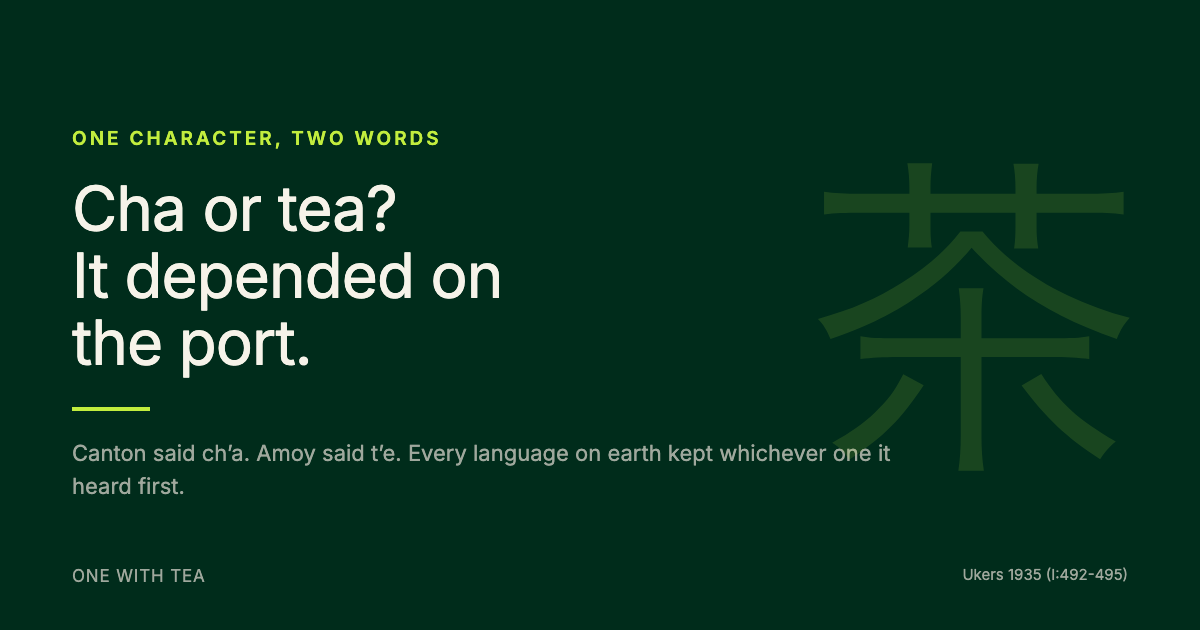
Both words are the same Chinese character, 茶, pronounced two different ways in two different parts of China. In Cantonese it is ch'a. In the dialect of Amoy, the Fujian port now called Xiamen, it is t'e. Whichever pronunciation a foreign trader heard first is the one their language kept, and has kept ever since.
That is the whole mechanism. The interesting part is what decided which one a trader heard.
The split is not impressionistic. The World Atlas of Language Structures surveys the word for tea across 230 languages and finds 110 built on Sinitic cha, 84 on Min Nan te, and 36 from some other source. Two Chinese pronunciations account for 194 of them.
The rule everyone repeats, and why it fails
You will often see this summarised as tea if by sea, cha if by land: the overland Silk Road carried cha west, while European ships carried te home. It is neat, it is memorable, and it breaks on the first country you check.
Portugal went by sea and says chá.
Writing in 1935, Ukers explains why, and it has nothing to do with ships. The Portuguese were the first Europeans to establish themselves commercially in China, from 1516, and they did their business with merchants from Canton. So they learned the Cantonese word. Ukers notes that Portuguese was the only European language to take cha that way.
The Dutch came next, and bought differently. Their first tea did not come from China directly at all. It came from Bantam, in Java, carried there by Chinese merchants out of Amoy, in Fujian. So the Dutch learned the Amoy word, t'e, and wrote it thee.
Then the multiplier: every other European country bought its early tea from the Dutch, and took the Dutch word with the cargo. English, French, German, Spanish, Italian, all of them descend from that one purchasing decision in a Javanese port.
Modern linguistics reaches the same conclusion by a different road. WALS puts it plainly: "The Dutch traders, who were the main importers of tea into Europe, happened to have their main contacts in Amoy (Xiamen) in Fujian." On the Portuguese side it differs from Ukers in one detail, placing their contact at Macao rather than Canton. Both are Cantonese-speaking, so the substance holds either way: the Portuguese heard cha because of where they stood.
The real rule: not sea versus land, but which Chinese port you dealt with. Canton gave you cha. Amoy gave you te. Portugal and the Netherlands both sailed, and ended up on opposite sides of the map.
The overland branch, and why it sounds different
The cha family spread east and west overland long before any European ship arrived. Ukers dates the start to the last quarter of the fifth century, when Turkish caravans reached China's northern border and tea first became an export. The Arabs later obtained Chinese tea through the Usbeck Tartars.
There is a detail here that most retellings flatten. The Turkish chay, Russian chai and Arabic shai do not come from the bare syllable ch'a. Ukers traces them to the compound ch'a-ye, meaning "tea leaf". That is why this branch carries a second sound the Portuguese branch does not, and why Persian, Hindi, Russian and Turkish all land on a two-part word.
Japan is the clean case. It imported the word cha, the character, and the first tea seeds together from China in the eighth century. Word and plant arrived in the same shipment.
Where each language landed
| Language | Word | From | How it arrived |
|---|---|---|---|
| Portuguese | chá | Cantonese | By sea, trading at Canton from 1516 |
| Japanese | cha | Chinese, direct | 8th century, with the first seeds |
| Persian | chā | Cantonese | Overland, via the Usbeck Tartars |
| Russian | chai | ch'a-ye, "tea leaf" | Overland by caravan |
| Turkish | çay | ch'a-ye, "tea leaf" | Overland, caravans from the 5th century |
| Arabic | shai | ch'a-ye, "tea leaf" | Overland, via the Usbeck Tartars |
| Dutch | thee | Amoy (Min Nan) | By sea, bought at Bantam from Amoy merchants |
| English | tea | Amoy, via Dutch | Bought from the Dutch |
| French, German, Spanish | thé, Tee, té | Amoy, via Dutch | Bought from the Dutch |
Ukers writes these romanisations in the convention of his day. In modern pinyin the Mandarin is chá, and the Min Nan of Amoy is tê. The sounds are the same; only the spelling convention has moved.
The character had to be invented first
None of this could happen until tea had a word of its own, and for a long time it did not.
Ukers puts the arrival of the present character at about AD 725. Before that, Chinese writers borrowed t'u, 荼, a character that carried three unrelated meanings: sow-thistle or bitter cabbage, grass or rush, and tea. Which one an author meant had to be read from context, which is why references to tea before the eighth century are argued over rather than settled.
The fix was a stroke of the brush, literally. The character 茶 was formed from 荼 by removing one horizontal stroke. A seventh-century commentator, Yen Shih Ku, recorded the change as it happened. Within about half a century, around 780, Lu Yu wrote the Ch'a Ching, the first book about tea, using the new character throughout.
How the word reached English
Late, and awkwardly. Ukers notes that the word appears nowhere in the Bible, nowhere in Shakespeare, and in no English publication before the second half of the seventeenth century. It simply did not exist in the language.
When it arrived it arrived unstable. English records from the 1650s use tee, and it was pronounced "tay". East India Company records spell it thea in 1664 and tey by 1668. The company had not settled on a spelling four years apart.
The spelling settled to tea in 1660, but the sound did not follow for another lifetime. You can hear the old pronunciation in Pope, writing in 1711:
Here thou, great Anna! whom three realms obey,
Dost sometimes counsel take, and sometimes tea.
Alexander Pope, The Rape of the Lock, 1711
It only rhymes if tea is said "tay". Ukers, following the Hobson-Jobson dictionary, puts the shift to the modern sound between 1720 and 1750. By about the later date Thomas Moore is rhyming tea with "Mrs. P.", and the change is done.
Frequently asked questions
What does cha mean?
It is simply the Chinese word for tea, the character 茶, in its Cantonese and Mandarin pronunciation. It is not a different plant or a different preparation. Languages that took the word overland or through Canton use a form of it.
Why is tea called cha in some countries and tea in others?
Because traders heard different Chinese dialects. Cantonese says ch'a; the Amoy dialect of Fujian says t'e. Portugal traded at Canton and got chá. The Dutch bought from Amoy merchants and got thee, then sold both the tea and the word onward to the rest of Europe.
Is "tea if by sea, cha if by land" true?
No. Portugal reached China by sea and says chá. The rule confuses a rough correlation for the cause. What decided the word was which Chinese port, and so which dialect, a trader dealt with.
Where does chai come from?
From the compound ch'a-ye, meaning "tea leaf", rather than from ch'a alone. That extra syllable is why Russian chai, Turkish çay, Persian and Hindi all carry a second sound. In English, "chai tea" therefore says tea twice.
Does matcha come from the same word?
Yes. Matcha is 抹茶, and the second character is the same 茶. The first means ground or rubbed. We wrote about that in what the word matcha really says.
Sources
- Ukers, William H. All About Tea. New York: The Tea and Coffee Trade Journal Company, 1935. Vol. I, Ch. XXIII "Etymology of Tea", pp. 492-495. Full scan at the Internet Archive. Ukers in turn cites Bretschneider's Botanicon Sinicum (1893), Dudgeon's The Beverages of the Chinese (1895), Brinkley's China (1902) and Olearius (1647) for the dates and routes above.
- Dahl, Östen. "Tea", chapter 138 in The World Atlas of Language Structures Online. wals.info/chapter/138. The 230-language survey and the 110 / 84 / 36 split, and an independent account of the Dutch Amoy contact.
- Cross-checked against Etymology of tea, which gives the same two dialect origins and notes the Portuguese exception.
The vocabulary in this piece, and roughly 130 other tea words including the 1935 trade terms and where their meanings have since drifted, is defined in the Tea Lexicon. For the ceremony that grew up around the character, see what the Japanese tea ceremony actually is.
Share:
Japan Exports the Same Weight of Tea Today as in 1932
Does Chlorophyll Detox Your Body? What the Research Actually Says