



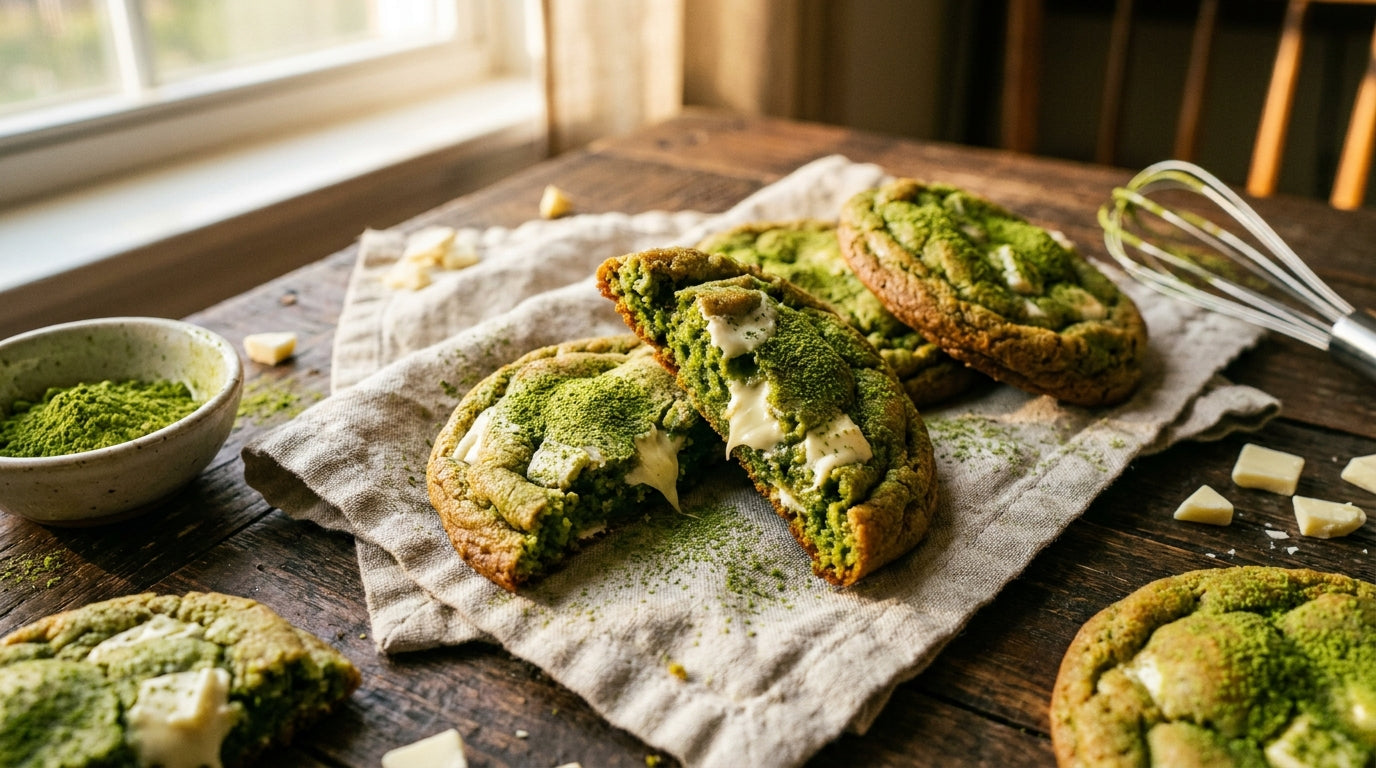
These matcha cookies are chewy in the center, slightly crisp at the edges, and finished in 25 minutes from bowl to cooling rack. The combination of earthy stone-ground matcha and sweet white chocolate is one of those pairings that just works, the bitterness and the sweetness balancing each other exactly the way good tea balances itself.
US matcha retail sales are up 86% over three years (Food Dive, 2025), and baking is one of the biggest reasons. People are moving past matcha lattes into matcha desserts, and cookies are the easiest entry point. No stand mixer required. No tempering. No complicated technique. Just a bowl, a whisk, and good matcha.
Key Takeaways
- Latte grade matcha (not ceremonial) is the right choice for baking. It's processed for heat stability, delivers vibrant color, and costs less per gram.
- The underbake method (pulling cookies when centers look slightly raw) is what creates the chewy texture. They firm up on the sheet.
- Two tablespoons of matcha is the sweet spot for 24 cookies. One tablespoon is too subtle, three gets bitter.
- Sifting matcha with the dry ingredients prevents green clumps from showing up in your finished cookies.
Ingredients
This recipe makes 24 cookies. All measurements are by volume with gram equivalents for precision.
Dry ingredients:
- 2 cups (250g) all-purpose flour
- 2 tablespoons latte grade matcha powder
- 1 teaspoon baking soda
- 1/2 teaspoon salt
Wet ingredients:
- 3/4 cup (170g) unsalted butter, softened to room temperature
- 3/4 cup (150g) granulated sugar
- 1/4 cup (50g) light brown sugar, packed
- 1 large egg + 1 egg yolk (the extra yolk adds chewiness)
- 2 teaspoons vanilla extract
Mix-ins:
- 1 cup (175g) white chocolate chips
Why latte grade matcha? Culinary and ceremonial matcha are processed differently. Latte grade is milled specifically for recipes where matcha encounters heat, fat, and sugar. It holds its color at baking temperatures and has a more robust flavor that stands up against butter and chocolate. Ceremonial grade is designed for drinking straight, where you'd taste its delicate sweetness and umami. In a cookie, those subtle notes get buried.
Step-by-Step Instructions
1. Prep your dry ingredients (2 minutes)
Sift the flour, matcha, baking soda, and salt together into a medium bowl. Sifting matters here more than in most cookie recipes because matcha powder is extremely fine and tends to clump. If you skip this step, you'll end up with pockets of concentrated matcha in some cookies and none in others.
2. Cream butter and sugars (3 minutes)
In a large bowl, beat softened butter with both sugars until light and fluffy, about 2-3 minutes. The combination of white and brown sugar is intentional: white sugar gives you crisp edges, brown sugar keeps the center chewy and adds a subtle molasses depth that pairs well with matcha's earthiness.
Baking tip: Your butter should be soft enough to dent easily with a finger but not melted or glossy. Melted butter makes flat, greasy cookies. Cold butter makes cakey ones.
3. Add eggs and vanilla (1 minute)
Beat in the egg, egg yolk, and vanilla extract until just combined. The extra egg yolk (without the white) is a classic pastry trick for chewiness. Egg whites add structure and crispness, yolks add fat and richness. We want rich and chewy, so we tip the ratio toward yolks.
4. Combine wet and dry (1 minute)
Add the dry ingredients to the wet in two additions, mixing on low speed or by hand just until the flour disappears. Stop mixing the moment you don't see dry streaks. Overmixing develops gluten, and gluten makes cookies tough instead of tender.
5. Fold in white chocolate (30 seconds)
Use a spatula to fold in the white chocolate chips. The reason we fold by hand rather than using the mixer: we want the chips distributed but the dough handled as little as possible at this point.
6. Scoop and bake (12 minutes)
Preheat your oven to 350°F (175°C). Scoop rounded tablespoons of dough onto parchment-lined baking sheets, spacing them about 2 inches apart. Bake for 10-12 minutes.
Here's the critical part: Pull the cookies when the edges look set but the centers still appear slightly underdone and puffy. They'll look like they need another 2 minutes. They don't. The residual heat from the baking sheet will continue cooking them as they rest, and in 5 minutes you'll have perfectly chewy centers with just enough structure to hold together.
One thing to know about matcha cookies specifically: the deep green color makes it harder to judge doneness by sight compared to a standard sugar cookie. Don't wait for golden edges, they won't come the same way. Trust the timer and the touch test: gently press the center, and if it feels like a soft marshmallow with slight resistance, they're ready.
7. Cool properly (5 minutes)
Let the cookies rest on the baking sheet for a full 5 minutes before transferring to a wire rack. Moving them too early when they're still soft causes breakage. Moving them too late means the bottoms keep cooking from the hot sheet.
Baking Temperature and Matcha Amount
These two variables make the biggest difference in your results. Here's what we've found through testing.
Why Latte Grade Matcha Works Better Than Ceremonial for Baking
This comes up in almost every baking conversation, so let's address it directly: ceremonial grade matcha is not better for cookies. It's different, and in this context, it's actually worse. A study in the Journal of Food Science (2016) found that chlorophyll degradation in green tea accelerates significantly above 170°C (338°F), which is why baking temperature control matters so much for color retention.
Ceremonial matcha is shade-grown for maximum L-theanine and chlorophyll content, then stone-ground to an ultra-fine particle size designed to dissolve in water. Its flavor profile is delicate, sweet, with pronounced umami. All of that subtlety gets completely masked by butter, sugar, and white chocolate in a cookie.
Latte grade matcha is processed at slightly higher temperatures during the final drying stage, which actually makes its chlorophyll more stable when exposed to oven heat. That's why latte grade cookies come out greener than ceremonial grade cookies baked at the same temperature. It's counterintuitive, but the "lower grade" matcha is engineered for exactly this use.
Cost matters too. Ceremonial matcha typically runs $1-2 per gram, while quality latte grade sits around $0.30-0.60 per gram. This recipe uses about 12g of matcha. At ceremonial prices, that's $12-24 worth of matcha per batch of cookies. At latte grade prices, it's $3.50-7.00. The cookies will taste the same.
Common Mistakes (and How to Avoid Them)
Overbaking
This is the number one reason matcha cookies turn out disappointing. Even one extra minute at 350°F can take you from chewy to dry. Set a timer. Don't rely on visual cues alone, because the green color of matcha makes it genuinely difficult to spot the golden-edge signals you'd use for regular cookies. When the edges feel firm to the touch and the center jiggles slightly when you tap the pan, pull them.
Using too much matcha
More green does not mean more flavor. It means more bitterness. Matcha contains catechins, particularly EGCG, and tannins that become astringent and drying at high concentrations. According to research in Food Chemistry (2019), matcha contains up to 137 times more EGCG than regular steeped green tea because the whole leaf is consumed. Two tablespoons gives you that "this is clearly a matcha cookie" flavor without the chalkiness. If you want a stronger matcha presence, try reducing sugar by 2 tablespoons rather than adding more powder. Less sweetness lets the matcha you already have stand out more clearly.
Not sifting the matcha
Matcha is ground to particles between 5-10 microns. For reference, that's smaller than a red blood cell. At that size, the powder clumps on contact with moisture in the air. If you dump unsifted matcha into butter and try to beat it in, you'll end up with pockets of concentrated matcha surrounded by plain dough. A 30-second sift through any fine mesh strainer solves this completely.
Cold butter
Room temperature butter (65-68°F) is essential. Cold butter doesn't cream properly with sugar, and the matcha won't distribute evenly through cold fat. Set your butter out 30-45 minutes before you start, or microwave it in 5-second bursts, checking after each one. You want it soft enough to dent with your finger, not soft enough to slump.
Storage Tips
Matcha cookies are best within the first 48 hours, when the centers are still at peak chewiness. After that, they're still good but gradually shift toward a more uniform, slightly firmer texture.
- Room temperature: Store in an airtight container for up to 5 days. Layer parchment paper between cookies to prevent sticking.
- Refrigerator: Not recommended. Cold firms up the butter and white chocolate, making them dense rather than chewy. If you do refrigerate, let cookies come to room temperature for 10 minutes before eating.
- Freezer: Baked cookies freeze well for up to 2 months in a sealed container. Thaw at room temperature for 15-20 minutes. Alternatively, freeze the dough in portioned balls and bake from frozen (add 1-2 minutes to bake time), which actually gives you the freshest results.
A note on matcha and light: The chlorophyll in matcha degrades with light exposure, which means cookies stored in clear containers on a countertop will gradually lose their green vibrancy. An opaque container or tin preserves the color longer. This doesn't affect taste, just appearance.
Variations
Dark chocolate matcha cookies
Swap white chocolate chips for dark chocolate (70% cacao or higher). The bitterness of dark chocolate amplifies the matcha flavor instead of softening it, giving you a more intense, less sweet cookie. Reduce sugar by 2 tablespoons if using very dark chocolate, since the overall flavor profile shifts toward bitter and the sugar needs to come down to match.
Matcha shortbread
Use this same matcha amount (2 tablespoons) in a basic shortbread recipe: 1 cup butter, 1/2 cup powdered sugar, 2 cups flour, plus the matcha. The higher butter ratio in shortbread carries matcha flavor beautifully, and the crumbly, melt-in-your-mouth texture is a different but equally satisfying experience. Bake at 325°F for 15-18 minutes. Shortbread should barely take on color.
Matcha sandwich cookies
Make the cookies slightly smaller (use a teaspoon instead of tablespoon for scooping) and fill pairs with white chocolate ganache. For the ganache: heat 1/2 cup heavy cream until it just simmers, pour over 1 cup white chocolate chips, wait 2 minutes, stir until smooth. Let it cool to a spreadable consistency before filling. These make excellent gifts and look striking with the green cookies framing the white center.
Matcha cookie ice cream sandwiches
Let cookies cool completely, then sandwich a scoop of vanilla or matcha ice cream between two cookies. Wrap in plastic and freeze for at least 1 hour to set. The contrast between cold, creamy ice cream and the chewy, earthy cookie is something special.
Frequently Asked Questions
Can I use ceremonial grade matcha for cookies?
You can, but it's not worth the cost. Ceremonial matcha is designed for drinking straight, where you taste its delicate umami and sweetness. In baking, the butter, sugar, and chocolate overpower those subtle notes. Latte grade matcha is specifically processed for heat applications, delivers the same vibrant color, and costs significantly less per gram.
Why are my matcha cookies brown instead of green?
Two common causes: the oven temperature is too high, or the matcha quality is low. High heat degrades chlorophyll, which gives matcha its green color. Bake at 350°F (175°C), not higher. Also check your matcha. If it's already yellowish-brown in the tin, it's likely oxidized or low grade. Fresh, properly stored latte grade matcha should be vibrant green.
How much matcha should I put in cookies?
For 24 cookies, 2 tablespoons (about 12g) gives you a clear matcha flavor with vibrant color. One tablespoon produces a milder, more subtle taste. Going above 3 tablespoons can make cookies taste bitter and chalky. Start with 2 tablespoons and adjust next batch based on your preference.
Can I make matcha cookie dough ahead of time?
Yes, and it actually improves the cookies. Refrigerating the dough for 24-48 hours lets the flour fully hydrate, producing a chewier texture and more concentrated flavor. Wrap the dough tightly in plastic wrap. You can also freeze portioned dough balls for up to 3 months, adding 1-2 minutes to bake time from frozen.
Are matcha cookies caffeinated?
Mildly. Each cookie contains roughly 6-8mg of caffeine (based on 2 tablespoons of matcha across 24 cookies). For comparison, a cup of coffee has about 95mg according to USDA data. It's a very small amount per serving, but worth knowing if you're sensitive to caffeine or serving them to children late in the evening.
From Our Kitchen to Yours
Baking with matcha is one of those small, quiet ways to bring more intention into your day. There's something about the color, that deep, living green, that reminds you this came from a real plant, grown in shade on a Japanese hillside, stone-ground into powder. When you sift it into flour and watch the bowl turn green, you're connecting with a tradition that's been alive for centuries, just adapted into a new form.
We source our organic latte grade matcha directly from farms in Uji, Japan, and it's the same matcha we use for every recipe on this site. If you try these cookies, we'd love to hear how they turn out. Tag us or drop us a note. Every batch is a little different, and that's part of what makes baking with real, whole ingredients worth the effort.
Share:
The Ultimate Matcha Green Smoothie: Spinach, Pineapple and Matcha
5 Matcha Breakfast Ideas That Take Less Than 10 Minutes