



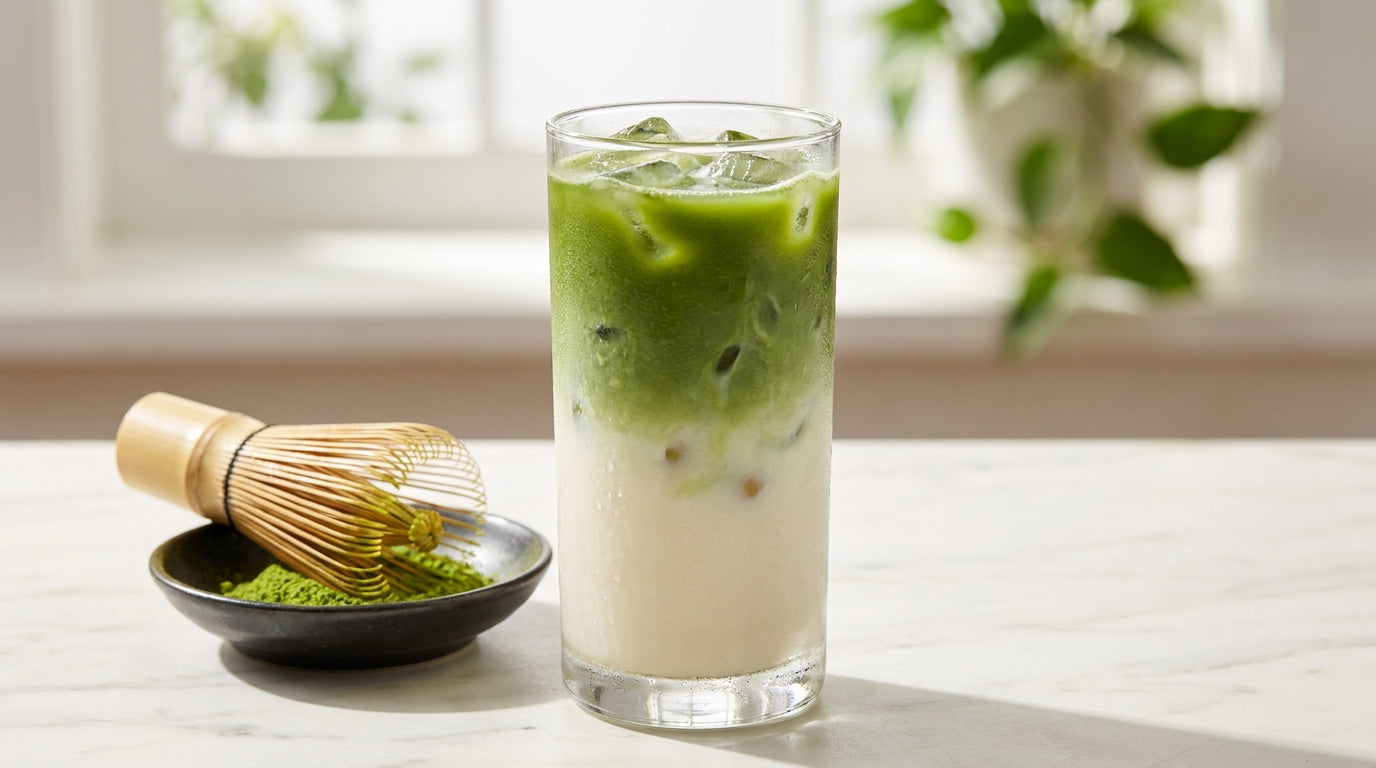
Matcha menu items grew 30% year-over-year across US cafes in 2025 (Tastewise, 2025), and iced matcha lattes are driving most of that growth. But here's the thing: the version you're making at home can genuinely taste better than what most cafes serve, because you control the one variable they often compromise on, the quality of the matcha itself.
This recipe takes five minutes. No special equipment required beyond a whisk (bamboo or regular) and a glass. The method matters more than the gadgets, and the paste-first technique below is how tea practitioners in Japan have been preparing matcha for centuries, just adapted for a cold drink.
Key Takeaways
- The paste-first method (matcha + hot water before milk) prevents clumps and produces a smoother drink than dumping powder directly over ice.
- Water temperature matters: 170°F (77°C) extracts sweetness and umami without the bitterness that boiling water creates.
- US matcha retail sales are up 86% over three years (Food Dive, 2025), making quality powder harder to find, so sourcing matters more than ever.
What You Need for an Iced Matcha Latte?
Five ingredients and about two minutes of prep. The Japanese Ministry of Agriculture reported that tencha (the leaf ground into matcha) hit a record 5,336 metric tons of production in 2024 (IntTea, 2025), yet supply still can't keep up with global demand. Starting with quality matcha is the single biggest factor in how your latte turns out.
Ingredients
- 2g (1 tsp) latte grade matcha powder, sifted to remove clumps
- 60ml (2 oz) hot water at 170°F / 77°C (not boiling)
- 240ml (8 oz) milk of choice (see our milk pairing guide below)
- Ice cubes, enough to fill your glass
- Sweetener (optional), 1-2 tsp simple syrup, honey, or maple syrup
Equipment
- Fine mesh strainer or matcha sifter
- Whisk (bamboo chasen is ideal, but a small regular whisk or milk frother works)
- Small bowl or wide cup for whisking
- Tall glass (12-16 oz)
How to Make an Iced Matcha Latte (Step by Step)
Our approach: We tested this recipe with six different milks and three sweeteners before settling on these ratios. The method below works whether you're using a bamboo chasen or the back of a fork. The key is always the same: make the paste first.
Step 1: Sift your matcha. Place your fine mesh strainer over a bowl and push 2g of matcha through with a spoon. This takes 15 seconds and eliminates the clumps that ruin texture. Don't skip this. Even high-quality matcha powder compresses during shipping.
Step 2: Add hot water and whisk. Pour 60ml of 170°F water over the sifted matcha. Whisk vigorously in a W or M motion (not circular) for 15-20 seconds. You should see a smooth, vibrant green paste with tiny bubbles across the surface. This concentrated paste is your matcha shot.
Step 3: Build your glass. Fill a tall glass to the top with ice. Pour your milk over the ice until the glass is about three-quarters full.
Step 4: Layer the matcha. Here's where it gets beautiful. Slowly pour your matcha concentrate over the back of a spoon, letting it float on top of the milk. You'll get that layered green-over-white gradient. Stir when you're ready to drink, or enjoy the visual for a moment first.
Why Does Water Temperature Matter So Much?
Water above 185°F (85°C) extracts more catechins and tannins from matcha, which is what creates bitterness. Water at 170°F (77°C) pulls out the L-theanine and amino acids responsible for sweetness and umami while keeping the harsh compounds in check. A 2020 study in Food Science and Biotechnology found that catechin stability decreases continuously at higher temperatures (PMC7406592, 2020). In practical terms, the difference between 170°F and boiling water is the difference between a drink you want to sip and one you need to mask with sugar.
Most iced matcha recipes online say "use hot but not boiling water" without explaining why. The reason is amino acid extraction. L-theanine, the compound that gives matcha its characteristic calm focus and smooth sweetness, dissolves efficiently at lower temperatures. Boiling water doesn't add more L-theanine to your cup, it just adds more bitterness alongside it. So you're not being precious about temperature, you're being practical.
No thermometer? Boil your kettle, then let it sit with the lid off for 3-4 minutes. That gets you close to 170°F. Or pour the boiling water into a room-temperature cup first (drops it about 15°F), then pour over your matcha.
Which Milk Works Best with Matcha?
The global matcha market is projected to reach $9.12 billion by 2033 (Mordor Intelligence, 2025), and much of that growth is driven by matcha lattes. Your milk choice shapes at least half the flavor experience. Here's what we've found after testing every common option.
Our finding: In our side-by-side tasting of six milks with the same matcha, oat milk (barista-style) and whole dairy tied for best overall pairing. Both have enough fat to create body without masking the matcha. Almond milk's nutty flavor competed with the matcha's umami, making it our least favorite for a drink where you want matcha to be the star.
Oat milk is our top recommendation. Barista-style oat milk has enough fat content to create a creamy, latte-like texture while its mild sweetness complements matcha rather than competing with it. It also froths well if you want to get fancy.
Whole dairy milk is the classic. The natural milk fat rounds out matcha's vegetal notes and enhances the umami. If you're not avoiding dairy, this is arguably the most balanced pairing.
Coconut milk adds a tropical note that works surprisingly well in summer. Use full-fat canned coconut milk diluted 1:1 with water, not the thin carton version.
Almond milk is popular but not our favorite for matcha specifically. Its distinct nutty flavor can overpower the more delicate matcha notes. If you use it, go unsweetened.
Sweetener Pairings: What Works (and What Doesn't)
A 2025 Tastewise analysis found that "less sugar" and "no added sugar" are among the fastest-growing consumer preferences in the tea category (Tastewise, 2025). Good matcha has a natural sweetness from L-theanine, so you may not need a sweetener at all. But if you prefer your iced latte on the sweeter side, not all sweeteners play nicely with matcha's umami character.
Simple syrup (equal parts sugar and water, dissolved) is the cleanest option for iced drinks because it mixes instantly. It sweetens without adding competing flavors. This is what most cafes use.
Honey adds floral notes that can complement lighter, more delicate matcha. Dissolve it in the hot water along with the matcha paste, since honey doesn't dissolve well in cold liquids. The warmth of the water (170°F) is enough to melt it.
Maple syrup brings a depth that pairs well with matcha's earthiness, especially in fall and winter versions. A little goes a long way.
Avoid agave (too neutral and cloying at the sweetness level matcha needs) and artificial sweeteners (they create an aftertaste that clashes with matcha's natural flavor). Vanilla extract (1/4 tsp) is a nice addition if you want a vanilla matcha latte variation.
Pro Tips for a Better Iced Matcha Latte
Matcha social media mentions jumped 107% year-over-year in 2025 (Tastewise, 2025), which means plenty of people are making matcha lattes at home for the first time. Here are the details that separate a good iced matcha latte from a great one.
Sift every time. Yes, every time. Matcha powder is incredibly fine and compresses during storage. Even the best matcha will clump if you skip sifting. It takes 15 seconds and saves you from gritty lumps floating in your drink.
Make matcha ice cubes. Freeze leftover matcha (mixed with water) in an ice cube tray. Use these instead of regular ice cubes and your latte won't get watery as the ice melts. This is the single best trick for iced matcha drinks.
Use a wider bowl or cup for whisking. Trying to whisk matcha in a narrow mug is frustrating. A cereal bowl or wide-mouth cup gives your whisk room to move in that W pattern. The result is a smoother, better-aerated paste.
Don't shake it in a jar. Some recipes suggest shaking matcha in a mason jar. This works in a pinch, but it introduces too much air and creates a frothy texture that's more like matcha foam than a smooth latte. The paste method gives you control over the texture.
Variations to Try
Vanilla Iced Matcha Latte: Add 1/4 tsp vanilla extract to the matcha paste. Pairs beautifully with oat milk.
Lavender Matcha Latte: Add 1/2 tsp dried culinary lavender to the hot water, steep for 2 minutes, strain, then whisk with matcha. For our full version, see our lavender matcha latte recipe.
Coconut Matcha Latte: Use full-fat coconut milk and top with toasted coconut flakes. Our coconut matcha latte recipe has the full breakdown.
Strawberry Matcha Latte: Blend 3-4 fresh strawberries with the milk before building. Layer the pink milk, then pour matcha on top for a striking color contrast. Our Strawberry Matcha blend makes this even easier.
Double-Shot Matcha: Use 3g matcha instead of 2g with the same amount of water. Stronger matcha flavor that holds up better against sweeter milks.
What Makes a Good Matcha for Lattes?
US matcha retail sales are up 86% over three years (Food Dive, 2025), which means there's more matcha on shelves than ever, and a lot of it isn't great. For iced lattes specifically, here's what to look for.
Latte grade (not ceremonial) is the right choice for iced lattes. Ceremonial matcha is designed for drinking straight with water. Its delicate flavor profile gets lost under milk and sweetener. Latte grade matcha is milled to be slightly bolder, with more presence in mixed drinks. It's also more affordable, which matters when you're making lattes daily.
Color tells you a lot. Good latte grade matcha should still be a vibrant green, not olive or yellowish. Dull color usually means the matcha was exposed to heat during processing or the leaves were harvested too late in the season.
Origin matters. Japanese matcha from regions like Uji, Nishio, or Kagoshima follows stricter cultivation standards than most matcha produced elsewhere. Our guide to matcha growing regions breaks down what each region brings to the cup.
Our USDA Organic Latte Grade Matcha is specifically blended for drinks like this. It's bold enough to shine through milk and ice while still delivering that smooth, clean matcha flavor without bitterness.
Frequently Asked Questions
Can I make iced matcha without a whisk?
Yes. A small regular whisk, milk frother, or even a fork works. The key is creating a smooth paste with the hot water before adding milk. A bamboo chasen produces the finest texture, but any vigorous whisking tool gets you 90% of the way there. You can also use a small jar with a tight lid and shake vigorously for 20 seconds.
How much caffeine is in an iced matcha latte?
About 38-70mg per serving, depending on how much matcha you use. A 2g serving (this recipe) contains roughly 38-50mg, less than a typical 8oz coffee (95mg) but more than most teas. The L-theanine in matcha modulates how you experience the caffeine, producing calm alertness rather than jitters.
Why does my matcha taste bitter?
Three likely reasons: your water was too hot (above 185°F), you used too much matcha for the amount of water, or the matcha itself is low quality or stale. Try reducing to 170°F, use the 2g:60ml ratio, and check that your matcha is vibrant green and stored properly. Matcha oxidizes quickly once opened, so use it within 4-6 weeks.
Can I make this the night before?
You can pre-mix the matcha paste and refrigerate it for up to 24 hours. But don't assemble the full latte in advance, the ice will melt and dilute it. In the morning, just pour the pre-made paste over fresh ice and milk. Takes about 30 seconds.
Is there a difference between hot and iced matcha preparation?
The paste-making step is identical. The difference is in ratios: iced lattes use more milk (240ml vs 160ml for hot) because ice dilutes the drink as it melts. Using matcha ice cubes instead of regular ice solves this completely.
Your Daily Iced Matcha Ritual
An iced matcha latte isn't complicated. Five minutes, a few good ingredients, and a little attention to temperature and technique. That's it. The paste-first method is how matcha has been prepared for centuries, just poured over ice instead of sipped from a bowl.
We built One with Tea around the idea that great tea doesn't need to be fussy. Our Latte Grade Matcha is sourced from Japanese farms we've visited, USDA organic certified, and ground to dissolve smoothly in cold drinks. If you've been paying $6 for cafe matcha lattes, making them at home with quality ingredients is a revelation.
Tomorrow morning, try this recipe once. Notice the color when you pour the matcha over the milk. Notice the first sip. There's a reason this drink is having a moment, and it starts with the powder in your cup.
Share:
Fall Matcha Baking Recipes with Pumpkin Spice: A Craft-First Guide for Home Bakers
The Ultimate Matcha Green Smoothie: Spinach, Pineapple and Matcha