



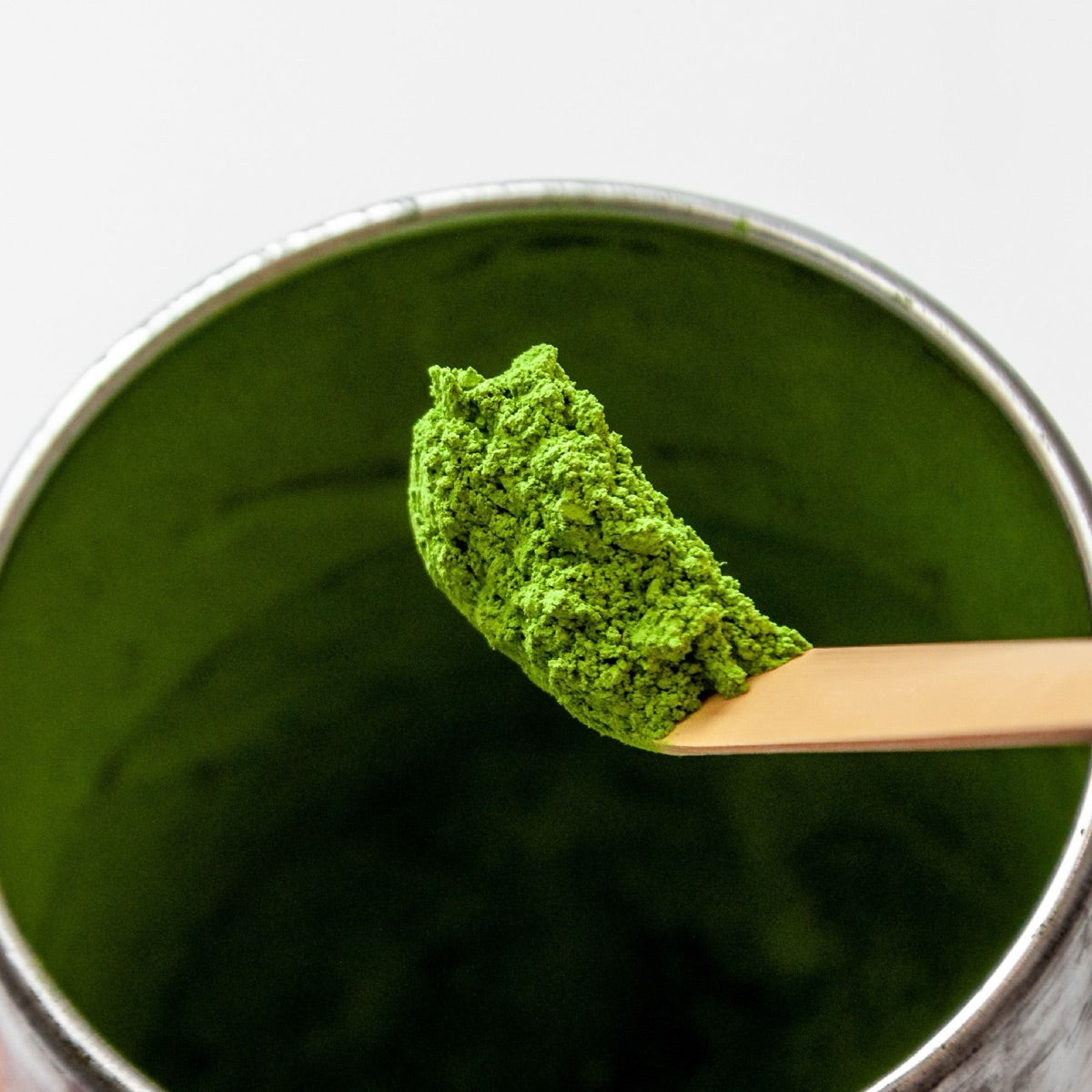
Decaf matcha is real, it's rare, and every published process I could find forces the same trade: you can protect what's in the leaf, or you can remove enough caffeine to legally call it decaf. I could not find a published process that does both. The gentlest documented method leaves more than twice the caffeine that Germany's food code accepts before the word can be used. The method that clears that bar strips about 87% of the catechins on the way through.
That trade matters more for matcha than for any other tea, for a reason that has nothing to do with quality and everything to do with how you drink it. You swallow the leaf.
I've spent time on farms in Shizuoka and Kyushu watching growers cover a field for three weeks to build one compound. So I went looking for what happens to that compound when the caffeine comes out. Here's what I found, including the parts where the honest answer is that nobody has measured it.

Does decaf matcha exist?
Yes. Based on producer listings and product pages I reviewed in September 2026, which I'm not naming here because we don't stock or endorse them, a small number of Japanese producers decaffeinate tencha and then grind it. Kyoto comes up most often. The whole conventional matcha chain stays intact, with one extra step inserted before milling. It isn't moringa or barley grass in a green tin. It's tea.
The regional picture is here: where Japan's tea is really grown.
Three different things get sold under the same words, though, and separating them is most of the work:
- Genuinely decaffeinated tencha, processed and milled in Japan. Rare, and the extra processing step makes it expensive.
- Reduced-caffeine matcha, marketed on reduction figures around 80% in the listings I looked at. Lower in caffeine, but not low enough for the one national standard that puts a number on the word.
- Non-tea green powders sold with matcha aesthetics. These never contained caffeine, and they contain none of the compounds that come from Camellia sinensis either.
Only the first is what most people picture when they search for this. If you want the baseline first, we covered how much caffeine is in matcha separately.
How is tea decaffeinated, and do those methods reach matcha?

Supercritical CO2 is the method that actually reaches matcha, and it's the one the producers name. Carbon dioxide held above its critical point behaves like a solvent, and a cosolvent gets added to help it pick up caffeine. Which cosolvent they choose turns out to decide everything, as the next section shows.
Three other methods exist, and each has a catch.
Hot water is the cheapest and safest, and its constraint settles the matcha question. Sun's team summarise the constraint plainly, citing earlier work: hot water treatment "can only be used to treat fresh tea leaf and it could not selectively remove caffeine from dry tea" (Sun et al. 2010, Journal of Medicinal Plants Research 4(12):1161-1168, retrieved 4 September 2026). You can't bolt it onto finished matcha. It has to happen upstream, on fresh leaf, inside the most controlled part of the craft chain.
Ethyl acetate gets marketed as "naturally decaffeinated" because the compound occurs in fruit. It's industrially synthesised for this use. It's a permitted extraction solvent in the EU under Directive 2009/32/EC. I couldn't find an open peer-reviewed measurement of what it costs green tea specifically, so I'm not going to give you a number for it.
Methylene chloride, also called dichloromethane, is effective and has fallen out of favour, though it has not been banned for this use. One correction here, because it travels: the 10 ppm residue limit people cite is real, but it sits at 21 CFR 173.255 and covers decaffeinated roasted coffee and coffee extract. Not tea. Anyone quoting that figure for tea is quoting a coffee rule.
Europe is the opposite case, and it is worth being accurate about it. Directive 2009/32/EC does authorise dichloromethane for "decaffeination of, or removal of irritants and bitterings from coffee and tea", with a residue limit of 2 mg/kg in roasted coffee and 5 mg/kg in tea. So a tea-specific limit does exist. It is European, not American.
The Swiss Water Process gets mentioned in this context too. It's a trademarked, coffee-specific system built around a saturated green-coffee extract and a carbon filter bed. A water-only principle exists for tea. That branded process isn't it.
What decaffeination takes along with the caffeine
The catechin cost isn't a fixed number. It's a function of how polar the solvent is, and the range is enormous. Two papers using the same supercritical CO2 technology disagree by more than an order of magnitude, and that disagreement is the actual story.
Sun's paper sits in a weakly indexed journal, so I checked its numbers against the PDF itself rather than a summary, and the group behind it publishes tea chemistry widely elsewhere. As far as I can tell nobody has replicated it. They ran a cosolvent screen, and it's the cleanest single-variable result in this literature. Under the same conditions, ethanol removed 67.4% of the caffeine for 7.2% of the catechins. Water removed 78.0% of the caffeine and took 67.6% of the catechins with it. Changing nothing but the cosolvent multiplied the catechin loss roughly ninefold. Sun's separate optimised run, at 80 degrees Celsius and 300 bar, pushed ethanol to 70.2% of the caffeine for 6.2% of the catechins. Push harder still, as Wang and colleagues did at 32 MPa with 150 mL of water, and you remove 98.2% of the caffeine and 87.2% of the catechins (Wang et al. 2022, Foods 11(20):3269, doi:10.3390/foods11203269, retrieved 4 September 2026).
If you are comparing, here is caffeine and L-theanine across every tea type.
| Condition | Caffeine removed | Total catechins removed | Source |
|---|---|---|---|
| CO2 + ethanol, cosolvent screen | 67.4% | 7.2% | Sun 2010 |
| CO2 + water, same screen | 78.0% | 67.6% | Sun 2010 |
| CO2 + ethanol, optimised, 80 °C, 300 bar | 70.2% | 6.2% | Sun 2010 |
| CO2 + water, 32 MPa, 50 °C | 98.2% | 87.2% | Wang 2022 |
Within the catechins, the losses aren't even. The gallated ones go first. In the Wang study, ECG fell 96.0%, EGCG 90.9%, GCG 88.6% and EGC 66.2%. EGCG is the catechin most people have in mind when they buy matcha at all.
For a Japanese tea brand, though, the buried headline sits elsewhere. Wang et al. 2022 measured a 26.9% reduction in total amino acids in green tea, and reported theanine as almost entirely removed. Theanine is what shade growing is for. Growers cover a field for weeks precisely to build it.
What that predicts for the bowl, and I want to be clear this is a prediction from the chemistry rather than a tasting note: less umami, less body, and a thinner, more vegetal cup. Theanine is the sweetness and the roundness. Take most of it out and the tea has less to stand on.
Two honest caveats on that. Wang measured green and black tea, not tencha. I could find no published study measuring decaffeination on tencha specifically, so read this as the nearest available evidence rather than a direct measurement of decaf matcha. And I found no study measuring chlorophyll or colour change from tea decaffeination at all. If someone tells you decaf matcha is duller green because of the process, they're guessing, and so would I be.
Why matcha is the hardest case in tea

With leaf tea, a catechin left behind in the spent leaf was never going to reach your cup anyway. With matcha you swallow the leaf, so anything the process extracts is subtracted from the product itself.
That isn't just my reasoning. The German Food Code makes the distinction explicitly, and names matcha while doing it. Clause 1.1 reads: "Verzehrt wird üblicherweise der Aufguss ohne die extrahierten Teeblätter oder Pflanzenteile. Bei einzelnen Spezialitäten, z. B. Matcha, werden die Pflanzenteile mitverzehrt." In my translation: usually the infusion is consumed without the extracted tea leaves or plant parts. But in individual specialities, matcha among them, the plant parts are consumed as well (Leitsätze für Tee, Deutsche Lebensmittelbuch-Kommission, 25 April 2022, retrieved 4 September 2026).
The processing loss is the same in both cases. The consequence is not. Decaffeinate a sencha and you've changed what the water can pull out. Decaffeinate a tencha and you've changed what's in the bowl, permanently, because there's no spent leaf to throw away.
Add the hot-water constraint to the leaf-swallowing problem and the picture tightens further. The gentlest method has to be applied to fresh leaf. That means intervening before or around steaming, upstream of the drying and milling the whole category is built around. It isn't a finishing step. It's surgery in the middle of the craft chain.
An international technical report defines matcha: ISO/TR 21380:2022. Its scope says it "does not apply to flavoured matcha tea, blended matcha tea, or decaffeinated or soluble extracts of matcha tea" (ISO/TR 21380:2022, clause 1, retrieved 4 September 2026). I'd like to tell you that settles it. It doesn't, quite. That sentence can be read as excluding decaffeinated matcha, or as excluding only decaffeinated and soluble extracts, and the parallel structure of the first two items argues for the narrower reading. So I'll say what's defensible: ISO's definition is built around shading, steaming, unrolled drying and fine grinding, and it doesn't contemplate a decaffeination step anywhere in that chain.
What "decaffeinated" legally means, and what it mostly doesn't
There's no US or EU-wide numeric threshold for calling a tea decaffeinated. The one clear standard I could verify is German, and it's 0.4%.
The German Food Code is unambiguous. Decaffeination may only be indicated if the dry matter of the tea contains no more than 0.4% caffeine, with a separate 1.2% threshold for tea extracts (Leitsätze für Tee, clauses 1.4.1 and 1.4.7). The Leitsätze are guidelines describing accepted trade practice rather than statute, though departing from them is treated as misleading. The same document sets the baseline that makes the number mean something, stating at clause 1.3.7 that tea contains at least 1.5% caffeine in dry matter. It also carves out an exception, naming kukicha and other specialities as teas that can sit lower.
For ordinary tea, then, the German threshold implies a reduction of at least 73%, from the 1.5% floor down to the 0.4% ceiling.
Now the numbers that don't survive checking, and I'd rather list them than repeat them.
- "EU Regulation 1169/2011 requires 99.9% caffeine removal for decaf tea." There's no such percentage. The regulation does name decaffeinated tea, in Annex V point 8, but only to exempt it from the mandatory nutrition declaration. It never defines the term or attaches a number to it (Regulation (EU) No 1169/2011, consolidated text, retrieved 4 September 2026).
- "The FDA requires 97% removal." No such section exists. The FDA has no standard of identity for tea at all.
- "Decaf green tea has zero caffeine." USDA FoodData Central does list brewed decaffeinated green tea at 0.0 mg per 100 g (FoodData Central, FDC ID 171910, SR Legacy, retrieved 4 September 2026). That contradicts every process paper above, and no method removes 100%. Treat it as a reporting limitation, not as evidence.
Here's the figure that ties the article together. Sun's gentle, catechin-sparing optimum left 9.48 g/kg of caffeine in the finished tea, roughly 0.95% of dry weight. That's more than twice the German threshold. The process that protects the tea doesn't qualify as decaf, and the process that qualifies as decaf doesn't protect the tea. Wang doesn't report residual caffeine as a share of dry matter, but 98.2% removal from a typical green tea would land far inside the German ceiling. That last step is my arithmetic, not theirs.
Japan is worth a note. The familiar 90% removal figure behind カフェインレス and デカフェ comes from a fair competition code for coffee labelling, and I couldn't locate an equivalent numeric code for tea. What Japanese labelling does draw cleanly is the distinction between カフェインレス, meaning caffeine was removed from something that had it, and ノンカフェイン, meaning the plant never had any. That's where mugicha and sobacha sit.
How much caffeine is actually in your bowl?

Matcha powder contains 3.2 g of caffeine per 100 g, which works out to about 64 mg in a standard 2 g bowl. That figure comes from the Standard Tables of Food Composition in Japan, item 16035, where it sits in the remarks column of the chapter 16 tables (MEXT, 日本食品標準成分表 (7th revision), chapter 16, retrieved 4 September 2026). Matcha has no infusion row in that table, because you drink the powder. The 64 mg is my arithmetic on their number, not a separately measured value.
Set 64 mg against the published safety reference points. The European Food Safety Authority concluded that single doses up to 200 mg don't raise safety concerns for healthy adults. Nor do habitual intakes up to 400 mg per day. During pregnancy the figure is 200 mg per day from all sources (EFSA NDA Panel, EFSA Journal 2015;13(5):4102, doi:10.2903/j.efsa.2015.4102, retrieved 4 September 2026). The FDA cites 400 mg per day for most adults, and puts decaffeinated coffee at 2 to 15 mg per 8 fl oz (FDA Consumer Update, retrieved 4 September 2026).
One 2 g bowl at 64 mg is roughly a third of EFSA's single-dose figure. Three bowls would sit close to the pregnancy figure from matcha alone, though that's a general population guideline rather than advice for any particular person, and it's a reason someone might genuinely want a decaf option. Worth saying plainly rather than treating the question as silly.
Individual response varies. If you're pregnant or you manage a condition, talk to your doctor before changing your routine rather than working from a table.
One caution on sourcing, since it affects most articles on this topic. USDA FoodData Central has no analytical entry for matcha powder. Searches return manufacturer-submitted label data only. Anything citing "USDA figures" for matcha caffeine per teaspoon is citing something that doesn't exist in that database.
What to drink instead when you want less caffeine

The most reliable way to drink less caffeine isn't to process a tea. It's to choose a tea that started lower, and brew it the way it's meant to be brewed.
Hojicha is the usual answer, and the usual explanation for it is wrong. Roasting doesn't destroy caffeine in any meaningful quantity. Trials at the Kochi Prefecture tea experiment station found almost no reduction from a light roast, and only a 6 to 13% reduction from a deep roast (高知県農業技術センター茶業試験場, 焙煎程度とほうじ茶の品質, retrieved 4 September 2026). Those trials ran a gentle two-pass protocol at exhaust temperatures of 90 and 100 degrees Celsius, well under the 178 degrees at which caffeine sublimes (PubChem CID 2519, citing HSDB and the ILO-WHO International Chemical Safety Cards). That is exhaust temperature, not leaf temperature, and a harder commercial roast may behave differently. I could not find a study that measured one.
What roasting removes is dramatic, just not caffeine. Measured against a standard sencha, hojicha came in at 20.71 versus 24.70 mg/g of caffeine. Over the same comparison theanine fell from 18.91 to 0.32 mg/g, and EGCG from 62.16 to 9.00 mg/g (Unno et al. 2025, Foods 14(1):103, doi:10.3390/foods14010103, retrieved 4 September 2026).
| Compound | Standard sencha | Hojicha | Difference |
|---|---|---|---|
| Caffeine | 24.70 | 20.71 | 16% lower |
| EGCG | 62.16 | 9.00 | 86% lower |
| Theanine | 18.91 | 0.32 | 98% lower |
Here is the part most articles skip, including ones that recommend hojicha for exactly this reason. In the Japanese tables hojicha's infusion is not lower than sencha's. Both come in at about 20 mg per 100 mL. The genuinely low ones are bancha and genmaicha. Hojicha drinks light because of what goes into it, coarse late-harvest leaf, older leaves and stems. The Japanese composition tables brew it at 15 g to 650 mL for thirty seconds. At that ratio its infusion measures about 20 mg of caffeine per 100 mL, with bancha and genmaicha nearer 10 mg (MEXT, chapter 16, items 16039 to 16041).
Kukicha works on the same logic from a different angle. In the Kochi trials, stem tea measured about 77% of first-flush leaf caffeine. Zhang's team, summarising earlier work, report that stems carry more theanine and less polyphenol than leaves, which would explain why karigane tastes sweet rather than thin (Zhang et al. 2022, Foods 11(15):2357, doi:10.3390/foods11152357, retrieved 4 September 2026). That study looked at a Chinese green tea, not a Japanese one, so treat it as the direction of travel rather than a measurement of kukicha.
If that's the direction you want, we mapped the whole ladder in our guide to low-caffeine Japanese green teas, and the comparison with brewed leaf sits in matcha versus green tea caffeine.
Frequently asked questions
Is there such a thing as caffeine-free matcha?
No. Decaffeination removes most of the caffeine, never all of it. In the best-documented gentle process the finished tea still held about 0.95% caffeine by dry weight. Products marketed as caffeine-free green powders are usually not tea at all, and contain none of the compounds that come from the tea plant.
Does decaf matcha still have EGCG and theanine?
Some, and how much depends entirely on the process. A gentle ethanol-cosolvent run retained about 94% of total catechins but removed only 70% of the caffeine. A run aggressive enough to reach decaf-grade caffeine levels reduced EGCG by 90.9% and cut total amino acids by 26.9%, with theanine almost entirely removed. Both figures come from studies on green tea rather than tencha.
Is decaf matcha still real matcha?
It's real tea, made from real tencha. Whether it's matcha by the international definition is genuinely unsettled. ISO/TR 21380:2022 excludes "decaffeinated or soluble extracts of matcha tea" from its scope, and that wording can be read either as covering decaffeinated matcha or as covering only extracts. What's clear is that the ISO definition describes shading, steaming, unrolled drying and fine grinding, with no decaffeination step anywhere in it.
How much caffeine is left in decaf tea?
There's no reliable published measurement of commercial decaffeinated tea per cup, and I'd be inventing a number if I gave you one. The nearest honest benchmarks are the German food-code threshold of 0.4% of dry matter, and the FDA's figure of 2 to 15 mg per 8 fl oz for decaffeinated coffee.
Which Japanese tea is naturally lowest in caffeine?
By the Japanese Standard Tables of Food Composition, bancha and genmaicha infusions come in lowest at about 10 mg per 100 mL, with hojicha and sencha at about 20 mg at comparable brewing ratios. Kukicha has no entry in that table, though stem tea measures around 77% of first-flush leaf caffeine in the Kochi Prefecture trials.
Can you decaffeinate matcha at home?
No. The hot-water method only works on fresh leaf and can't selectively remove caffeine from dry tea, and rinsing a powder simply washes the tea away. The often-repeated thirty-second rinse trick applies to leaf tea, and even there it softens the cup rather than decaffeinating it.
Where One with Tea stands on decaf matcha
We don't make one. Not out of purism, but because every process we've looked at asks you to give up either the caffeine reduction or the shading chemistry, and we haven't seen one that does both. If that changes, and someone publishes measured numbers on tencha rather than a marketing claim, we'll look again.
What we do make is matcha worth the caffeine it carries, and a roasted and stem tea range for the hours when it isn't the right drink. If you're sourcing for a cafe, a studio or a shop, our wholesale program covers both ends of that. If you're drinking at home, the full range is here.
Questions about any of this, or a source you think I've got wrong, reply to any of our emails and it reaches me directly.
Christian Mauerer, Founder, One with Tea
Share:
Blue Matcha Is Not Matcha: What Butterfly Pea Powder Really Is
Rare Japanese Teas: Kamairicha, Tamaryokucha, and Japan's Fermented Banchas