



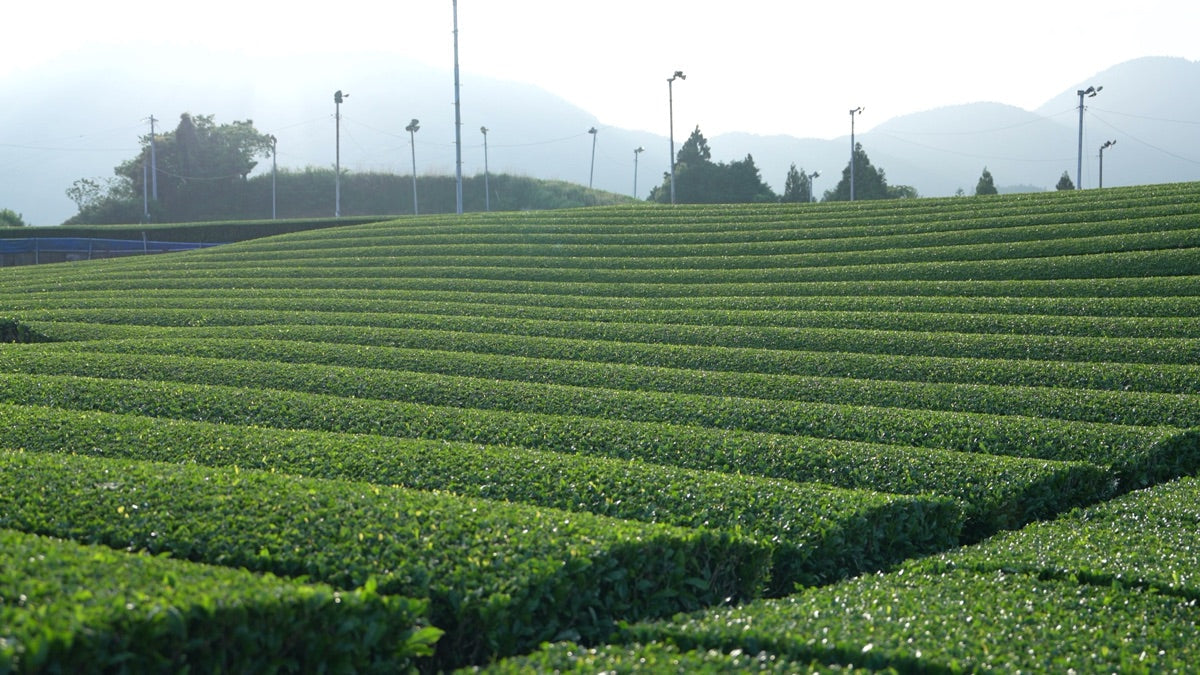
by Christian Mauerer, founder of One with Tea, who filmed with tea growers across Shizuoka and Kyushu in May 2025
Nara Prefecture has bred exactly one tea cultivar in its history, and almost nobody has tasted it. Yamatomidori entered Japan's national register in 1953 as 茶農林10号, Chanorin No. 10, then went nowhere at home: extremely late, slow to establish, low-yielding, shipped into blends rather than sold by name.
The English-language web knows it for one claim, that it is a parent of Meiryoku. The register says otherwise, and settling that opens a better story, one that runs through Saitama, Japan's northern-limit tea prefecture. We do not sell it, and it is not a tea most people will ever get to try.

What is the Yamatomidori tea cultivar?
Yamatomidori (やまとみどり, 大和緑) is a Japanese sencha cultivar registered in 1953 as 茶農林10号, Chanorin No. 10, and carried through trials as 奈良59号. It was selected from seedlings of Nara's native zairai tea, 奈良在来種実生, and it is the only tea cultivar Nara Prefecture has ever bred.

From our tea room
Superior Sencha Green Tea - USDA Organic Japanese First Flush
First-flush loose leaf, USDA Organic, direct from Japanese family farms.
View Superior SenchaKey Takeaways
- Nara's only cultivar. MAFF calls it 「奈良県が過去唯一育成した品種」. Registered 1953, line name 奈良59号, registered use 煎茶, sencha.
- Not a parent of Meiryoku. The register gives Meiryoku やぶきた×Z1, and Z1 is a natural-hybrid seedling of Tamamidori out of Uji.
- It nearly disappeared at home. 極晩生, extremely late, plus poor early growth and low productivity, left it 「栽培面積は非常に少ない」, a very small planted area.
- Cold hardiness saved its genes. Winter frost damage and 裂傷型凍害, bark-split frost injury, are both rated 極強, extremely strong.
- Three registered cultivars carry it: Okumusashi (1962), Nagomiyutaka (2012) and Okuharuka (2015), all through Saitama lines.
Where did Yamatomidori come from?

One cultivar is Nara's entire breeding record. Saitama's prefectural list carried eleven registered cultivars as of July 2026. Nara bred one, in 1953, and nothing since.
Provenance matters as much as the date. Yamatomidori is 奈良在来種実生, a seedling selection out of Nara's native zairai tea, so nobody designed it. Most plants in our guide to Japanese tea cultivars have a cross behind them. This one has a hillside.
That hillside is the 大和高原, the Yamato Plateau, where the Nara grower 月ヶ瀬健康茶園 records 「厳寒期の低温」, deep-winter cold, and 「季節の変わり目に起こる急激な気温の変化」, sharp temperature swings at the turn of the seasons. A plant selected there was selected for cold.
Why did Yamatomidori almost disappear?

The ministry's verdict runs to three clauses. 極晩生, extremely late budding. 「初期生育も悪く」, poor early growth. 「生産性も低い」, low productivity. The consequence is just as flat: 「栽培面積は非常に少ない」, a very small planted area.
Late means late. The Nara grower 月ヶ瀬健康茶園 puts budding and picking ten days or more behind Yabukita, and My Japanese Green Tea gives ten. In a crop where the first flush carries the value, that is not a detail.
Then there is how Nara sells tea: 「系統出荷を中心とする本県の流通特性上、本種の単品販売も無い」. Because the prefecture ships in bulk into blends, there was no single-cultivar sale of this plant at all. A cultivar never named on a package builds no following, and without one, no grower accepts a late, low-yielding bush. Hence 幻の品種, the phantom cultivar.
What does the register actually say about Meiryoku?
Yamatomidori is not a parent of Meiryoku, whatever the English-language pages say. My Japanese Green Tea's Meiryoku page and the pages that copy it have Meiryoku made by crossing Yabukita with Yamatomidori. The Chanorin register gives Meiryoku (茶農林35号, line name 金谷6号, 1986, Kanaya) the pedigree やぶきた×Z1, Yabukita crossed with Z1.
So are Z1 and Yamatomidori one plant under two labels? No. NARO's pedigree chart records Z1 as 国立茶業試験場育成, bred at the national tea experiment station, a natural-hybrid seedling of たまみどり, Tamamidori, itself an Uji selection, 宇治在来種実生. Yamatomidori is 奈良在来種実生, Nara stock. The specialist nursery 心向樹 lists the two separately. Our article on the Z1 cultivar works through that record.
Be precise about what is corroborated by what. The pedigree itself, やぶきた×Z1, rests on the Chanorin register, and Meiryoku has no card in NARO's sixth-edition handbook to check it against. What NARO does corroborate is the part that matters here, that Z1 is a distinct line out of Tamamidori and so cannot be Yamatomidori. 心向樹's cultivar list gives the same cross independently, 「”やぶきた”と”Z1”を交配し誕生」, and lists Yamatomidori and Z1 as two separate plants. I wanted that second reading because the compiled register is not infallible: it misprinted the Sayamakaori pedigree that our Musashikaori article had to correct earlier this year.
The error is easy to sympathise with. My Japanese Green Tea, a reference I cite elsewhere here, says on its Meiryoku page that Yabukita and Yamatomidori were crossed. That page is well indexed, so the claim travels, and it reached us too: it was sitting in the brief that commissioned this article.
What I am glad about is that our article on Meiryoku already declined it: 「Some sources online identify Z1 as the cultivar Yamatomidori. [...] I cannot verify the claim, so I am leaving Z1 as the register leaves it.」 That was the right call made without the proof in hand. Z1 stays Z1.
The Saitama legacy: Okumusashi, Nagomiyutaka, Okuharuka

Yamatomidori failed as a crop and succeeded as a parent, and every success runs through Saitama, the northern limit of Japanese tea. When your problem is winter, a bush rated 極強 against winter frost damage and bark-split frost injury is exactly the germplasm you want.
Okumusashi (おくむさし) is the direct child: 茶農林26号, 1962, bred in Saitama from さやまみどり×やまとみどり. Our article on Sayamamidori carries the same pedigree, which is the second source I wanted before trusting the compiled list.
Nagomiyutaka (なごみゆたか) is a grandchild, crossed in 1988 in Miyazaki and registered on 14 November 2012 as plant variety No. 22071. Its seed parent is 埼玉16号, which NARO's chart gives as やまとみどり♀ × 埼23F1-17♂.
Okuharuka (おくはるか) is the other, crossed in 1975 in Saitama and registered on 11 March 2015 as No. 23946, out of 埼玉20号, さやまみどり♀ × やまとみどり♂. That is the same pairing that produced Okumusashi, so 埼玉20号 is a separate Saitama selection out of the same cross rather than Okumusashi under a line number. Saitama's own page confirms the 2015 date.
| Cultivar | Register | Registered | Bred in | Relationship to Yamatomidori |
|---|---|---|---|---|
| Okumusashi (おくむさし) | 茶農林26号 | 1962 | Saitama | Direct child, さやまみどり×やまとみどり |
| Nagomiyutaka (なごみゆたか) | No. 22071 | 14 Nov 2012 | Miyazaki | Grandchild via 埼玉16号 (Yamatomidori as ♀) |
| Okuharuka (おくはるか) | No. 23946 | 11 Mar 2015 | Saitama | Grandchild via 埼玉20号 (Yamatomidori as ♂) |
Look at the partner each time. Sayamamidori for Okumusashi, Sayamamidori again for Saitama No. 20, a Saitama line for Saitama No. 16. That is not an accident: a prefecture fighting winter went looking for cold tolerance and found it in a plant Nara could not grow profitably. Our pieces on Musashikaori and Sayamaakari cover two more of Saitama's cultivars, neither of them descended from Yamatomidori.
The late budding reads differently up there too. 月ヶ瀬健康茶園 makes the point that in a frost-prone spring, budding late is frost avoidance rather than a defect. A bush that has not pushed its shoots has nothing for a frost to take.
What does Yamatomidori taste like?

The nickname 天然玉露, natural gyokuro, is about colour. The leaf comes in naturally deep green, the darkness you would expect from shaded tea, without the shading. It is long elliptical and medium sized. Nothing in the name implies the growing method of real gyokuro.
For the cup I have one published tasting rather than my own. A September 2024 note from the Japanese tea retailer Senchado gives 「ほのかに甘い香り」, a faintly sweet aroma, over dried shiitake and kombu, summed up as 「昔ながらのお店の香り」, an old-fashioned dried-goods shop, with 「蒸したての葉野菜のような香り」, freshly steamed leafy greens, underneath.
The shape is the useful part. Sweetness first, umami accumulating rather than landing at once, a heavier second infusion carrying greenness, umami and bitterness together, and a long finish, 「余韻がだいぶ長い」. One taster, one tea.
The revival: kabusecha, black tea, matcha, and a 2x price

Nara went back to this plant on purpose, and MAFF's extension case study records it year by year. A 2014 grower survey found it being made into more than ordinary sencha: かぶせ茶, kabusecha; 紅茶, black tea; and 食品添加用抹茶, matcha for food manufacturing.
In 2016 the propagation work started. Three growers took 900 plants each, and 3節2葉 cuttings, three nodes and two leaves, gave good seedlings at about half the cost of cell-raised ones. Nara's tea research centre notes, via 月ヶ瀬健康茶園, that those cuttings were the first planting of this cultivar in the prefecture in sixty years.
Then the number that changes the argument. In 2017 the first flush sold to Tokyo-area traders at 「奈良県市況の2倍以上」, more than twice the Nara market price. New planting came to three households and 30 ares, 0.3 hectares. Four Nara confectionery businesses began selling products made with its matcha from 2017, and the cultivar was shown at the 全国地紅茶サミット on 4 and 5 December 2016.
How do you brew Yamatomidori?
The honest part first: no source gives a water temperature or a steep time for this cultivar, and I will not invent one. What the record gives you is the registered use, 煎茶, and one published tasting.
So I work backwards from that tasting. Sweetness ahead of building umami, then a heavier second infusion, is a pattern I brew cooler and longer first, then hotter and much shorter. Around 70°C, plenty of leaf, close to a minute is where I start with any umami-forward sencha, including the organic Japanese sencha we actually sell.
If you do meet it, ask the maker what style it is first. Sencha, kabusecha, black tea and food-grade matcha are four different sets of instructions for one plant.
Frequently asked questions
Is Yamatomidori a parent of Meiryoku?
No. The Chanorin register gives Meiryoku (茶農林35号, 金谷6号, 1986, Kanaya) the pedigree やぶきた×Z1, Yabukita crossed with Z1. NARO's chart records Z1 as a natural-hybrid seedling of Tamamidori, an Uji selection bred at the national tea experiment station. Yamatomidori is a Nara selection. Two different plants.
When is Yamatomidori picked?
Late, which is the whole problem and also the whole point. Yamatomidori is classed 極晩生, extremely late budding, and the Nara grower 月ヶ瀬健康茶園 puts it ten days or more behind Yabukita for both budding and picking. That wrecks its place in a harvest schedule built around Yabukita, but on a frost-prone plateau a bush that has not yet pushed its shoots has nothing for a late frost to take.
Can you buy Yamatomidori tea?
Rarely, and One with Tea does not sell it. Its planted area is very small, and because Nara ships into bulk blends there was historically no single-cultivar sale of it at all. Since 2017 some first flush has gone to Tokyo-area traders at more than twice the Nara market price, and four Nara confectionery businesses use its matcha.
Which cultivars descend from Yamatomidori?
Three registered ones. Okumusashi (茶農林26号, 1962, Saitama) is the direct child, from Sayamamidori crossed with Yamatomidori. Nagomiyutaka, registered 2012 as No. 22071, descends through Saitama No. 16. Okuharuka, registered 2015 as No. 23946, descends through Saitama No. 20.
Why is Yamatomidori called natural gyokuro?
Because of leaf colour, not growing method. The Nara grower 月ヶ瀬健康茶園 records the nickname 天然玉露 for the cultivar's naturally deep green leaf, a darkness usually associated with shaded tea. The name says nothing about shading.
A note from me
I have never tasted Yamatomidori, we do not sell it, and in five weeks filming with growers in Shizuoka and Kyushu nobody mentioned it once. That is the accurate picture of a plant with a very small planted area in a prefecture that ships into blends.
What I did not expect was how good the real story is. A brief landed on my desk saying Yamatomidori is a parent of Meiryoku, and the register says it is not. Underneath that error sat Nara's single contribution to the national list: a bush too late to earn its keep at home, whose cold hardiness made it worth breeding from in the coldest tea prefecture in the country. The correction is small. What it uncovers usually is not.
Buying tea for a shop, cafe or studio? We supply organic Japanese tea at wholesale, with the same attention to where each lot comes from. See our wholesale program and tell us what you are pouring.
Christian
Founder, One with Tea
Sources
- Chanorin registered cultivar list (附表1 茶農林登録品種一覧), hosted by minorien: list, PDF in Japanese. The register lines for やまとみどり, めいりょく and おくむさし. Two caveats: the site soft-404s, so a bogus path still returns HTTP 200 and this was validated on contents rather than status code, and this compiled table misprinted a pedigree on a sibling article this year, so every pedigree taken from it here is corroborated elsewhere.
- NARO, 茶品種ハンドブック 第6版: handbook, PDF in Japanese. Pedigree charts on PDF pages 47 and 48: Z1 out of Tamamidori, Nagomiyutaka via 埼玉16号, Okuharuka via 埼玉20号, with both registration numbers and dates.
- MAFF with Nara Prefecture, 奈良県育成品種「やまとみどり」の特徴を活かした商品開発: case study, PDF in Japanese. The central document: Nara's only bred cultivar, the late budding, poor early growth and very small planted area, the bulk-shipment sentence, and the whole revival record through to the 2017 double price.
- Saitama Prefecture, 埼玉県の茶の品種: cultivar list, in Japanese. Eleven registered cultivars as of July 2026, the contrast with Nara's one, and confirmation of Okuharuka's 2015 registration.
- 月ヶ瀬健康茶園, a Nara grower on the Yamato Plateau: the grower's essay on Yamatomidori, in Japanese. The 極強 cold-hardiness and bark-split frost ratings, and the Yamato Plateau climate description. Ten days or more behind Yabukita, lateness as frost avoidance, the 天然玉露 nickname, and the 2016 cuttings as the prefecture's first planting in sixty years.
- Senchado, cultivar tasting note, September 2024: tasting note, in Japanese. The only published tasting I found: faintly sweet aroma, dried shiitake and kombu, steamed leafy greens, sweetness ahead of accumulating umami, a heavier second infusion, a long finish.
- My Japanese Green Tea, Yamatomidori profile: cultivar page, in English. Cited for the profile only, including the ten-day gap behind Yabukita. Caveat: the same site's Meiryoku page says Yabukita and Yamatomidori were crossed, which is the error corrected above.
Share:
Musashikaori: Named for Its Aroma, Specified for Its Umami
Koju: The Unregistered Tea Cultivar That Smells of Grapes