



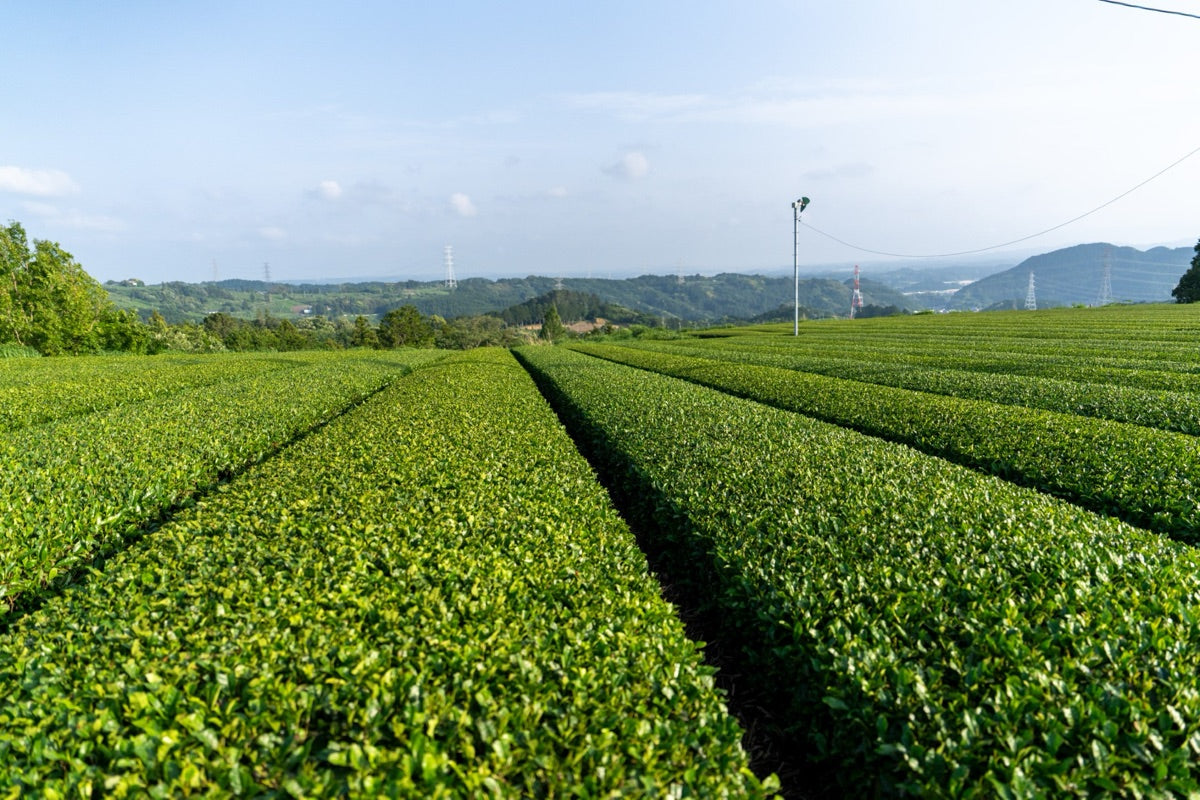
In January 2021 Saitama Prefecture registered a new tea cultivar called Sayamaakari. Its pollen parent is Sayamakaori, the prefecture's own workhorse and the fifth most-planted tea cultivar in Japan.
The regional picture is here: which Japanese prefectures actually grow the tea.
So a public breeding institute spent forty years building a plant whose main job was to beat the plant it already had. That sounds like institutional stubbornness until you read why. The target was never Sayamakaori's yield. It was Sayamakaori's two known faults, both of which growers had been living with since 1971, and both of which show up in the cup.
Key Takeaways
- Sayamaakari was registered on 26 January 2021 as plant variety number 28264 under Japan's Seed and Seedling Act. It is not a Chanorin cultivar.
- It comes from a cross made in 1981. Seed parent 60F1-148, a third-generation Taiwan-variety line. Pollen parent Sayamakaori. Forty years from cross to registration.
- On mature bushes it yielded 308 kg per 10 ares of first flush, 162 percent of Yabukita, ahead of Sayamakaori's 290 kg.
- It carries strong resistance to mulberry scale, inherited from Sayamakaori and confirmed with a gene marker. It is weak to anthracnose.
- Its defining trait is bright fresh green colour, bred specifically to remove the blackish tone Sayamakaori is known for.

What is the Sayamaakari tea cultivar?
Sayamaakari (さやまあかり) is a Japanese green tea cultivar for sencha, which the Saitama Prefectural Tea Research Institute in Iruma City bred and registered as a protected plant variety on 26 January 2021, registration number 28264 (高橋淳ら, 茶業研究報告 135, 2023). During trials it carried the line name SAYAMA002.
One thing to settle immediately, because Saitama has now produced three cultivars whose names all begin with Sayama and the differences matter.
- Sayamamidori, registered 1953, the oldest of the three.
- Sayamakaori, registered 1971, by far the most widely planted.
- Sayamaakari, registered 2021, the newest.
Sayamamidori and Sayamakaori are unrelated to each other despite the near-identical names. Sayamaakari is the exception: it genuinely descends from Sayamakaori, which is its pollen parent. If you remember one thing about the naming, make it that one. The oldest two are strangers and the newest is family.
For how the wider naming and numbering system works, our guide to Japanese tea cultivars covers it.
Why it is not a Chanorin cultivar, and why that is easy to get wrong
Japan runs two separate systems that both get translated as "registered", and Sayamaakari sits in only one of them.
The Chanorin (茶農林) system is the national tea cultivar register. That is where Yabukita's number 6 and Sayamakaori's number 31 come from. Sayamaakari has no Chanorin number. What it has is a plant variety registration under the Seed and Seedling Act, the breeder's rights system, number 28264.
The paper trail is specific. An in-house review committee approved it as a registration candidate in January 2017. The institute filed the application on 22 February 2017. The ministry published it on 25 May 2017 and granted it on 26 January 2021 (茶業研究報告 135, 2023).
This matters practically, because it explains an absence. Sayamaakari does not appear in NARO's national tea cultivar handbook, whose sixth edition was updated in August 2022 and therefore postdates the registration by more than a year (農研機構, 茶品種ハンドブック 第6版). I want to be careful about what that absence proves, which is nothing on its own. A plant can be missing from a handbook for any number of dull editorial reasons. The reason I can state the registration status positively is that the breeding paper prints the number and the grant date, not that I failed to find the plant somewhere else.
Forty years from a single 1981 cross

Breeders made the cross in 1981. The seed parent was a line called 60F1-148, described in the breeding record as a third-generation Taiwan variety carried for its distinctive aroma and flavour lineage (茶業研究報告 135, 2023). The pollen parent was Sayamakaori.
What followed was slow even by the standards of tree crops:
- 1982, seed collected and sown.
- 1984, planted out into the field.
- 1984 to 1989, individual plant selection.
- 1991 to 1993, nursery selection trials.
- 2012, entered the promising-line comparison trial as SAYAMA002.
- 2017, named Sayamaakari and the application published.
- 2021, registered.
Forty years from the pollination to the certificate. There is a thirty-year gap in the middle of that list where the plant was simply being grown and watched. Tea is a perennial shrub that takes years to reach a yield you can honestly measure, and the yield figures below come from the seventh year after planting for exactly that reason.
The Taiwanese seed parent is the part I did not expect. Saitama's newest cultivar is half Saitama workhorse and half imported aroma line, and the institute kept that maternal side in play for three generations before it was ever crossed with Sayamakaori.
The late frost problem that made a new plant necessary

Most cultivars registered in recent decades are plucked earlier than Yabukita. In warm regions that is a straightforward commercial advantage: an earlier first flush is a more valuable first flush.
Saitama cannot use it. The prefecture sits near the practical northern limit of commercial tea in Japan, and its last frost date falls after budbreak. An early cultivar planted there does not give you an early harvest. It gives you tender new shoots standing out in a frost. The breeding record makes the point plainly: in Saitama, early cultivars almost never achieve the earlier plucking that the same plants achieve in warm districts (茶業研究報告 135, 2023).
So the requirement was narrower than "breed something earlier". It was: breed something cold-hardy that can still be plucked earlier than Yabukita, in a place where the weather punishes anything that wakes up too soon. That constraint is why the programme kept coming back to Sayamakaori, which is hardy, and why it took as long as it did.
The two faults it was built to fix

Sayamakaori's strengths are not in dispute. It is robust, high-yielding, recovers well from cold and frost damage, and resists mulberry scale. That is why growers plant it across the country.
Its two recorded faults are just as consistent. In the processed leaf it carries a blackish cast to the colour (色沢の黒み), and in the cup it carries a bitter astringency (滋味の苦渋味). Saitama's other slightly early cultivar, Sainomidori, tends toward the same darkness.
The brief for Sayamaakari was therefore unusually explicit for a breeding programme: hold onto the robustness, the high yield and the scale resistance, and get rid of the blackness. The result is a plant whose headline trait is its colour. The breeding record describes the leaf as 鮮緑, bright fresh green, and specifically notes it lacks Sayamakaori's dark tone (茶業研究報告 135, 2023). The mature leaf is a lighter green than its parent's, and the shape is a narrow ellipse.
On flavour the record is more measured, and I would rather quote it than improve on it: the taste combines umami with an astringency still recognisably like Sayamakaori's. Half the brief, then. The colour fault was fixed. The astringency is still in there.
What the yield figures actually say

These are from the breeding site, seventh year after planting, measured in 2021, in kilograms per 10 ares.
| Cultivar | First flush | vs Yabukita | Second flush | vs Yabukita |
|---|---|---|---|---|
| Sayamaakari | 308 kg | 162% | 548 kg | 215% |
| Sayamakaori | 290 kg | 153% | 400 kg | 157% |
| Yabukita | 190 kg | 100% | 255 kg | 100% |
The first flush margin over Sayamakaori is real but modest, roughly six percent. The second flush margin is the striking one: 548 kg against 400 kg, which is where "higher yielding even compared to the high-yielding Sayamakaori" stops being a slogan and starts being a number.
The mechanism is recorded too. Sayamaakari yields more because it puts up more buds per unit of plucking surface and because those buds are individually heavier. It is not a taller or wider plant doing the work, it is a denser and fatter flush (茶業研究報告 135, 2023).
One counterweight worth knowing. In refining, Sayamaakari returned 84.8 percent against Sayamakaori's 86.4 percent, which the record treats as equivalent. But it produced a higher proportion of bud tea and stem tea, and graders repeatedly noted that stems are more visible in the finished leaf. If you are buying on appearance, that is a mark against it, and it is in the breeder's own paper rather than a critic's.
Strong against the pest, weak against the disease
Mulberry scale (Pseudaulacaspis pentagona, クワシロカイガラムシ) is classed in the Japanese literature as a 難防除害虫, a hard-to-control pest. At the breeding site, scale infestation on Sayamaakari was almost absent, at the same level as Sayamakaori, which is rated strong. Graders rated Sayamaakari strong on that basis, and the finding was confirmed independently: the plant tested positive for the scale resistance gene marker derived from Sayamakaori (茶業研究報告 135, 2023).
That is a clean piece of inheritance. The trait came from the pollen parent, and they could point to the marker rather than only to the field observation.
Anthracnose is the other side of the ledger. Sayamaakari showed slightly less anthracnose than Sayamakaori, which is rated weak, but about the same as Yabukita, which is also rated weak. So graders rated it weak. A cultivar bred to fix its parent's faults inherited the parent's disease susceptibility more or less intact.
The cold ratings came out where the programme needed them. Red wilt resistance came in slightly strong, matching Sayamakaori and better than Yabukita's moderate. Frost-crack injury resistance was comparable to Yabukita. The trial could not resolve bacterial wilt cleanly, because too little of it appeared on any of the plants, and the record says so rather than guessing, placing it somewhere between moderate and strong.
Mid-season or slightly early? The two records disagree
Here the sources genuinely conflict, and both of them are primary.
The peer-reviewed breeding paper classes Sayamaakari as 中生, mid-season. Its reasoning is on the page: budbreak matched Yabukita and came one day later than Sayamakaori, and the first flush came one day before Yabukita. One day earlier than Yabukita is a mid-season plant.
Saitama Prefecture's own public cultivar page calls it やや早生, slightly early (埼玉県, 埼玉県で栽培されている茶の品種). That is the same institution that bred it, describing its own plant, using the same category it applies to Sayamakaori.
I cannot reconcile these and I am not going to pretend otherwise. My read is that the paper is making a formal classification against a standard scale while the prefecture page is describing how the plant behaves relative to the local harvest calendar, and in a place where Yabukita is the late benchmark those can land on different words. But that is my inference, not something either document states. If you need the classification for a real decision, use the paper's figure, which is one day before Yabukita at the breeding site, and ignore both labels.
The prefecture page adds the practical consequence, and it is the most useful sentence either source offers: because the plant yields so well, you can pluck it slightly early and still take a full crop, which lifts the quality of the processed tea. The yield surplus buys timing flexibility. That is what a grower actually gets.
Frequently asked questions
What is Sayamaakari tea?
Sayamaakari is a Japanese green tea cultivar for sencha, bred at the Saitama Prefectural Tea Research Institute and registered in 2021. It is a cross between the line 60F1-148 and Sayamakaori, and it is known for bright fresh green colour and high yield.

From our tea room
Superior Sencha Green Tea - USDA Organic Japanese First Flush
First-flush loose leaf, USDA Organic, direct from Japanese family farms.
View Superior SenchaWhen was Sayamaakari registered?
Saitama registered it on 26 January 2021 as plant variety number 28264 under Japan's Seed and Seedling Act, on an application filed 22 February 2017. It does not hold a Chanorin national tea cultivar number.
What are Sayamaakari's parents?
The seed parent is 60F1-148, a third-generation Taiwan-variety line. The pollen parent is Sayamakaori, the widely planted Saitama cultivar registered in 1971. Breeders made the cross in 1981.
Is Sayamaakari the same as Sayamakaori?
No, but they are related. Sayamakaori is Sayamaakari's pollen parent. Sayamakaori, registered in 1971, is the fifth most-planted cultivar in Japan. Saitama registered Sayamaakari in 2021 and bred it to keep Sayamakaori's robustness and yield while removing the blackish colour of its processed leaf.
Why did Sayamaakari take forty years to develop?
Breeders made the cross in 1981 and registration followed in 2021. Tea is a perennial shrub, so individual selection ran from 1984 to 1989, nursery trials from 1991 to 1993, and the promising-line comparison trial did not begin until 2012. The institute took yield figures in the seventh year after planting.
What does Sayamaakari taste like?
The breeding record describes a flavour combining umami with an astringency still similar to Sayamakaori's. Its clearer improvement is visual rather than in the cup: the leaf is bright fresh green instead of Sayamakaori's darker tone. Graders also noted more visible stems in the finished leaf.
A note from me
We do not sell Sayamaakari. I wrote it up because a map of Japanese tea that only showed what sits in our shop would not be much of a map.
What stayed with me is how narrow the goal was. Nobody set out to make a great tea. They set out to take one specific defect, a darkness in the colour of the finished leaf, out of a plant that was otherwise doing its job, and it took forty years and they got about half of it. The colour came right. The astringency came along anyway. The stems got worse.
I find that more honest than most cultivar stories, which tend to arrive fully formed with the compromises sanded off. Here the compromises are printed in the same paper as the achievements, by the people who spent the four decades. They wrote down that their new plant is weak to anthracnose, just like the parent. They wrote down that the graders kept seeing stems.
Breeding a tea plant is a bet placed by people who will mostly not be working when it pays. Someone whose career ended long before 2021 made that 1981 cross. That is the part of tea that does not fit on a tin, and it is the part I keep coming back to.
Written by Christian, founder of One with Tea. I read the Japanese sources below in the original on 11 September 2026. The breeding paper in 茶業研究報告 is peer reviewed, and the Saitama prefecture page is the breeding institution's own. Where the two disagree, as they do on the maturity class, I have said so in the text rather than picking the tidier answer.
Sources
高橋淳・酒井崇・梶浦圭一・後藤高秋・上野将成・小川英之・中島健太 (2023), 「鮮緑色の色沢でクワシロカイガラムシに強い煎茶用中生品種 'さやまあかり' の育成」, 茶業研究報告 135: 1-8, DOI 10.5979/cha.2023.135_1, the primary peer-reviewed breeding record. Used for: the 1981 cross with seed parent 60F1-148 (a third-generation Taiwan variety) and pollen parent Sayamakaori; the line name SAYAMA002; the full selection timeline from 1982 sowing to the 2012 comparison trial; the registration chain of 22 February 2017 application, 25 May 2017 publication and 26 January 2021 grant with registration number 28264; the mid-season (中生) classification and the one-day-before-Yabukita first flush; the seventh-year yield figures of 308 and 548 kg per 10 ares against Sayamakaori's 290 and 400 and Yabukita's 190 and 255; the explanation that yield comes from more buds per plucking surface and heavier hundred-bud weight; the refining yields of 84.8 and 86.4 percent and the higher bud and stem tea proportions; the strong mulberry scale rating and the Sayamakaori-derived resistance gene marker; the weak anthracnose rating; the slightly strong red wilt and Yabukita-comparable frost-crack ratings and the unresolved bacterial wilt rating; the bright green colour lacking Sayamakaori's darkness; the umami-with-astringency flavour description; Sayamakaori's recorded faults of blackish colour and bitter astringency; and the late frost constraint that prevents early cultivars from being plucked early in Saitama. Retrieved 2026-09-11.
埼玉県, 「埼玉県で栽培されている茶の品種」, the breeding institution's own prefecture. Used for: the やや早生 (slightly early) classification that conflicts with the paper's 中生; the description of Sayamaakari as higher yielding even compared to the high-yielding Sayamakaori; the point that its yield allows slightly early plucking while still taking a full crop and so improves processed tea quality; the mulberry scale resistance described as against a hard-to-control pest; the 2021 (令和3年) breeding date; and Sayamakaori's own slightly early, cold hardy, high yielding and fifth most-planted description. Retrieved 2026-09-11.
農研機構, 茶品種ハンドブック 第6版, updated August 2022. Used only to establish that Sayamaakari carries no Chanorin national registration and is absent from the national handbook despite the handbook postdating its 2021 plant variety registration. Retrieved 2026-09-11.
Share:
Sayamamidori: The Tea Cultivar That Became a Parent Instead
Why Organic Ceremonial Matcha Is So Hard to Find