



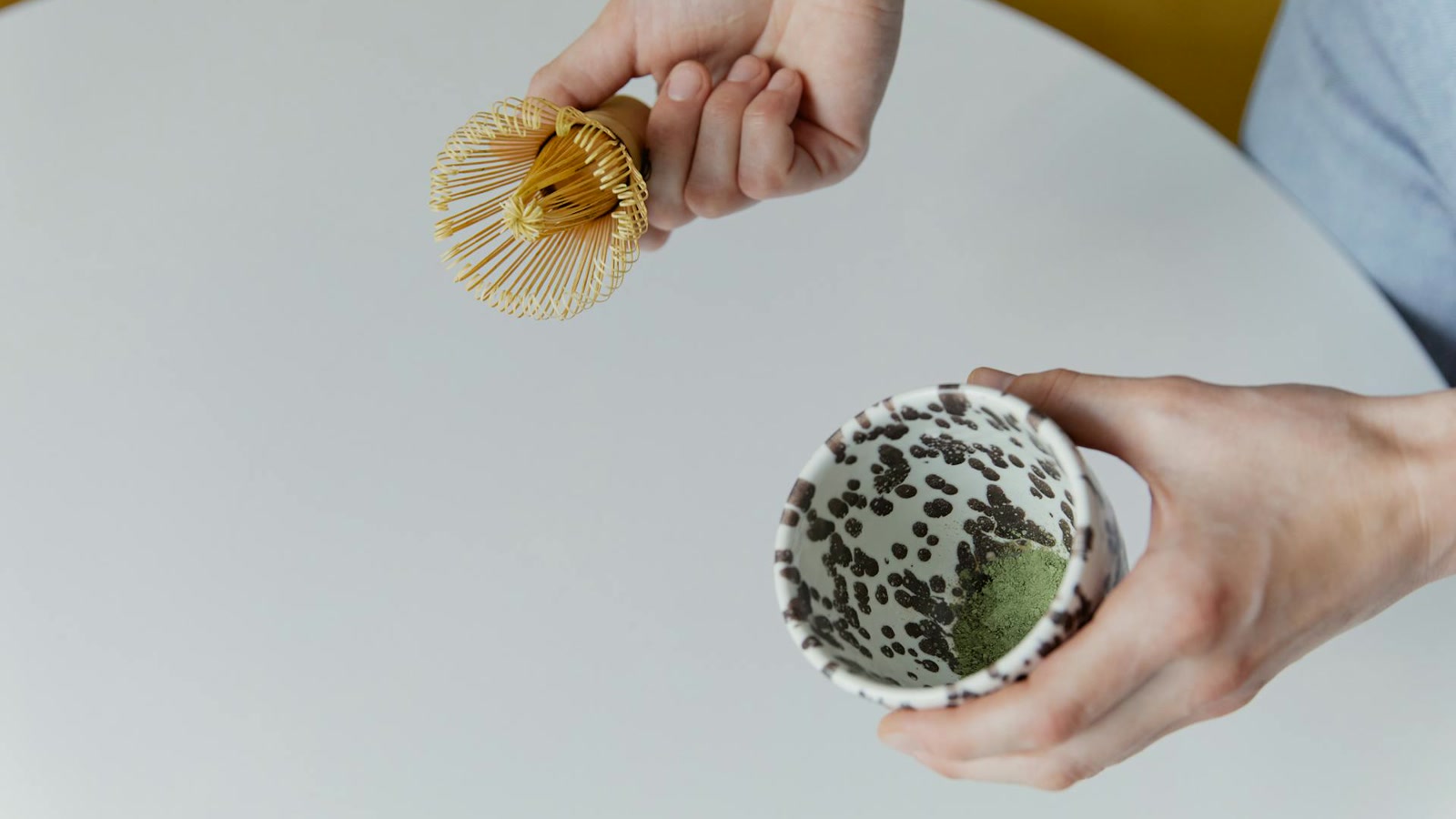
Using a matcha whisk, called a chasen, is simpler than it looks. You soak the bamboo tines in warm water, sift your matcha into a bowl, add 70-80°C water, and whisk in a rapid "W" motion for about 20-30 seconds until a fine layer of foam forms on the surface. That's the core technique, and with a little practice, you'll produce smooth, lump-free matcha every time.
The chasen isn't just a kitchen tool. It's a handcrafted instrument with roots stretching back over 500 years to the Muromachi period in Japan. Today, Takayama in Nara Prefecture remains the sole production center for handcrafted chasen in Japan, holding the largest share of global production (Nara Tea Company). Every time you pick one up, you're holding centuries of intentional craftsmanship.
This guide walks you through everything: choosing the right prong count, seasoning a new whisk, the whisking technique for both thin and thick matcha, common mistakes, and how to care for your chasen so it lasts.
Key Takeaways
• Soak your chasen in warm water for 1-2 minutes before every use to soften the tines and prevent breakage.
• Whisk in a rapid "W" or "M" motion, not circles, for 20-30 seconds to create a smooth, frothy layer.
• Choose 80-prong for thick matcha (koicha), 100-prong for everyday use, 120-prong for ceremonial thin matcha (usucha).
• Water temperature matters: 70-80°C (160-175°F). Boiling water burns the matcha and creates bitterness.
• Takayama, Nara is the sole production center for handcrafted bamboo whisks in Japan, with a 500-year craft tradition.
What Is a Chasen (and Why Does It Matter)?
A chasen is a bamboo matcha whisk carved from a single piece of bamboo, traditionally white bamboo (hachiku) or smoked bamboo (susudake). The global matcha market reached $3.67 billion in 2025 and is projected to grow to $5.35 billion by 2031 (Research and Markets, 2026). As more people discover matcha outside Japan, the chasen has become essential for anyone who wants to prepare it properly.
Why not just use a regular whisk or an electric frother? Matcha powder is stone-ground to particles around 5-10 microns. The fine bamboo tines of a chasen suspend those particles evenly in water, creating the characteristic smooth texture and microfoam that a metal whisk can't replicate. A frother will aerate the liquid, but it won't integrate the powder the same way. There's also something grounding about the manual process. The quiet rhythm of whisking, the sound of bamboo against ceramic. It invites you to slow down and be present with what's in front of you.
If you're new to premium organic matcha, a chasen is the single most important tool to invest in.
Which Chasen Prong Count Should You Choose?
Chasen whisks come in different prong (tine) counts, and the number you choose affects the texture of your matcha. An 80-prong whisk is sturdier with thicker tines, producing larger bubbles, while a 120-prong whisk has delicate, fine tines that create a velvety microfoam (Wide Bamboo, 2024). Here's how they compare:
For koicha (thick, paste-like matcha used in formal tea ceremonies), a 60-80 tine chasen works best because the thicker prongs can knead the dense mixture without snapping. For usucha (thin, frothy everyday matcha), 100-120 tines create the fine aeration you want (Yunomi).
If you're buying your first chasen, start with a 100-prong. It's the most versatile, handles both preparation styles well, and forgives a heavier hand while you learn.
How to Season a New Chasen (First Use)
A new chasen arrives with its tines curled inward from drying. You need to "bloom" them before first use. Skip this step and you risk snapping the delicate bamboo prongs during your first whisking session. Here's how:
Step-by-Step: Seasoning Your Chasen
- Fill a bowl with warm water (not boiling, around 70°C / 160°F). The water should be deep enough to submerge the tines but not the handle.
- Place the chasen tines-down in the water. Let it soak for 2-3 minutes. You'll see the prongs gently unfurl and fan outward.
- Gently swirl the chasen in the water a few times to help the tines separate evenly.
- Lift it out and inspect. The prongs should form an even, open shape, like a blooming flower. If a few are stuck together, gently separate them with your fingers.
- It's ready. Your chasen is now seasoned for use.
This isn't a one-time process. Before every use, soak the chasen in warm water for 1-2 minutes. This keeps the bamboo supple and prevents cracks. Think of it as a small ritual before the ritual, a moment to be intentional about what you're about to do.
How to Whisk Matcha: Step-by-Step Technique
The recommended water temperature for matcha is 70-80°C (160-175°F), and proper whisking takes 20-40 seconds (Matcha Direct, 2024). The technique matters more than speed or strength. Here's the full process:
What You'll Need
- Chasen (bamboo matcha whisk), pre-soaked in warm water
- Chawan (matcha bowl) or any wide-mouthed ceramic bowl
- Chashaku (bamboo matcha scoop) or a small teaspoon
- Fine mesh sifter
- Matcha powder, 1-2 scoops (about 1-2 grams). We recommend starting with a ceremonial grade matcha for the best flavor.
- Hot water, 60-70ml at 70-80°C (160-175°F)
For Usucha (Thin Matcha, Everyday Style)
- Sift your matcha. Place 1-2 scoops (1-2g) of matcha into the sifter over your bowl. Gently press it through with the back of your chashaku or a spoon. This breaks up clumps and gives you a smoother result. (Not sure why this matters? Read our guide on why stone-ground matcha benefits from sifting.)
- Add hot water. Pour 60-70ml of water at 70-80°C over the sifted powder. Don't use boiling water. It scorches the matcha, creates bitterness, and destroys the bright green color.
- Hold the bowl steady. With your non-dominant hand, cradle the bowl. With your dominant hand, hold the chasen handle between your thumb and fingers, like holding a pen but more upright.
- Whisk in a "W" motion. This is the key. Don't stir in circles. Move the chasen rapidly back and forth in a "W" or "M" pattern, keeping the motion in your wrist, not your arm. Start at the bottom of the bowl to break up any remaining powder, then bring the whisk to the surface.
- Whisk for 20-30 seconds. You'll see a layer of fine, pale green foam forming on the surface. When the bubbles are tiny and uniform (no large bubbles), you're done.
- Lift from the center. Slowly draw the chasen up from the center of the bowl to create a small peak in the foam.
From our experience: The most common mistake we see is whisking too slowly or in circular motions. The "W" technique feels unnatural at first, but it's what creates the suspension and foam. Give it 3-4 tries, and your muscle memory will take over.
For Koicha (Thick Matcha, Ceremonial Style)
Koicha uses about 3-4g of matcha (double the amount) with only 30-40ml of water. The result is a thick, paste-like consistency with no foam.
- Sift 3-4 scoops of high-quality ceremonial matcha into your bowl.
- Add 30-40ml of water at 80°C (slightly warmer than usucha).
- Knead slowly. Instead of the rapid "W" motion, move the chasen in slow, gentle circles. You're folding and kneading, not aerating. The goal is a smooth, thick consistency without any lumps or foam.
- Continue for 30-45 seconds until the texture is even and glossy.
Koicha requires the highest quality matcha you can find. Lower grades will taste astringent and bitter at this concentration. It's traditionally shared from a single bowl in tea ceremonies, passed from guest to guest. There's something quietly beautiful about that shared intention.
What Are the Most Common Matcha Whisking Mistakes?
Even experienced matcha drinkers sometimes struggle with consistency. With the global matcha market growing at 6.47% annually and North America as the fastest-growing region at 7.59% CAGR (Mordor Intelligence, 2025), millions of new matcha drinkers worldwide are learning this technique right now. Here are the most common pitfalls:
Mistake 1: Using Boiling Water
Water above 80°C (175°F) burns the L-theanine and catechins in matcha, turning the bright green into a dull yellow-brown and creating a harsh, bitter taste. Let your kettle sit for 2-3 minutes after boiling, or use a thermometer.
Mistake 2: Skipping the Sift
Matcha powder clumps naturally due to its fine particle size and static charge. If you pour water directly onto unsifted powder, you'll spend twice as long whisking and still find lumps at the bottom. Ten seconds of sifting saves you frustration.
Mistake 3: Whisking in Circles
Circular stirring moves the liquid around but doesn't create the rapid back-and-forth shearing force needed to suspend the particles and create foam. The "W" motion is faster and more effective.
Mistake 4: Not Soaking the Chasen
Dry bamboo is brittle. Whisking with a dry chasen dramatically shortens its lifespan and can leave broken tine fragments in your matcha. Always soak for 1-2 minutes before use.
Mistake 5: Using the Wrong Bowl
A narrow mug doesn't give the chasen enough room to move. Use a wide-mouthed bowl (at least 12cm / 5 inches across) so the tines can fan out properly during the "W" motion.
How to Care for Your Bamboo Matcha Whisk
A well-cared-for chasen lasts 2-4 months with daily use, or much longer with occasional use. Since Takayama, Nara remains the sole production center for handcrafted chasen globally, treating your chasen with care is a way of honoring that craft.
After Every Use
- Rinse under warm running water. Gently swish the tines to remove all matcha residue. Don't use soap, as it absorbs into the bamboo.
- Shake off excess water. A gentle flick is enough.
- Place on a chasen holder (kusenaoshi) to air dry. This ceramic or wooden stand keeps the tines fanned in the correct shape as they dry. If you don't have a holder, rest the chasen upright on its handle, tines facing up.
What to Avoid
- Never put your chasen in the dishwasher. The heat and detergent will destroy the bamboo.
- Never leave it soaking for hours. Extended soaking weakens the bamboo fibers.
- Never store it in a closed container while wet. Mold will develop within days.
- Avoid direct sunlight for drying. It dries the bamboo too quickly and causes cracking.
Worth knowing: Your chasen will naturally change color over time, shifting from pale white to a warm green-brown. This is normal and actually indicates proper use. In the Japanese tea tradition, this aging is respected, not a sign of needing replacement. Replace your chasen when tines start breaking off or the center prongs lose their spring.
The Craft Behind Your Chasen: Takayama's 500-Year Tradition
Takayama, a small district in Ikoma City, Nara Prefecture, is the sole production center for handcrafted chasen in Japan. The craft dates back to the Muromachi period (1336-1568), when a local craftsman began making whisks for the tea ceremonies that were becoming central to Japanese culture (Nara Tea Company).
Each chasen is carved from a single piece of bamboo. The artisan splits, shaves, and curls each tine by hand, a process that takes considerable skill and patience. With a small number of masters keeping this art alive, it's a living craft tradition that continues because people still value the handmade over the mass-produced.
When you use a chasen, you're participating in something that's been passed down for over 500 years. There's a presence in that, an awareness that this simple act of making tea connects you to generations of people who did the same thing, with the same intention: to be fully here, in this moment, with this cup.
You can explore the matcha that was made for this kind of preparation in our premium organic matcha collection, sourced directly from Japanese tea farms in regions like Uji, Nishio, and Shizuoka.
Frequently Asked Questions
Can I use an electric frother instead of a chasen?
You can, but the result is different. An electric frother aerates liquid quickly, creating large, unstable bubbles. A chasen's fine bamboo tines produce microfoam and properly suspend the matcha particles, giving a smoother mouthfeel. The market's 6.47% annual growth reflects growing appreciation for traditional preparation methods that bring out matcha's best qualities.
How long does a bamboo matcha whisk last?
With daily use and proper care, a chasen typically lasts 2-4 months. Occasional use can extend it to a year or more. Replace it when tines break off or the center prongs lose their spring. Since Takayama, Nara is the sole global production center for handcrafted chasen, consider a holder (kusenaoshi) to extend its life.
What's the difference between koicha and usucha whisking?
Usucha (thin matcha) uses 1-2g of powder with 60-70ml of water and a rapid "W" whisking motion to create foam. Koicha (thick matcha) uses 3-4g with only 30-40ml of water and a slow kneading motion with no foam. Koicha requires 100-120 tine whisks for the initial mixing, while the final consistency comes from careful slow strokes.
Why does my matcha taste bitter even with a chasen?
Bitterness almost always comes from water temperature, not your whisk. Water above 80°C (175°F) scorches matcha's amino acids and catechins. Use 70-80°C water. Also check your matcha quality. Ceremonial grade matcha is specifically processed for drinking and will taste significantly smoother than culinary grades.
Do I need to buy a matcha bowl (chawan) or can I use any bowl?
Any wide-mouthed ceramic bowl (at least 12cm across) works. A traditional chawan is designed with slightly curved inner walls that help the chasen move efficiently, but it isn't required. The important thing is giving the whisk enough room to move freely. Narrow mugs and cups don't work well because the tines can't complete the "W" motion properly.
Your Next Cup
Making matcha with a chasen isn't complicated, but it is intentional. The soaking, the sifting, the whisking, each step has a reason, and together they transform a scoop of powder into something genuinely worth pausing for.
If you're just getting started, grab a 100-prong chasen, a bamboo scoop, and some ceremonial grade matcha. Follow the steps above, give yourself a few tries, and notice how the process itself starts to feel like the best part.
Ready to explore more? Learn about why stone-grinding matters for matcha quality, or discover where Japan's finest matcha is grown. And if you'd like a matcha latte instead, here's how to make the perfect one using your new whisking skills.
Looking for ceremonial matcha sourced honestly from named Japanese regions?
USDA Organic and JAS certified, third-party lab tested, direct from family farms.
Shop Matcha CollectionInquire About Wholesale
Share:
Mastering the Best Matcha Drinks
Brew Green Tea Perfectly: Guide for Best Flavor & Benefits