



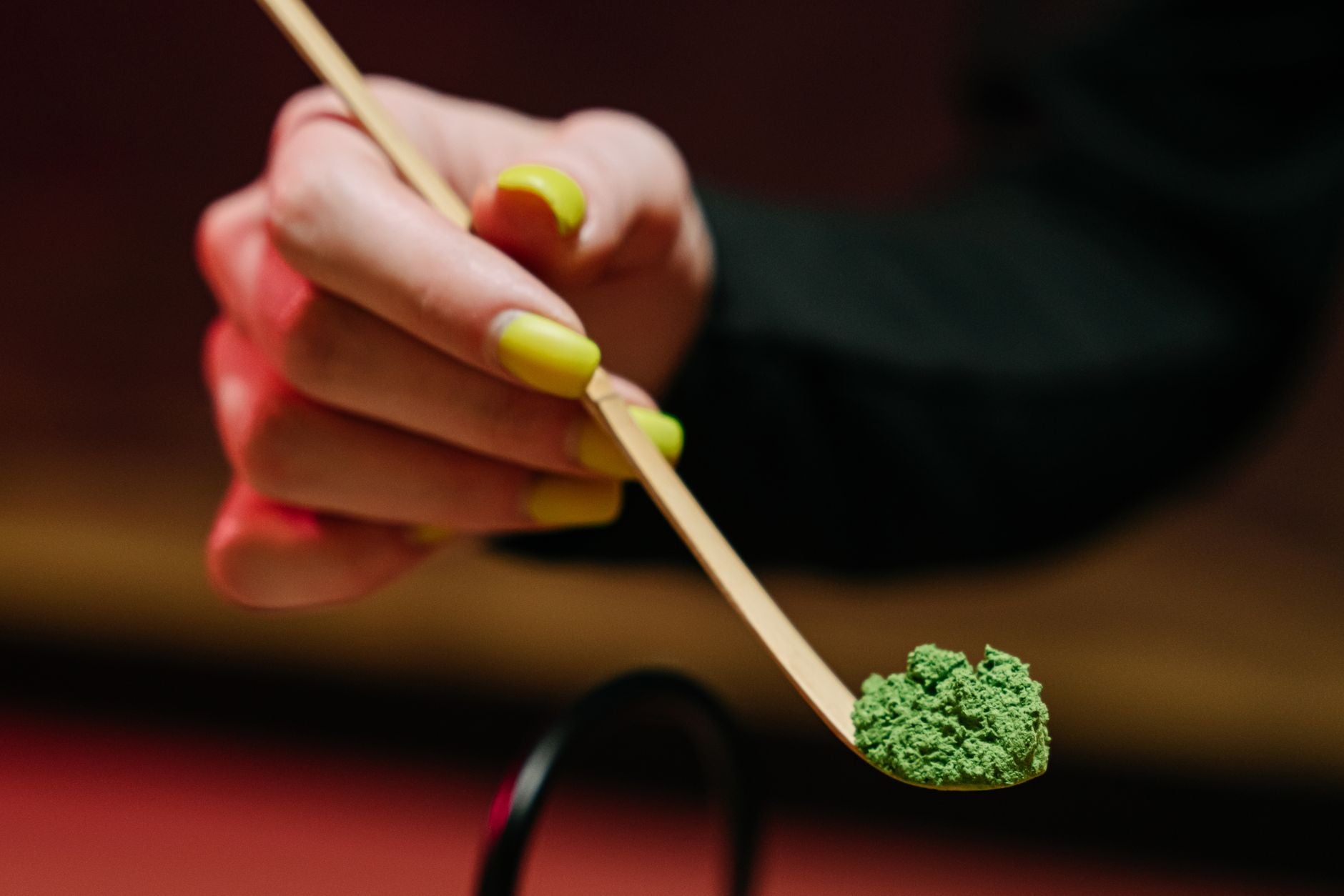
Matcha does expire, but only in the sense of quality, not safety. The date on a tin is a best-before date: it marks how long the powder keeps its bright green color, sweet aroma and smooth umami. Past that date, matcha that has stayed dry and sealed is still safe to drink. It just tastes flatter and looks duller. The one thing that makes matcha unsafe is moisture, because damp powder can grow mold.
So the honest answer is yes and no. If you mean "will it turn dangerous," no, not while it stays dry. If you mean "will it lose the jade color and sweetness I paid for," yes, and that slow fade is what most people are really asking about.
Key takeaways
- The date on matcha is a best-before (quality) date, not a use-by (safety) date. Japan's Consumer Affairs Agency draws exactly this line, and Japanese tea carries the best-before label.
- Matcha is only about 5 g water per 100 g (Japan's official food composition table), far too dry for the bacteria that spoil fresh food. Dry, mold-free matcha past its date won't make you sick.
- Color is the clock. In a 12-month storage study, green tea lost significant chlorophyll from the sixth month in every storage condition, and metal packaging protected it best.
- Throw it out only if you see mold, smell something sour or musty, or find wet, caked powder.
What the date on a matcha tin actually means
Matcha carries a best-before date, which is a promise about flavor, not a safety cutoff. Japan, matcha's home, uses two different date labels, and the difference answers most "does matcha expire" questions on its own.
- 賞味期限 (shōmi kigen), best-before. Japan's Consumer Affairs Agency defines it as the period during which all the expected quality is fully kept when the food is stored as directed. It adds that the quality may still hold after that date. It is used on shelf-stable foods like snacks, instant noodles and canned goods, and it is the label Japanese tea carries.
- 消費期限 (shōhi kigen), use-by. This is the date after which a food may no longer be safe because it can rot or spoil. It appears on bento boxes, sandwiches and prepared dishes, the foods that go off within days.
That distinction matters. A best-before date on matcha tells you when the producer stops guaranteeing peak color and flavor. It does not tell you the powder turns harmful the next morning.
Can expired matcha make you sick?
Dry, mold-free matcha past its date is very unlikely to make you sick. The reason is water. Japan's Standard Tables of Food Composition list matcha at 5.0 g of water per 100 g of powder. The bacteria, yeasts and molds that spoil food need far more available moisture than that. The US FDA notes that most foods have a water activity above 0.95, which is enough to support bacteria, yeasts and mold. Dry tea powder sits far below that.
The risk starts when water reaches the powder. A damp scoop, condensation from a cold tin opened in a warm kitchen, or a loose lid in a humid bathroom can wet the surface. Wet powder clumps, and in the worst case it grows mold. That is the line:
- Safe to drink, just stale: pale or yellowish color, faint or hay-like smell, flat or slightly bitter taste, dry texture.
- Throw it out: visible mold or fuzzy spots, a sour, musty or off smell, or powder that feels wet, sticky or caked.
If you are unsure, whisk a small bowl and taste it. Stale matcha tastes dull. Spoiled matcha smells wrong before it ever reaches your lips.
Does matcha expire if unopened?
Unopened matcha fades too, just much more slowly. A sealed tin keeps out moisture, light and most of the oxygen, but not time or heat. Research on stored green tea shows how steady that slide is.
In a study published in Acta Veterinaria Brno (Ošťádalová et al., 2014), researchers stored green teas for 12 months at room temperature (20°C), either in a closed cupboard or in direct daylight, in several kinds of packaging. Chlorophyll, the pigment behind the green color, declined throughout storage, and from the sixth month onward the drop was statistically significant in every sample, whatever the storage method. Original packaging and metal containers protected the chlorophyll best. Glass and paper left in daylight did the most damage. The authors concluded that tea's shelf life should be shorter than the 12 months most manufacturers claim. One caveat: the containers were lidded and opened at each monthly check, not factory-sealed.
That study measured loose green tea, not matcha. Matcha is ground to a fine powder, so far more of its surface meets the air, and it likely fades faster than whole leaf once opened, not slower. The practical reading: even a well-kept tin is at its best in roughly its first six months, and still drinkable, if duller, after its printed date.
| State | Best quality | Still drinkable | Main risk |
|---|---|---|---|
| Unopened, sealed, cool and dark | Up to the best-before date, freshest in the first months | Past the date, as long as it stays dry | Slow chlorophyll loss from time and heat |
| Opened, stored well | About 1 to 2 months (common producer guidance) | Several months more, fading steadily | Oxygen every time the lid opens |
| Opened, stored poorly | Days to a few weeks | Until it clumps or smells off | Heat, light, humidity, odors |
The takeaway is simple. Buy a size you will finish within a month or two of opening. A 30 g tin, like our organic ceremonial matcha, is about fifteen 2 g bowls, which suits a daily or every-other-day ritual. Freshness rewards the small, frequent purchase over the big tin you sip once a week.
A 60-second freshness test
You can judge any matcha, old or new, with a sheet of white paper and one bowl. No lab needed.
- Look. Tap a small pinch onto white paper and press it flat with the back of a spoon. Fresh ceremonial matcha is a vivid jade green. Olive, yellowish or brownish means the chlorophyll has broken down.
- Smell. Open the tin and breathe in. Fresh matcha smells sweet, grassy and a little like spring greens. Dusty, hay-like or muted means the aroma has faded. Sour or musty means stop here.
- Feel. Rub a pinch between two fingers. It should feel silky, like eyeshadow. Hard lumps that don't break, or a damp, sticky feel, mean moisture got in.
- Taste. Whisk about 2 g in 70 ml of water at 75 to 80°C (167 to 176°F). Fresh matcha is smooth and savory-sweet with a soft finish. Stale matcha tastes flat, dry or harshly bitter.
- Watch the foam. Fresh powder whisks into a fine, lasting froth. Faded powder struggles to hold it. If foam is your only problem, water temperature and technique may be the cause, and our guide on why matcha won't froth walks through the fixes.
Dull color, muted smell and a flat taste, but dry, with no sour or musty note? It's safe, just past its best. Read on for how to still enjoy it.

From our tea room
Organic Ceremonial Matcha Powder - USDA Certified (30g)
Stone-milled ceremonial grade, USDA Organic, third-party lab tested.
View Ceremonial MatchaWhat to do with matcha that is past its best
Faded matcha is still good for anything where it isn't the only star. Throwing out safe, dry tea feels wrong, and it doesn't have to go to waste.
- Lattes. Milk and a little sweetness round out a flatter flavor and soften bitterness. This is where most older ceremonial matcha finds a happy second life.
- Smoothies and overnight oats. Fruit carries the flavor, and the matcha adds color and a gentle green note.
- Baking. Cookies, cakes and pancakes need color and earthiness more than delicate aroma. Use a little more powder than the recipe calls for to make up for the faded color.
Our matcha recipes page has lattes and bakes that work well for an older tin. What faded matcha can't do is shine on its own in a traditional bowl. That is the job for fresh powder, and why the tasting difference between grades shows up most clearly when matcha is whisked with water alone, as we explain in what matcha tastes like.
Why matcha fades over time
Matcha fades because its color and flavor come from delicate leaf compounds that react with light, heat and oxygen. Chlorophyll gives the powder its green, and as it breaks down it turns into pheophytins, the compounds behind the olive and brown tones of old tea. The amino acids and catechins that shape aroma and taste shift as the powder meets air.
Heat and humidity speed up every one of these reactions. That is craft chemistry, not spoilage, and it explains why storage matters so much more for matcha than for most pantry staples. It is also why what happens before the tin reaches you sets the ceiling. Shade-growing, careful stone-milling and fast, airtight packing all decide how green and sweet a fresh bowl can be, which is the story behind what makes ceremonial grade matcha.
How to keep matcha fresh
Keep four things away from the powder: air, light, heat and moisture. Do that and your matcha holds its color and flavor far longer.
- Keep it sealed and airtight. Close the tin fully after every use, so oxygen has less to work with.
- Choose an opaque container. A metal tin or another light-blocking vessel protects the chlorophyll. In the storage study above, metal was one of the most protective options.
- Store it cool and dark. A pantry shelf away from the stove, the oven and sunny windows is ideal.
- Guard against moisture. Use only a dry scoop, never a wet one, and keep the tin away from steam and humidity.
- Keep odors out. Matcha absorbs smells, so store it away from spices, coffee and anything strongly scented.
- Refrigerate with care. Cold storage helps a sealed tin, but let it come back to room temperature before opening, so condensation doesn't wet the powder.
For the full walk-through, including the fridge and freezer debate, see our guide on how to store matcha powder. And if you want the deeper look at what happens to catechins and caffeine as matcha ages, read does matcha go bad.
Frequently asked questions
Does matcha powder expire?
Matcha has a best-before date, not a use-by date. The date marks peak color and flavor, not safety. Kept dry and sealed, matcha past that date is still safe to drink. It simply loses color, aroma and sweetness.
Can expired matcha make you sick?
Not if it has stayed dry. Matcha holds only about 5 g of water per 100 g, too little for the bacteria and molds that spoil food. The risk is moisture getting in. If you see mold or smell something sour or musty, throw it out.
Does matcha expire if unopened?
Unopened matcha still fades, just slowly. Time and heat keep breaking down its chlorophyll, even through a sealed tin. A sealed tin kept cool and dark is freshest in its first months and still drinkable after the printed date, as long as it stays dry.
How long does matcha last once opened?
Opened matcha is at its best for about one to two months. Stored airtight, cool and dark, it stays drinkable for several months more, though its green color and flavor keep fading.
Can I still use matcha after the expiration date?
Yes, if it is dry and mold-free. Check the color on white paper, smell it, and whisk a small bowl. If it tastes flat, use it in lattes, smoothies or baking instead of a traditional bowl.
Why did my matcha turn yellow or brown?
That color shift is chlorophyll breaking down under light, heat, air and time. A yellow or brown tone signals stale, lower-quality tea. It is still safe if it is dry and mold-free.
Sources
- Consumer Affairs Agency, Japan (消費者庁), "期限表示(消費期限・賞味期限)" [Date labels: use-by and best-before], explanatory material. caa.go.jp
- Ministry of Education, Culture, Sports, Science and Technology, Japan, Standard Tables of Food Composition in Japan (8th revised edition), item 16035, matcha: water 5.0 g per 100 g. fooddb.mext.go.jp
- US Food and Drug Administration, "Water Activity (aw) in Foods," Inspection Technical Guide. fda.gov
- Ošťádalová M, Tremlová B, Pokorná J, Král M. "Chlorophyll as an indicator of green tea quality." Acta Veterinaria Brno 2014; 83: S103-S109. doi:10.2754/avb201483S10S103. actavet.vfu.cz
Last updated September 21, 2026.
Share:
Is Matcha Bad for You? An Honest, Lab-Data Answer
Is Matcha Better Than Coffee? An Honest Comparison