



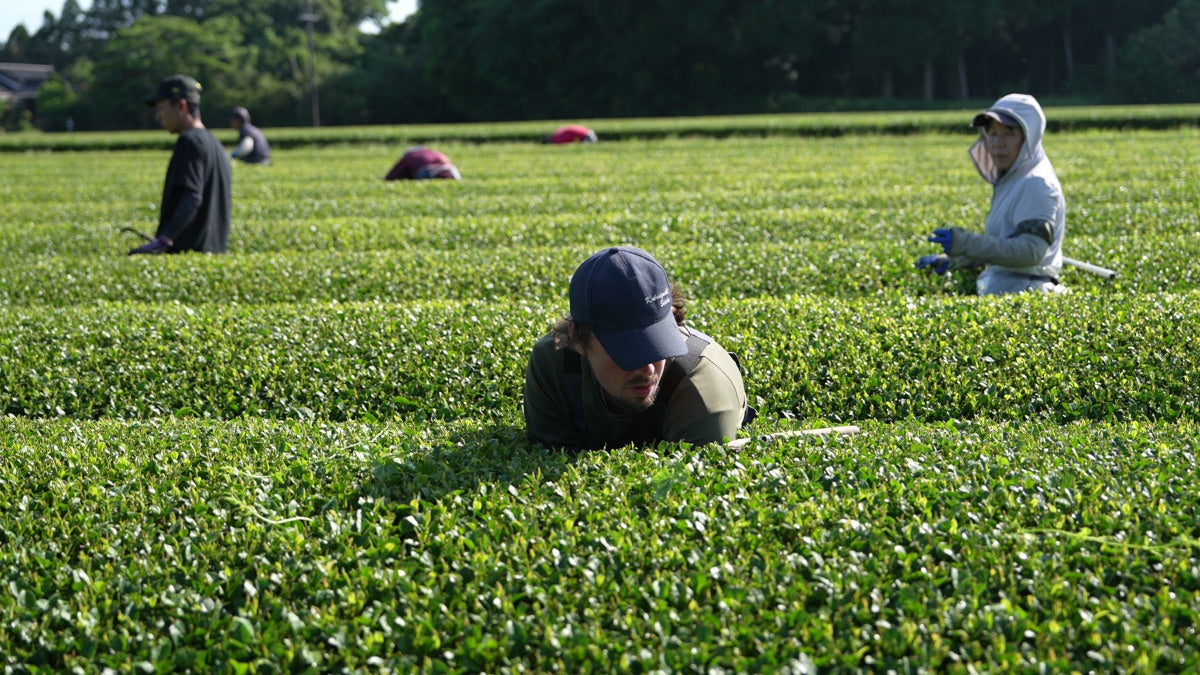
Unkai (うんかい, written 雲海) is a Japanese tea cultivar whose name means "sea of clouds". Bred in Miyazaki from a 1952 cross, it was named and registered as Cha Norin No. 29 in April 1970. It was made for kamairicha, the pan-fired green tea of Kyushu's hill country, and now also turns up as black tea and oolong.
The paper trail is rich. The breeders' 1971 trial report runs sixteen pages and nineteen tables, and it even explains the name. I'll read it closely, including three spots where its tables say less than its summary. Our guide to Japanese tea cultivars maps the wider family.
Key Takeaways
- Unkai (うんかい, 雲海, "sea of clouds") is Cha Norin No. 29, a Miyazaki kamairicha cultivar registered in April 1970.
- Its parents are Takachiho and F1 9-4-48, a 1934 cross of a Miyazaki Assam type and a Miyazaki Caucasus type.
- It out-yielded Takachiho at its breeding station in 1963-69, and scored 0.2 for anthracnose damage in 1969, against Izumi's 11.6.
- It sprouts later than Takachiho and Yabukita, yet was plucked with Yabukita. At Shizuoka it was plucked 4-6 days later.
- Its one recorded quality drawback was a slightly paler liquor. It now also appears as black tea and oolong.

What is the Unkai tea cultivar?
Unkai is a mid-season tea cultivar bred for kamairicha. The Cha Norin registry list hosted by Minorien gives it as 茶農林29号, former line A15, Takachiho × F1-9-4-48, registered in 1970 in Miyazaki, for 釜炒り茶 (kamairicha). The report's title says 玉緑茶, and it was tested throughout as kamairi-sei tamaryokucha: pan-fired, curled green tea, or "suitable for Kamairicha" in its English summary.
Kamairicha is pan-fired rather than steamed, and our guide to rare Japanese teas covers it.
The name is the easy part. The report's naming section writes it 雲海, sea of clouds, and My Japanese Green Tea (MJGT), Ricardo Caicedo's English reference site, says the same. The Ocha Museum, a reference site run by Ichikawaen, lists うんかい among the ministry-named Norin cultivars.
| Attribute | Detail |
|---|---|
| Japanese name | うんかい (雲海, sea of clouds) |
| Registration | Cha Norin No. 29 (茶農林29号), named and registered April 1970 |
| Former line name | A15 |
| Bred at | Miyazaki Prefecture's tea experiment station |
| Parentage | Takachiho (seed parent) × F1 9-4-48 (pollen parent), crossed 1952 |
| Registered use | Kamairicha (釜炒り茶) |
| Season | Mid-season (中生種) |
| Recommended variety | Kumamoto and Miyazaki, from 1969 |
| Planted area | No figure in anything I read |
Where Unkai came from: Takachiho and an Assam-Caucasus cross

Unkai comes from a 1952 cross at the Tea Branch of the Miyazaki Prefectural General Agricultural Experiment Station, then still the Kawaminami Branch of the Miyazaki Prefectural Agricultural Experiment Station. The seed parent was Takachiho, then called Miyazaki No. 9. The pollen parent was F1 9-4-48, an F1 line from MA23 × MC3, crossed in 1934. The pedigree note decodes them: MA23 is 宮崎アッサム種, a Miyazaki Assam type, and MC3 is 宮崎コーカサス種, a Miyazaki Caucasus type.
So "assamica" is half the story. MJGT calls F1-9-4-48 "a tea plant from the assamica variety". The report's English summary writes "MA 23 (the Assam var.) × MC 3 (the Caucasia var.)": one Assam grandparent, one Caucasus. MJGT's shorthand isn't wrong, just incomplete. Takachiho, the mother, was registered in 1953 as Cha Norin No. 11, selected from the station's native seedling garden.
Why breed it at all? Each existing kamairicha cultivar had a flaw, the report says: Takachiho in regional adaptability, Izumi in disease resistance, Yamanami in quality. Growers wanted an easy plant with stable high yields and good quality that beat them all, Yabukita included.
The steps are dated. Kashiwagi Noboru and Nagatomo Kiyoshi made the cross. Surveyed in 1958, this seedling became a first selection, then in 1959 a second selection numbered A15. It entered the line comparison trial in 1960 and was field-planted in March 1961. Plucking and quality tests on 2 kg batches began in 1963.
From 1962 it was trialed at the Kumamoto and Shizuoka prefectural tea stations and Miyazaki's Highland Section, and from 1965 at the MAF Tea Research Station and Miyazaki's Miyakonojo farm. Eight Miyazaki farm households grew it, in Gokase, Takachiho, Morotsuka and elsewhere, and Kagoshima planted it in 1969 (see our guide to Japan's growing regions). Kumamoto and Miyazaki made it a recommended variety (奨励品種) in 1969, before it had a name. Kanayamidori, Cha Norin No. 30, was registered on 24 April 1970, the same month.
Then the name. The report says Unkai stands for the refreshing sea of clouds over Kumamoto and Miyazaki's renowned tea districts, the hilly and mountainous kamairicha belt where it was to spread, and for a wish that it would spread like clouds. The breeders name no viewpoint. For a picture, the Takachiho Town Tourism Association says its Kunimigaoka lookout, 513 m up, is famous for its sea of clouds, best on clear, windless, cold autumn mornings. Takachiho town was one of Unkai's on-farm trial sites.
What the 1971 trial report says about the plant

The report describes a vigorous bush that out-yielded Takachiho at the breeding station every year it was measured, by 16 to 48% in the three-flush totals of 1965-69 (Table 6). Its only recorded quality drawback as kamairicha was a slightly paler liquor.
The bush. It's intermediate in shape (Takachiho and Yabukita are upright), with strong vigor and a large spread. The mature leaf is elliptical, medium-sized, dark green, glossy and smooth, and 0.32 mm thick (Takachiho 0.29, Yabukita 0.28). The text puts its size between Takachiho's and Yabukita's. Young leaves are green and glossy with a faint anthocyanin tinge neither comparator shows. First-flush shoots were longer than Takachiho's (15.6 vs 14.2 cm) and somewhat more numerous (55 vs 50 per (20 cm)²), but 100 shoots weighed slightly less (52.5 vs 53.5 g). Cuttings root as easily as either comparator.
The yield. Table 6 counts kilograms of fresh leaf per 10 a (1,000 m²), Takachiho = 100. The 1963 first flush was 120 against 78, printed as index 155. The text sums up about 150% in years 3-5 after planting and 115-130% in years 6-9, though 1966, year 6 from the 1961 planting, is printed at 148.
Elsewhere, Kumamoto's 1969 figure was 1,909 kg against 918 (index 208), and Miyakonojo, the only site with a Yabukita yield, gave Unkai 292, Takachiho 251, Izumi 278 and Yabukita 189 in 1970. Only the MAF Tea Research Station's 1969 first flush came in lower, 24 against 31.
The cup. As kamairi-sei tamaryokucha, the leaf rolled tight, its shape beat Takachiho's, the aroma was good and the taste mild (温和) and good, but the liquor was slightly paler. First-flush scores (1963-67 mean) were 85.0 of 100 against Takachiho's 85.8, liquor color 16.7 against 18.5 of 20, quality the English summary calls "equal to those of Takachiho". Third flush was weaker (83.3 vs 87.7), put down to early-hardening shoots. At Kumamoto, Unkai's first flush won (89.3 vs 83.4) with no liquor-color drawback; at the Highland Section, the pale liquor cost points again.
For composition only, first-flush dry matter (1967-68 mean) held 4.95% total nitrogen (Takachiho 5.07, Yabukita 5.08), 12.1% tannin (13.0, 11.1) and 15.7% total catechins (15.5, 14.4). The paper measured no caffeine, amino acids or theanine.
Late to sprout, on time to pluck

Unkai sprouts later than Takachiho and Yabukita but was plucked with Yabukita. The 1964-69 means at the breeding station put its sprouting on 2 April and its first-flush plucking on 5 May.
| Cultivar | Sprouting | First-flush plucking |
|---|---|---|
| Unkai | 2 April | 5 May |
| Takachiho | 29 March | 7 May |
| Yabukita | 31 March | 5 May |
The text puts sprouting about 2-5 days behind Takachiho and plucking about 1-3 days ahead, and the English summary says plucking is "like Yabukita". The report files it as mid-season (中生種).
It didn't hold everywhere. At the Shizuoka station, the report says Unkai was plucked 4-6 days later than Takachiho and Izumi (mean 10 May, against 4 and 3 May). At Miyakonojo, plucking was "about the same". A calendar belongs to a place. The breeders add a grower's note: the shoots harden somewhat early, so pluck on time, especially in second and third flush.
Blight, winter cold and scale insects

Unkai's best-documented strength is anthracnose resistance: in the report's 1969 inoculation test its damage index was 0.2, against 2.1 for Takachiho, 4.4 for Yabukita and 11.6 for Izumi. It was also rated strong for winter cold, and a 2007 paper reports less scale-insect infestation.
| Cultivar | Anthracnose index, 1969 | Anthracnose rating | Field cold damage, 1963 (0-4) | Cut shoots at -17 °C, 1969 (0-5) | Cold rating |
|---|---|---|---|---|---|
| Unkai | 0.2 | Strong | 1.07 | 3.7 | Strong |
| Takachiho | 2.1 | Medium to weak | 1.07 | 4.4 | Somewhat strong |
| Yabukita | 4.4 | Weak | 1.50 | 4.5 | Somewhat strong |
| Izumi | 11.6 | Very weak | n/a | n/a | n/a |
| Yamanami | 0.9 | Strong | n/a | n/a | n/a |
| Benihomare | 1.7 | Medium | n/a | n/a | n/a |
Winter cold. In the harsh, dry winter of 1963, Unkai's field damage matched Takachiho's and beat Yabukita's. Cut shoots frozen at -17 °C for 2-3 hours (0 = no damage, 5 = dead) also did better, "somewhat superior" in the text's words. Miyazaki's Highland Section rated it very strong (極強). In Kagoshima, a sudden cold spell at the end of November 1969 split stems at the base on 6.7% of Unkai plants at the Tea Experiment Station, against 36.7% for Yabukita, 43.3% for Yamanami, 76.7% for Sayamamidori and 100% for Okumusashi.
All of that is winter injury. The report has no late-frost test on new shoots, and our Terakawawase guide explains why that's a separate risk.
Blight and die-back. Die-back hit 6.1% of Unkai plants in 1968, against 15.3% for Takachiho. For net blister blight, the 1965 field count per (30 cm)² was 1.4 blighted leaves for Unkai, 0.4 for Takachiho and 31.6 for Yabukita. The breeders say no special disease care is needed; standard control is enough.
A careful reading. The English summary says Unkai resists net blister blight better than Takachiho, but Table 9 shows slightly more blighted leaves on Unkai (1.4 against 0.4 in 1965, 0.2 against 0 in 1966), and the Japanese text claims only that it beats Yabukita there. The anthracnose claim is solid.
Scale insects. A 2007 paper on the cultivar Yumekaori, by Nagatomo Hirofumi and colleagues, cites a survey by Furuno and colleagues of 276 cultivars and lines for white peach scale (クワシロカイガラムシ, Pseudaulacaspis pentagona). It found significantly less infestation on a group including Unkai, its pollen parent F1 9-4-48, Hatsumomiji, Minamisayaka and Sayamakaori, and suggested the resistance is heritable. The paper adds that the pest spread in Miyazaki from about 1985 and was estimated in 77% of the prefecture's tea fields in 2006.
Unkai's family: Minekaori and a sister seedling
Unkai has one registered child in the Cha Norin list: Minekaori (みねかおり), Cha Norin No. 38, registered in 1988 as Miyazaki No. 3 from Yabukita × Unkai, and a kamairicha cultivar like its parent. Our Fujikaori guide mentions it too.
Minamisayaka is the one to read carefully. Cha Norin No. 42, registered in 1991 for sencha, is listed as Miya A-6 (Takachiho × Miya F1 9-4-48) × NN27. Its seed parent came from the same cross that produced Unkai, which makes Minamisayaka a niece line, not Unkai's child.
Where Unkai turns up now: kamairicha, black tea and oolong
Unkai turns up in three forms today: kamairicha, Japanese black tea and, in a 2025 Miyazaki study, oolong. The 1971 report tested only kamairi-sei tamaryokucha, so the other two came later. I found no planted-area figure; MJGT wrote in 2014 that Unkai "makes just a tiny fraction of the cultivated area in Japan".
Shinkoju (心向樹), a cultivar-tea specialist in Tokorozawa, Saitama, lists Unkai kamairicha in two grades, both marked 完売 (sold out) on 17 September 2026. Its Unkai black tea (和紅茶) was 在庫あり, in stock, from ¥486 for 10 g.
CHA-OLOGY, a UK tea shop, sells "ICHOU Kamairicha", organic single cultivars by Kourogi san, a producer based in Miyazaki. The shop says its ichou kamairicha has a much looser roll and a lighter color than standard kamairicha. Unkai is one of six cultivars there, with Takachiho, Yumewakaba, Kanayamidori, Koushun and Minamisayaka. The page shows no stock status.
The oolong is research. Per the abstract of a 2025 study by Atarashi Masanori, Miyazaki's tea branch and Kawasaki Kiko developed a drum-type withering machine, and consumers rated oolong made with it from Yabukita, Takachiho and Unkai. All three scored relatively high, Takachiho highest in every age group, and Yabukita's aroma low. The abstract gives no separate result for Unkai.
What does Unkai tea taste like?

Nobody at One with Tea has tasted Unkai, so each note belongs to its source. The 1971 breeders found it mild, with a good aroma and a slightly paler liquor than Takachiho. MJGT (2014): "Its main feature is that it produces a high quality kamairicha with a characteristic aroma."
My Japanese Green Tea (MJGT) expected more bitterness from the "assamica heritage", "but it is not the case", and asks, "Perhaps this is due to the kamairi process?" That's the site's own guess.
CHA-OLOGY, on its withered kamairicha: "Retaining the fullness, smoothness and sweetness of Takachiho, Unkai also has a gentle caramelised" flavor and liquor color, though "not nearly as much as Koushun!" Shinkoju describes its kamairicha as 「澄んだ空のような爽やかな香りと凛としたキレのある味わい」, a refreshing aroma like a clear sky and a crisp, clean-cut taste, rating umami 1, astringency 2 and floral aroma 3 of 5. Its black tea is 「和と洋が折り重なる香味がありながらも、洗練された後口を演出」, layered Japanese and Western flavor with a refined finish: sweetness 3, astringency 2, body (コク) 2 of 5.
I won't merge these into one profile. The breeders' pale liquor came from 2 kg test batches in the 1960s, CHA-OLOGY's caramel note from ichou kamairicha decades later. No source gives brewing numbers for Unkai, so start from the brewing section of the rare Japanese teas guide above.
Frequently asked questions
What does Unkai mean?
Unkai (うんかい, 雲海) means "sea of clouds". The 1971 breeding report says the name stands for the clouds over the hilly kamairicha districts of Kumamoto and Miyazaki, and for the wish that the cultivar would spread like clouds.
Is Unkai an assamica tea?
Only in part. Its seed parent, Takachiho, was selected from a Miyazaki native seedling garden. Its pollen parent, F1 9-4-48, came from a 1934 cross of a Miyazaki Assam type and a Miyazaki Caucasus type.
Is Unkai early or late?
Mid-season. At the breeding station it sprouted on 2 April on average, a few days after Takachiho and Yabukita, but was plucked on 5 May, with Yabukita. At Shizuoka it was plucked 4-6 days later than Takachiho.
What tea is Unkai used for?
It was registered and tested for kamairicha, pan-fired green tea. Shinkoju also sells Unkai black tea, and a 2025 Miyazaki study made oolong from it, though the abstract gives no separate Unkai result.
Can I buy Unkai tea?
Sometimes. On 17 September 2026, Shinkoju in Saitama had Unkai black tea in stock and both Unkai kamairicha grades sold out. CHA-OLOGY in England lists an Unkai ichou kamairicha without showing stock. One with Tea does not sell Unkai.
A note from me
To be straightforward with you: One with Tea doesn't sell Unkai, and I haven't tasted it. The photos on this page aren't Unkai either. Our own organic ceremonial matcha isn't labeled with this cultivar, so please don't read one into the other.
What stays with me is the name. In 1970 the breeders named their plant for the clouds over Kyushu's tea hills, hoping it would spread like them. Today's record is quieter: a sold-out kamairicha, one black tea, one grower's ichou kamairicha, a line in an oolong study. Maybe clouds spread like that too, softly.
Sources
- Sameshima Hitoshi et al., Miyazaki tea branch, 玉緑茶用新登録品種「うんかい」 (A Newly Registered Tea Variety "Unkai" for Green Tea), 茶業研究報告 (Tea Research Journal) No. 35 (1971), pp. 7-22. Breeding history, trials, tables and naming. Retrieved 2026-09-17.
- Minorien (host), 附表1 茶農林登録品種一覧, the Cha Norin registered cultivar list (PDF). Registry entries for Unkai and its relatives. Retrieved 2026-09-17.
- Nagatomo Hirofumi et al., クワシロカイガラムシに抵抗性を有する緑茶用品種'ゆめかおり'の育成, 茶業研究報告 No. 104 (2007), pp. 1-14. The Furuno et al. scale-insect survey and Miyazaki infestation figures. Retrieved 2026-09-17.
- Atarashi Masanori, ドラム式萎凋機を活用した国産烏龍茶の嗜好性に関する調査 (consumer preferences for drum-withered domestic oolong), 茶業研究報告 No. 140 (2025), pp. 21-25. Abstract only; the full text is not open. Retrieved 2026-09-17.
- Takachiho Town Tourism Association (高千穂町観光協会), 観る. Kunimigaoka's sea of clouds. Retrieved 2026-09-17.
- Ocha Museum (お茶ミュージアム), run by Ichikawaen, 品種による区分. Unkai among the Norin cultivars. Retrieved 2026-09-17.
- Ricardo Caicedo, The Unkai Tea Cultivar, My Japanese Green Tea, published 12 August 2014. English reference: summary and taste remarks. Retrieved 2026-09-17.
- Shinkoju (心向樹), うんかい, merchant page. Products, tasting notes, price and stock. Retrieved 2026-09-17.
- CHA-OLOGY, ICHOU Kamairicha - Organic Single Cultivars by Kourogi san, merchant page. Producer, ichou process and tasting note. Retrieved 2026-09-17.
Share:
Terakawawase Tea Cultivar: Uji's Early Tencha Plant
Z1 Tea Cultivar: The Unnamed Line Behind Saeakari and Seimei