



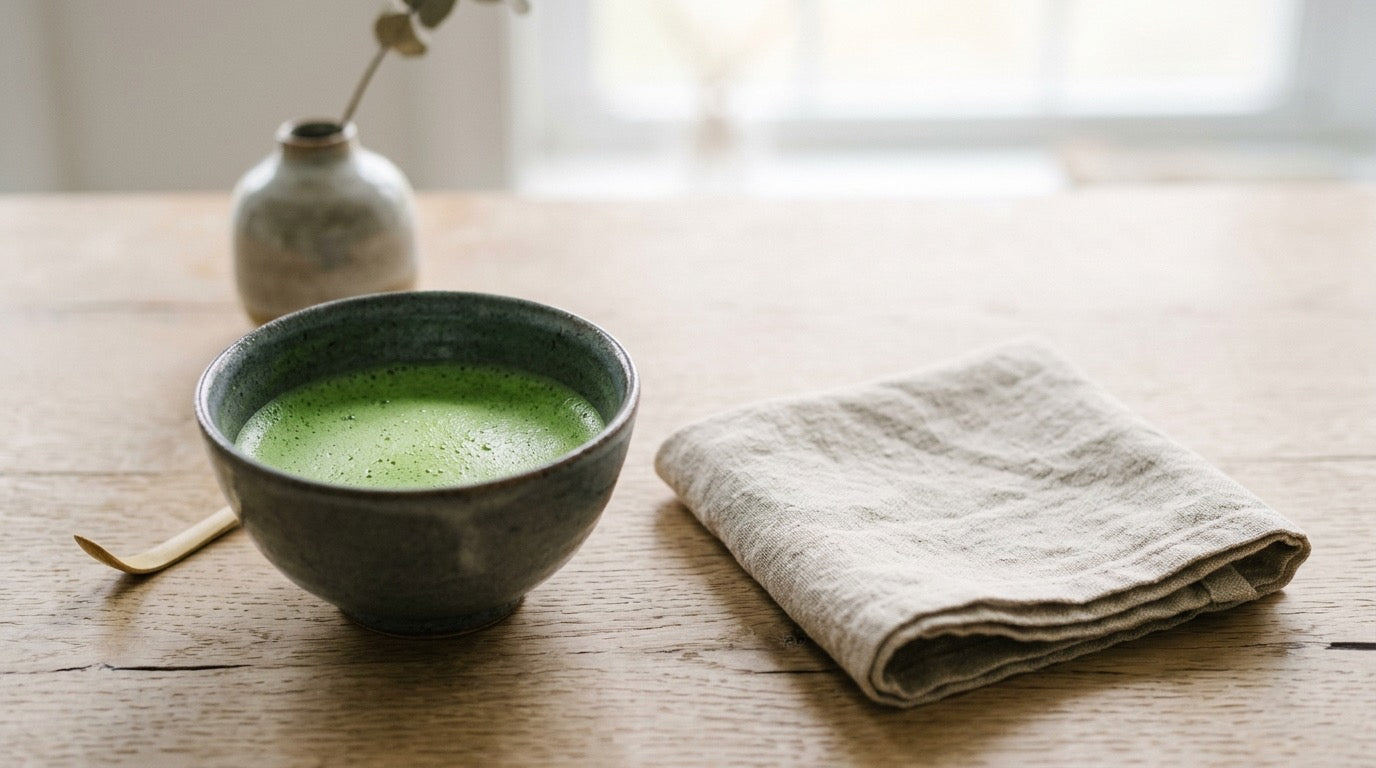
Short answer: yes, matcha is a sensible pre-workout drink, but a gentle one. A 2 g bowl carries roughly 40 to 90 mg of caffeine, well under the dose sports research links to performance gains, so don't expect a coffee-sized kick. What the research does show is a small, real shift toward burning fat during easy-to-moderate exercise, including in two trials that used matcha itself. Drink it 60 to 120 minutes beforehand, with something light in your stomach, and keep it unsweetened.
Key Takeaways
- Matcha trials: in 13 women, one 1 g matcha drink two hours before a 30-minute brisk walk raised fat oxidation from 0.31 to 0.35 g/min (Willems 2018). Three weeks of 3 g a day lifted it by about 35% on average in 12 women, with wide individual spread (Willems 2021).
- Green tea extract: 366 mg EGCG over the prior 24 hours meant about 17% more fat oxidized during cycling in 12 men (Venables 2008).
- Caffeine: a 2 g bowl holds about 38 to 89 mg (Kochman 2020). Sports research ties performance gains to 3 to 6 mg/kg, possibly as low as 2 mg/kg (ISSN position stand), so one bowl is a mild dose.
- Before or after: the effects were measured during exercise, so before is the only timing with evidence. For late sessions, caffeine six hours before bed still cut sleep in one study (Drake 2013).
- Modest and individual. Small, short trials on fat use, not speed or endurance. A real nudge, not a fat burner.
Why matcha and exercise are a natural pair
Most of matcha's health claims live in "promising but modest" territory. The exercise one is a little firmer, because it's been tested directly: give people green tea catechins, have them exercise, and measure how much fat versus carbohydrate they burn. Matcha is a practical way to get those catechins, plus a smoother caffeine lift than coffee, which is why it's become a popular pre-workout drink.
What the research shows about matcha before exercise
Matcha itself, in women. Willems and colleagues ran two small crossover trials with premium-grade matcha. In the first, 13 women had three 1 g matcha drinks the day before and one more two hours before a 30-minute brisk walk. Fat oxidation rose from 0.31 to 0.35 g/min and respiratory exchange ratio dropped from 0.84 to 0.82, with no change in perceived effort (Willems 2018, n=13). In the second, 12 women took 3 g of matcha a day in capsules for three weeks, the last 1 g two hours before a 30-minute walk. Fat oxidation was higher by about 35% on average, though people varied widely (plus or minus 47%), and carbohydrate oxidation was lower (Willems 2021, n=12). The 2018 authors themselves warn that the metabolic effect of regular brisk walking shouldn't be overstated.
Green tea extract, in men. In a placebo-controlled crossover, men who took capsules with 366 mg EGCG over the 24 hours before a 30-minute ride at 60% of VO2max oxidized about 17% more fat than on placebo, 0.41 vs 0.35 g/min (Venables 2008, n=12). In a 10-week training study, the group taking about 573 mg of green tea catechins daily ended with a lower respiratory exchange ratio during exercise (0.816 vs 0.844 before), while the placebo group's was unchanged (Ichinose 2011, n=12).
Training adaptation. In a Japanese trial, untrained men drank a matcha beverage with 1.5 g of powder twice a day through 8 or 12 weeks of resistance training. They reported less fatigue after exercise at week one, and in the 12-week trial their muscle mass rose more and salivary cortisol was lower than on placebo (Shigeta 2023). Strength only "tended" to be higher, and the matcha samples were supplied by a member of the Matcha and Health Research Group (Nestle Japan). It was a daily habit, not a single pre-workout dose.
The honest caveat. Every trial here is small (about 12 to 13 people), short and lab-based, and the matcha trials used one premium-grade product in women. "More fat oxidized during a workout" is not the same as "more weight loss," "more endurance," or "better performance." Take it as a gentle metabolic tilt. The studies also can't separate catechins from caffeine, since matcha contains both and both have been linked to fat oxidation (Willems 2018).
| Study | Setup | Finding |
|---|---|---|
| Willems 2018 (n=13 women) | 1 g matcha, 2 hours before a 30-minute brisk walk | Fat oxidation 0.31 to 0.35 g/min |
| Willems 2021 (n=12 women) | 3 g matcha a day for 3 weeks, last 1 g 2 hours before a walk | About 35% more fat oxidized, wide spread |
| Venables 2008 (n=12 men) | 366 mg EGCG from extract over the prior 24 hours | +17% fat oxidation while cycling |
| Ichinose 2011 (n=12 men) | 10 weeks of catechins plus endurance training | Lower respiratory exchange ratio in the catechin group only |
| Shigeta 2023 (untrained men) | 3 g matcha a day through 8 to 12 weeks of lifting | Less early fatigue, larger muscle mass change at 12 weeks |
Should you drink matcha before or after a workout?
Before, if you want what the research measured. The fat-oxidation results in these trials were recorded during exercise, after a dose taken beforehand, and none of them tested matcha afterward. Drinking it after training is fine as part of a recovery routine, but nothing here shows an advantage from that timing.
How long before? The catechin studies dosed anywhere from two hours ahead (the Willems trials) to the preceding day (Venables). For the caffeine itself, the most common window in sports research is about 60 minutes before exercise (Guest 2021, ISSN). So 60 to 120 minutes fits both and leaves a light stomach time to settle.
Evening sessions are where "before" can backfire. In a home sleep study, 400 mg of caffeine reduced sleep even when taken six hours before bedtime (Drake 2013). A bowl of matcha is a fraction of that dose, but sensitivity varies, so if you train late, choose a smaller bowl and notice how your own sleep responds.
How much matcha before a workout?
Matcha holds 18.9 to 44.4 mg of caffeine per gram (Kochman 2020 review), so a 2 g bowl lands at roughly 38 to 89 mg depending on the product. The International Society of Sports Nutrition reports that 3 to 6 mg/kg of body mass consistently improves exercise performance, that the minimum effective dose may be as low as 2 mg/kg, and that doses around 9 mg/kg bring a high rate of side effects (Guest 2021). For a 70 kg (154 lb) person, 2 mg/kg is 140 mg, which would take roughly 3 to 7 g of matcha. That's arithmetic from those two sources, not a study result.
The practical reading: one bowl of matcha is a light version of a pre-workout caffeine dose. For an easy-to-moderate session, 1 to 2 g is plenty, and 1 g is what the walking trials used. If you want caffeine's performance effect specifically, coffee or a larger serving gets closer, with a higher chance of jitters (see our matcha vs coffee comparison). Steeped green tea is the milder option, and our guide to matcha vs green tea caffeine has the numbers.
We put them side by side: our caffeine comparison across teas.
Grade matters less than people expect, but product does. Both Willems trials used a premium-grade matcha, and the reported caffeine range spans more than twofold, so the same scoop can feel noticeably different from one tin to the next.
If matcha leaves you jittery or queasy before training
Caffeine response is individual. The ISSN position stand notes that genetics, body response and habitual caffeine intake all shape who feels anxious or sleeps badly after caffeine (Guest 2021). A few adjustments that usually help:
- Halve the scoop. Start at 1 g, the dose used in the walking trials.
- Pair it with something light. If your stomach is sensitive, our guide to the best time to drink matcha suggests having it after breakfast or alongside a light snack.
- Sip, don't gulp. Finish the bowl well before you start moving, and try it on an easy day before a hard one.
- Know why it feels steadier. Many people find matcha's energy calmer than coffee's, and the L-theanine story explains why.
Matcha before the gym, a run or lifting
- Lifting and the gym: a bowl about an hour ahead is plenty. The lifting trial above looked at daily matcha over weeks, not a single pre-session dose.
- Running: running jostles the stomach more than lifting does, so test matcha on an easy run first, keep the bowl small, and sip rather than gulp.
- Walking and low-intensity cardio: this is where the matcha trials were run, at moderate walking pace.
A simple pre-workout bowl
- Amount: 1 to 2 g, about half to one level teaspoon.
- Timing: 60 to 120 minutes before exercise.
- Unsweetened: whisk into hot, not boiling, water or unsweetened milk; skip the sugary pre-workout latte.
- Consistency: the stronger signals came from regular intake over weeks alongside regular training, not from a single session.
Matcha won't replace training, sleep, or nutrition, and "more fat burned during a workout" is a small metabolic tilt, not a fat burner. Individual response varies; if you have a health condition or are caffeine-sensitive, check with your doctor. May you become one with tea, one with yourself.
Pre-workout ritual? Our USDA Organic Ceremonial Matcha (30g) is stone-ground, first-harvest, and unsweetened, the whole-leaf catechins this guide describes.
If your goal is body composition rather than performance, the same fat-oxidation research underpins our guide to matcha for weight loss.
Frequently asked questions
Is matcha good before a workout?
Yes, modestly. Matcha adds a gentle caffeine lift (roughly 38 to 89 mg in a 2 g bowl) and, in small trials, a modest rise in the share of fat burned during moderate exercise. One bowl sits below the 3 to 6 mg/kg caffeine range linked to performance gains, so think of it as a mild pre-workout, not a strong one.
Should I drink matcha before or after a workout?
Before, if you want the effects the research measured. The fat-oxidation results were recorded during exercise after a dose taken beforehand. After a workout is fine too, but no trial shows an advantage, and for a late session a smaller bowl is wise because caffeine can shorten sleep.
How long before a workout should I drink matcha?
About 60 to 120 minutes before. The Willems matcha trials dosed two hours ahead, and the most common caffeine window in sports research is around 60 minutes.
How much matcha should I have before the gym?
One to two grams, which is half to one level teaspoon. That gives roughly 19 to 89 mg of caffeine depending on the product. One gram is what the walking trials used.
Does matcha burn fat during exercise?
It raises the share of fat your body uses during moderate exercise by a modest amount in small trials, for example from 0.31 to 0.35 g/min during a brisk walk (Willems 2018). The studies can't separate the catechins from the caffeine, and more fat oxidized during a session is not the same as weight loss.
Will matcha make me jittery at the gym?
It can, if you're sensitive to caffeine or have a large bowl on an empty stomach. Halve the serving, have it with something light, and try it on an easy day first.
Is matcha better than coffee before a workout?
Coffee usually has more caffeine per cup (about 95 mg, against 38 to 89 mg for a 2 g bowl of matcha), so it is the stronger choice if you want a performance lift. Matcha's energy tends to feel steadier and gentler on the stomach for many people.
More in the matcha science series: What is EGCG · Matcha health benefits · Best time to drink matcha · Matcha vs coffee
Share:
Matcha and Sleep: Does It Help or Hurt? (2026)
Matcha and Brain Health: Focus, Memory, and the Honest Science (2026)