



Ceremonial Grade Matcha Online: How to Buy Authentic Japanese Matcha in 2026
Buying ceremonial grade matcha online sounds simple. The hard part is knowing whether the bright green powder in the photo will match what arrives at your door. The matcha category has roughly tripled in size since 2020, and the global market reached $5.07 billion in 2025 with a projected 10.6% CAGR through 2026 (Grand View Research, 2026). That growth pulled in a wave of online sellers, some sourcing first-flush tencha from Uji, others repackaging late-harvest culinary powder under "ceremonial" labels. This guide is what we'd tell a friend before they hit checkout.

From our tea room
Organic Ceremonial Matcha Powder - USDA Certified (30g)
Stone-milled ceremonial grade, USDA Organic, third-party lab tested.
View Ceremonial MatchaKey Takeaways
- "Ceremonial grade" has no legal definition in the US, so the term alone tells you almost nothing. Origin region, harvest, and current lab tests do.
- Authentic ceremonial matcha is first-flush tencha, shaded for 20 to 30 days, stone-ground at roughly 30 to 40 grams per hour (Mizuba Tea Co.).
- Independent testing in 2024 and 2025 found measurable heavy metals in many widely sold "organic" matcha brands, so a current lab report matters as much as the certification seal (Lead Safe Mama, 2025).
- Online matcha quality lives or dies on freshness logistics: nitrogen-flushed packaging, climate-aware shipping, and stock turnover. Always look for a recent harvest date, not just a "best by" sticker.
- The honest US price band for premium ceremonial powder is roughly $26 to $40 per 30 grams. Anything labeled ceremonial below $20 is almost always mislabeled.
What Does "Ceremonial Grade" Actually Mean?
Ceremonial grade is the highest tier of drinking matcha, made from the youngest tencha leaves of the first spring harvest, fully shaded for at least 20 days, stone-ground at low temperature, and meant for whisking straight with water. There's no government body that polices the term in the US, which is why the same word appears on tins ranging from $12 to $90 (Wikipedia: Matcha). The grade lives in the leaf, not the label.
True ceremonial powder shows three things at once: a vivid jade color, a sweet vegetal aroma, and a clean umami taste with no harsh bitterness. Those traits track back to four production decisions on the farm. Shading length, harvest timing, processing method, and storage discipline. Each one shapes the chemistry of the cup before the powder ever leaves Japan.
A 2-gram serving of real ceremonial matcha contains roughly 50 mg of L-theanine and 40 to 70 mg of caffeine. That's about five times the L-theanine of unshaded green tea, because shading the field reduces photosynthesis by up to 90% and forces the plant to retain L-theanine instead of converting it to catechins (Mizuba Tea Co.). The chemistry is what makes the focused, calm energy real ceremonial powder is known for.

Why Buying Matcha Online Is Different
Online matcha is a freshness business disguised as an e-commerce business. Tencha begins to lose color, aroma, and L-theanine within weeks of grinding once exposed to air, light, or heat. The supply chain matters more than the marketing. With the global matcha market growing at 10.6% annually through 2026 (Grand View Research, 2026), more powder is sitting in more warehouses for longer than ever, which means a vendor's freshness logistics matter more than they did five years ago.
When you buy online, the questions shift. You can't smell the tin, you can't see the color, and you can't ask the shop owner where it came from. So you ask the website instead. Three things tell you whether a vendor takes freshness seriously: the harvest date is published (not just "best by"), the powder ships in nitrogen-flushed or vacuum-sealed packaging, and the brand turns inventory fast enough that a tin shipped to you in May is still close to its grinding date.
When we started One with Tea, we tested this end to end. We ordered ten "ceremonial" tins online from US retailers, opened them on the same day, and lined them up next to a control tin we'd flown back ourselves from Uji. Three of the ten matched on color. One matched on aroma. None matched on foam density. The label said the same thing on every package. The leaf inside told a different story.
Seven Things to Verify Before You Click Buy
The cleanest way to evaluate an online matcha vendor is a short checklist you run on their site before placing the first order. According to research published by Japanese tea producers and confirmed across multiple regional cooperatives, premium ceremonial matcha shares a small set of verifiable signals that should be visible on any honest brand's product page or about page (MAFF Japan).
1. Named Origin Region
Real ceremonial matcha names its prefecture, often its town, sometimes its farm. Uji (Kyoto), Nishio (Aichi), Kagoshima, and Shizuoka grow the overwhelming majority of authentic Japanese matcha. A vendor that says only "Product of Japan" without naming the region is a yellow flag. Real producers are proud of their fields and they say where they are.
2. Harvest Date, Not Just Best-By
The harvest year and flush (ichibancha or first-flush is the gold standard) tell you what's inside. A tin ground in May 2026 from a first-flush 2026 harvest is fundamentally different from a tin packed in March 2026 using leaves picked in 2024. Honest brands publish both dates. Most do not.
3. Stone-Ground Tencha
Stone mills produce about 30 to 40 grams of finished matcha per hour. That's slow on purpose. Heat from industrial mills oxidizes the leaf and dulls the powder before it ever reaches a tin. If a vendor describes the grinding process at all, it's a positive signal. If they don't, ask before you buy.
4. USDA Organic or JAS Certification
Since January 1, 2014, the US and Japan have held an organic equivalence agreement, and as of 2025 the USDA's National Organic Program Import Certificate (NOPID) is mandatory on all certified organic shipments leaving Japan for the US (MAFF Japan). Look for the green USDA Organic seal or the Japanese JAS seal, plus the certifying body's name. "Naturally grown" and "pesticide-free" are not regulated terms in either country.
5. A Current Heavy Metal Lab Report
Tea plants pull lead, cadmium, mercury, and arsenic from soil, and matcha drinkers consume the entire leaf rather than steeping and discarding it. Independent 2024 to 2025 testing by Tamara Rubin's lab found measurable heavy metals in many "organic" brands, including ones with strong reputations (Lead Safe Mama, 2025). The fix isn't to stop drinking matcha. It's to drink brands that publish recent third-party lab reports, dated within the last 18 months, with the lab's name visible.
6. Nitrogen-Flushed or Vacuum-Sealed Packaging
Oxygen is matcha's main enemy in transit. Nitrogen-flushed pouches and vacuum-sealed tins keep the powder stable from the grinding line to your kitchen. A loose foil bag in a paper box without a moisture or oxygen barrier is a packaging shortcut, and the cup pays for it.
7. A Real Person Behind the Brand
This one's harder to quantify and easier to feel. About pages with a named founder, photos from the farms, and a clear sourcing story usually correlate with cleaner products. Anonymous brands that won't tell you who's running the operation rarely tell you anything else worth trusting.
Online Matcha Price Tiers in 2026
Pricing in the matcha world spans an enormous range, and most of it correlates with the seven markers above. Here's roughly what you're paying for at each tier in the US online market in 2026, based on a One with Tea retail survey of organic matcha brands sold to US customers in April 2026.
$8 to $19 per 30g. Almost always culinary or industrial powder mislabeled as ceremonial. Useful for baking and recipes where matcha competes with sugar and butter, but the cup will be flat and bitter on its own. Skip for whisking.
$20 to $29 per 30g. The honest entry into ceremonial territory. Look for first or early-second flush from a named region, USDA Organic seal, and a recent lab report. Many reputable online brands sit here for their daily-drinker tin.
$30 to $45 per 30g. Premium ceremonial. First-flush, fully shaded tencha from Uji, Nishio, Kagoshima, or Shizuoka. Bright color, sweet umami, persistent foam. This is where most committed home drinkers settle once they've tasted the difference.
$50 to $90+ per 30g. Single-farm or single-cultivar lots, often with a named tea master and a small annual production run. Beautiful if matcha is a daily ritual. The honest premium tier above delivers most of the experience for less.
Red Flags on Online Matcha Listings
Most disappointing online matcha purchases share a small set of warning signs. According to consumer guidance compiled by Consumer Reports on heavy metals in food, and across multiple Japanese tea trade publications, here's what to walk away from on a product page.
- "Ceremonial grade" priced under $20 per 30g. The math doesn't work. Real ceremonial powder costs more to produce than that, even at scale.
- No origin information. Vague phrases like "from Japan" or "Asian-sourced" should disqualify a product immediately.
- No lab results page on the website. Or a report dated more than 18 months ago. Soil and harvest conditions change every year.
- Stock photos of unrelated tea fields. A surprising number of online matcha brands use generic Chinese green tea imagery in product photography. Real brands photograph their own farms.
- Reviews that all sound the same. Five-star avalanches with identical phrasing are usually paid or generated. Look for reviews that mention specific harvests, dates, or sensory details.
- No founder or company story. Anonymous brands selling premium products at premium prices is a fundamentally weird configuration.
- Free shipping on a $14 tin. Real ceremonial matcha doesn't ship for free at $14 per 30g. The unit economics don't allow it. Something else is paying for that shipment, usually leaf quality.

How One with Tea Approaches Online Sourcing
We started One with Tea because the matcha most Americans were drinking online didn't reflect the tea we'd had on Japanese farms. Our ceremonial matcha is sourced from organic-certified producers in Japan's traditional tea regions, stone-ground at low temperature, sealed for freshness, and tested independently for heavy metals before each release. Every batch's lab results are published on our Lab Results page, dated and named. The whole catalog carries the USDA Organic seal.
One thing we learned the hard way: freshness logistics matter more than most online sellers admit. We turn inventory fast, ship from a temperature-controlled facility, and date every tin so the harvest year is on the package, not buried in a spreadsheet somewhere. It's why our flagship 30g ceremonial tin sits in the premium tier and our 60g pouch refill drops the per-gram cost without dropping the leaf grade.
If you want to see how the brand was built, the about page walks through the journalism background, the farm visits, and the sourcing decisions in plain language. If you're new to whisking, the matcha preparation guide covers water temperature, dosage, and chasen technique, all of which shape the cup as much as the powder itself.
Why Real Ceremonial Matcha Is Worth the Practice
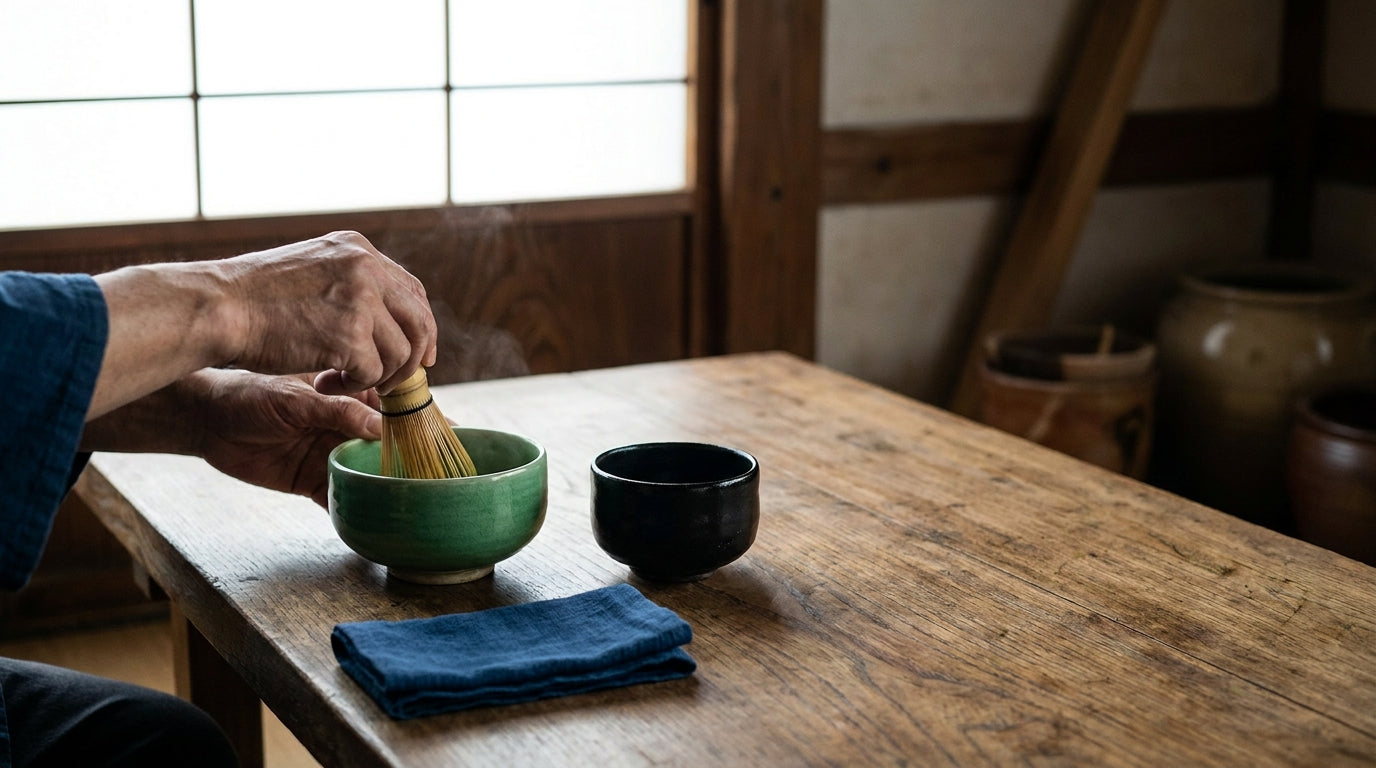
Ceremonial matcha isn't really a beverage. It's a small repeatable ritual: the boil, the cool, the sift, the whisk, the pause. The powder you choose shapes that ritual. Bright color, sweet umami, and a clean lab report change the experience entirely. A study published in Biological Psychology found that 100 mg of L-theanine combined with 50 mg of caffeine produced faster reaction times and improved sentence verification accuracy compared to either compound alone. Two cups of good ceremonial matcha sit close to that ratio, naturally.
The reason we put so much weight on sourcing isn't because we want to sell you a more expensive tin. It's because the cup either rewards your attention or it doesn't. Real ceremonial matcha rewards attention. The five minutes of preparation become the most present part of your morning. That's the part the marketing language tends to miss.
Frequently Asked Questions
What's the difference between ceremonial matcha and culinary matcha online?
Ceremonial matcha uses the youngest, fully shaded first-flush leaves and is meant for whisking with water. Culinary or latte grade uses later-harvested leaves and stands up better to milk, sweetener, and heat. There's no legal definition of either term in the US, so any online tin labeled "ceremonial" priced under $20 per 30g should be questioned closely (Wikipedia: Matcha).
How can I verify that ceremonial matcha sold online is actually authentic?
Check the product page for four things: a named origin region (Uji, Nishio, Kagoshima, or Shizuoka), a harvest year and flush, a USDA Organic or JAS certification seal, and a current third-party heavy metal lab report dated within 18 months. Brands that publish all four are nearly always honest. Brands that publish none rarely are.
Is it safe to buy ceremonial matcha online from overseas sellers?
Generally yes if the brand publishes lab results and ships through a US-side warehouse. Direct-from-Japan shipments are fine when the importer is registered for the USDA's NOPID program, mandatory since 2025 (MAFF Japan). Be cautious of overseas marketplace listings without traceable certification or recent lab data.
How long does ceremonial matcha stay fresh after I open the tin?
Roughly four to six weeks at peak quality, then a slow fade. Matcha oxidizes when exposed to air, light, and heat, which dulls the color and flattens the aroma. Store in an airtight container in the refrigerator after opening, and finish a 30g tin within six weeks of breaking the seal for the best experience.
Should I buy a small tin or a large pouch when ordering online?
Start with a 30g tin if you're new to a brand or new to whisking. The smaller size lets you confirm color, aroma, and taste before committing to a larger volume. Once a brand becomes your daily, the 60g pouch usually drops the per-gram cost by 15 to 25% without dropping the leaf grade, assuming inventory turnover is fast.
What's an honest price for premium ceremonial matcha online in 2026?
Roughly $30 to $45 per 30 grams. That price band buys first-flush, fully shaded tencha from a named Japanese region with a current lab report and proper packaging. Below $20 the leaf is almost always mislabeled. Above $50 you enter single-farm territory, which is wonderful but offers diminishing returns for most home drinkers.
Why is online ceremonial matcha sometimes cheaper than in-store?
Online brands skip retail markup, so a $35 tin online would often sit at $50 to $60 on a specialty shop shelf. The savings only work if the online brand maintains real freshness logistics. A cheap online tin from a slow-turnover warehouse is no bargain when the powder arrives oxidized and dull.
Where to Start
If you're choosing your first ceremonial matcha online or upgrading from a supermarket tin, start with first-flush tencha from a named Japanese region, with a current heavy-metal lab report and an honest USDA Organic or JAS seal. That single decision puts you ahead of most matcha drinkers in the US, and it makes every cup that follows easier to enjoy. Our 30g ceremonial tin is where most new customers begin. The 60g pouch is the better value once a brand has earned a daily place on your counter.
However the order plays out, give the powder a quiet morning, a quiet bowl, and a real chance. Good matcha rewards attention. That's true at the farm, true at the stone mill, and true in the moment you whisk it.
Looking for ceremonial matcha sourced honestly from named Japanese regions?
USDA Organic and JAS certified, third-party lab tested, direct from family farms.
Shop Matcha CollectionInquire About Wholesale
Share:
Sencha Vs Gyokuro: Your Guide to Japanese Green Tea
Traditional Japanese Tea Set: Art & Ceremony