



Looking for ceremonial matcha sourced honestly from named Japanese regions?
USDA Organic and JAS certified, third-party lab tested, direct from family farms.
Shop Matcha CollectionInquire About WholesaleThere's no Japanese government standard for ceremonial grade matcha. The term is a Western marketing invention, and any seller can put it on a tin. But there's a meaningful, working definition from Japan's own tea industry, and once you know it, you can tell premium matcha from mass-market powder no matter what the label says.
We built One with Tea around that higher standard. This guide walks you through where the term came from, what it should mean if it means anything, and the five honest signals you can use to evaluate any matcha in your hand.
Where the Term "Ceremonial Grade" Actually Came From
"Ceremonial grade" is a marketing term that grew up in the West, not a translation of any Japanese standard. An essay from a New York-based single-origin Japanese tea importer puts it plainly: there's "no central organisation, in Japan or abroad, that sets standards for the use of this term."
A 2018 critique by tea writer Andre Fasciola reaches the same conclusion. "Ceremonial grade" reads as an American invention used as shorthand. In Japan, any high-quality matcha can be served in a tea ceremony. There's no separate ceremonial-only category at the wholesale level. Tea masters pick powders by taste, color, and origin, not by an English-language label.
So why does the phrase exist? Because matcha exploded into Western cafes and supermarkets in the 2010s, and shoppers needed a quick signal for "this is the good kind, made for drinking." "Ceremonial" did that job. The problem is the word stuck without any gate at the door. Today you'll find $15 tins and $80 tins both labeled ceremonial, and both calling themselves authentic.
This isn't a reason to throw out the term. It's a reason to look past it.
What Does Japan's Industry Association Say Real Matcha Requires?
Here's where it gets useful. The Central Association of the Japanese Tea Industry publishes a working definition of what should count as ceremonial-grade matcha, even though it isn't a binding law. According to Florent, the first French Japanese Tea Instructor, the association's criteria require three things:
- Shade-grown using the honzu method. The tea plants spend the final three to four weeks before harvest under fabric covers that block 70 to 90% of sunlight, per Global Japanese Tea Association industry guidance. The plant responds by producing more chlorophyll, more L-theanine, and less catechin bitterness. Honzu refers to a traditional shading technique where the structure stands above the bushes rather than draping directly on them.
- Unrolled leaves processed as tencha. The picked leaves get steamed, then dried flat, never rolled. The veins and stems are removed. What remains is a brittle, deep-green flake called tencha. Sencha leaves are rolled; tencha is not. This single step separates real matcha from any green powder ground from rolled sencha.
- Stone-mill grinding. The tencha gets fed through granite stone mills that turn slowly, around one revolution per minute, producing roughly 40 grams of powder per hour per mill (Global Japanese Tea Association industry data). Particle size lands between 5 and 15 microns. Slow grinding keeps the heat down and the cellular structure intact. Machine grinding heats the powder, oxidizes the volatile compounds, and changes the taste.
If a powder doesn't meet all three of those, it isn't ceremonial matcha by the industry's own definition, regardless of what the package says. We hold our ceremonial tin to that bar because that's the only definition we trust.
The 3 Percent Reality: Why Most "Matcha" Isn't What You Think
This is the number that should change how you shop. Florent's analysis of 2009 Japanese industry data found that manually picked, first-harvest tencha was only about 3% of all powdered teas sold globally as "matcha." The other 97% included mechanical-harvest tencha, fall-harvest leaves, and powders ground from rolled green tea that never met the tencha definition at all.
The shift toward industrial matcha has a date. In 1996, before the new tea harvest opened, a major wholesaler bought up most of the remaining mechanical-harvest tencha to fulfill "a huge order from Haagen Daz, for making matcha flavor ice cream." Prices spiked. Producers who had been making sencha saw they could earn more by switching to industrial tencha, and many did. Florent calls this the "Haagen Daz shock," and treats it as the moment industrial matcha became the dominant model.
Thirty years later, that shift is still shaping what shows up in cafes and supermarket shelves. A lot of the "matcha latte" boom rides on powders that wouldn't meet the Central Association's three criteria. None of that's necessarily wrong if you know what you're drinking. The trouble starts when it gets sold as ceremonial.
Five Honest Quality Signals You Can Evaluate Yourself
You don't need a lab to evaluate matcha. The 2018 essay by Andre Fasciola proposes five practical signals, and we'd add a few notes from our own farm visits.
1. Color
Real ceremonial matcha is a vivid, almost neon green. Shade-growing concentrates chlorophyll, and stone-grinding keeps it from oxidizing. A dull, olive, yellow-tinged, or khaki powder is a flag. It usually means longer sun exposure, lower-grade leaves, or oxidation from heat or age. Hold a teaspoon next to a white background and look for that bright, almost electric green.
2. Aroma
A fresh ceremonial powder has a clean, sweet, vegetal aroma. Some people read it as fresh-cut grass, others as snap peas or seaweed. What you don't want is a hay-like, dusty, or fishy smell. Stale matcha smells flat. Industrial matcha often smells slightly burnt.
3. Flavor
The signature flavor of premium matcha is umami forward with a clean, sweet finish. The bitterness should be present but balanced, never harsh. If your matcha tastes mostly bitter or astringent, it likely wasn't well shaded, well processed, or well stored. Powders ground from rolled sencha taste sharp and one-note compared to true tencha.
4. Texture
Run a small amount between your fingers. Ceremonial-grade powder should feel like talcum, almost weightlessly fine. Stone-grinding produces particles in the 5 to 15 micron range. Industrial grinding gives a coarser, grittier feel and leaves more sediment at the bottom of your bowl after whisking.
5. Freshness
Matcha is fragile. Once milled, the powder starts losing color, aroma, and L-theanine to oxidation. Look for a harvest date or a "milled on" date, not just a "best by." If a tin has been sitting on a shelf since last spring's harvest, the quality has already faded, regardless of how good the leaf started.
These five signals work even when no one can agree on what "ceremonial" means. They're things you can do in your kitchen with a small scoop and a clean bowl. If you want a deeper sourcing primer, our guide to Japan's main matcha-growing regions covers how origin shapes color and flavor before any of these signals show up in your cup.
How Does One with Tea Meet the Higher Bar?
I'll speak plainly here. I'm Christian, the founder. I came to tea through journalism and meditation. I started One with Tea because I wanted matcha I could trust, sourced from farmers I'd met, with a paper trail I could show anyone who asked.
Our ceremonial tins come from organic farms in Japan that use the honzu shading method, process the leaf as tencha, and grind it on traditional stone mills. We test every batch for heavy metals before we ship it. We label harvest dates, not just expiration dates. We post our lab results because if we're going to use the word ceremonial, we want the work behind it to be visible.
None of that's unique to us. Other small Japanese tea brands hold the same line. The point is to say what should be normal: if a seller uses the word ceremonial, they should also be willing to tell you the shade method, the processing, the grinding, the harvest date, and what's inside the tin. If they can't, the word's doing all the work, and you're paying for the marketing.
Ceremonial Grade vs. Culinary or Latte Grade: When Does It Actually Matter?
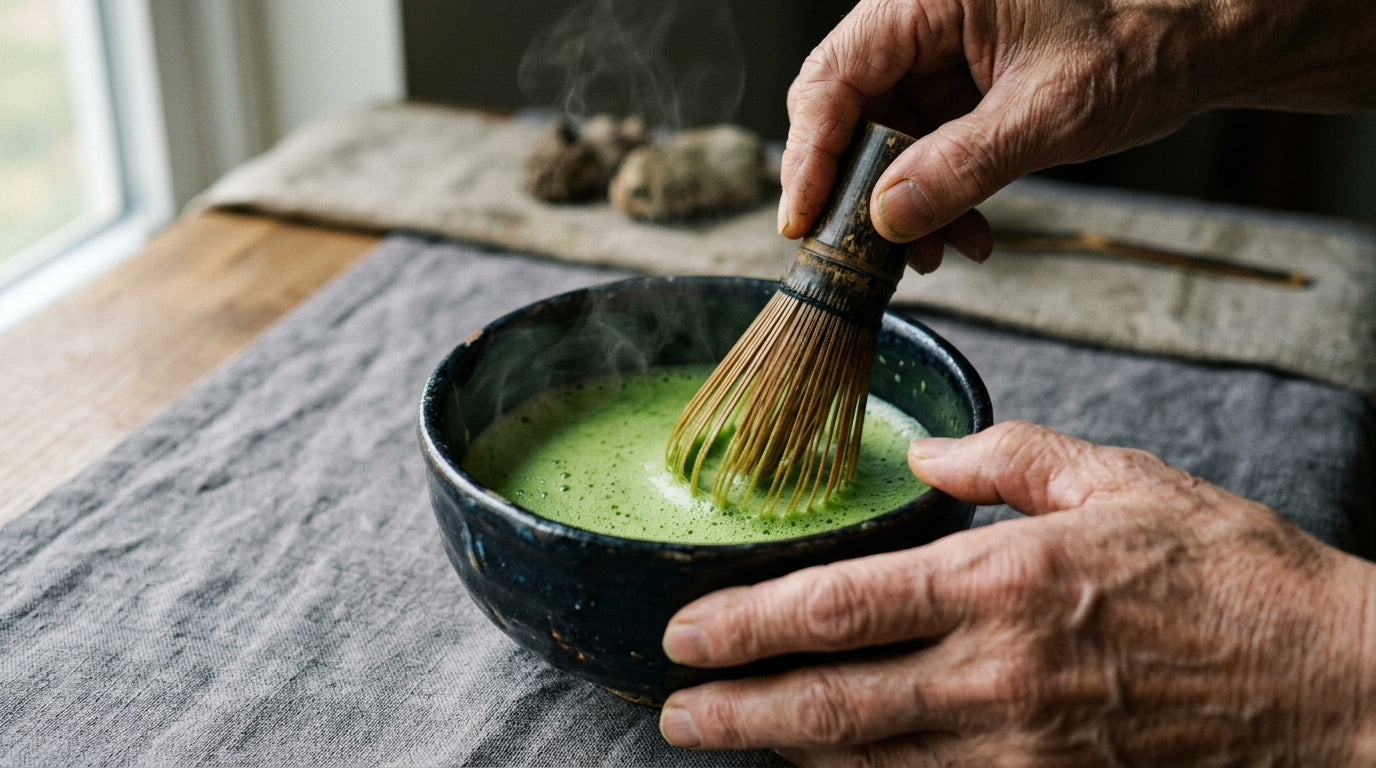
The grade matters most when matcha is the star. For a whisked bowl of usucha, where the tea meets only hot water and your chasen, every variable shows up in the cup. Color shifts, bitterness, aroma, all of it. Here, ceremonial-grade powder rewards you.
For a matcha latte, an iced drink, baking, or a smoothie, the milk, sweeteners, and other ingredients smooth out the rougher edges of lower-grade powder. Using a true ceremonial tin in a 16-ounce oat milk latte is mostly wasted. The flavor gets buried. That's why we make a separate latte grade: still organic, still Japanese, still tencha, but priced for daily lattes and recipes where you'll add other ingredients.
The honest answer is that you don't need ceremonial-grade for every cup. You need it when you want the tea to speak for itself, and a step down when it's mixing with milk and oats and sugar. Buying the right grade for the right use saves money and respects the work that went into the powder. Our stone-grinding deep-dive explains why even our latte tier shares the same processing tradition as our ceremonial.
Frequently Asked Questions
Is ceremonial grade matcha actually better quality?
Sometimes. The term has no legal definition, so it depends on the seller. A ceremonial-grade powder that meets the Central Association of the Japanese Tea Industry's three criteria (honzu shade, unrolled tencha, stone-mill ground) is genuinely better than industrial matcha. One that just carries the label without naming origin or processing may not be.
Is ceremonial grade matcha regulated in Japan?
No. There's no Japanese government regulation defining "ceremonial grade." The closest thing is a non-binding professional criterion from the Central Association of the Japanese Tea Industry, which specifies shade-grown honzu cultivation, unrolled tencha leaf, and stone-mill grinding. Compliance is voluntary, not legal.
What's the difference between ceremonial grade and culinary grade matcha?
Ceremonial-grade matcha is meant to be whisked with hot water and tasted on its own. It uses younger, shade-grown leaves and slow stone-grinding for a brighter color and sweeter, fuller flavor. Culinary or latte grade uses later-harvest leaves and is priced for cooking, baking, and milk drinks where other ingredients dominate the taste.
Why is real ceremonial matcha so expensive?
Shade-grown tencha is labor-intensive. Farms cover the plants for three to four weeks, hand-pick the youngest leaves, steam and dry them flat, then grind them on stone mills at roughly 40 grams per hour per mill. A premium tin reflects all of that. Industrial matcha is mechanically harvested and machine-ground, which is why it can sell for a fraction of the price.
How do I know if my matcha is real ceremonial grade?
Check five things: the color should be vivid green, the aroma fresh and sweet-vegetal, the flavor umami-forward with balanced bitterness, the texture talcum-fine, and the tin should list a harvest date. Then check the seller's sourcing page for honzu shading, tencha processing, and stone grinding. If any of that information is missing, the label alone isn't proof.
What percentage of "matcha" sold worldwide is true ceremonial grade?
About 3%, according to Florent, an independent Japanese tea sommelier writing from Japan. His 2016 analysis of 2009 Japanese industry data showed only 128 of every roughly 4,000 tons of products labeled "matcha" came from manually picked, first-harvest tencha. The rest were industrial powders that wouldn't meet the Central Association's criteria.
Can I use ceremonial grade matcha for lattes?
You can, but it isn't necessary. In a milk-based drink, the subtle umami and aroma of ceremonial powder get buried under milk, sweetener, and ice. Latte-grade matcha gives you the same plant, the same processing tradition, at a price that makes sense for daily use. We recommend saving ceremonial powder for whisked bowls and matcha you taste straight.
The word "ceremonial" can be useful or it can be empty. The difference is whether the seller behind it does the work the word implies. We started One with Tea so the work would be visible: the farms, the shading, the stone mills, the lab tests, the harvest dates. If you take one thing from this guide, take this. You don't have to trust a label. You can trust your eyes, your nose, and the page that tells you where the leaf came from. The ritual was never in the word. It's in the bowl.
Sources
- Florent, "Kyoto Uji: The Land of Yamashiro, An History of Tea in Japan," Japanese Tea Sommelier, September 26, 2016. Retrieved 2026-05-19. https://japaneseteasommelier.wordpress.com/2016/09/26/kyoto-uji-the-land-of-yamashiro-an-history-of-tea-in-japan/
- Andre Fasciola, "Why Ceremonial Grade is Meaningless and Even Misleading," April 15, 2018. Retrieved 2026-05-19. https://matcha.com/blogs/news/why-ceremonial-grade-meaningless-and-even-misleading-2019
- "Why Ceremonial Grade Is Meaningless," essay from a New York-based single-origin Japanese tea importer. Retrieved 2026-05-19. https://www.tezumi.com/blogs/tezumi-insights/why-ceremonial-grade-is-meaningless
- Global Japanese Tea Association. Retrieved 2026-05-19. https://gjtea.org/
Share:
Matcha Health Benefits: 7 Backed by Research (Founder's Guide)
Mohei Honda: a fifth-generation tea master in Shizuoka